


 138 / 140

November 2018
136 \
World Cement
FIVE MINUTESWITH...
Briefly describe your job.
My job is to manufacture and get cement out of the
door at Canada’s largest plant. Working efficiently,
with world-class safety and environmental performance
top of mind, rounds out the task. Our market is robust
and we doubled the plant’s capacity in recent years,
so maximising all the plant can do ensures we meet
customer expectations and company goals.
How did you start in the cement industry?
I got my Mechanical Engineering degree at the
University of Victoria in British Columbia. My first job at
Lafarge was at the Richmond, British Columbia, plant in
the mechanical engineering department.
What is your proudest career achievement?
I’m most proud of being chosen for my demonstrated
skills and leadership to be the Plant Manager of
Canada’s largest cement plant. Lafarge has been
preparing me for this opportunity for 18 years. I earned
it through hard work, determination, a solid technical
background, and experience in community issues.
What schooling experience influenced you most?
I attended an all-girls school during my high school
years and was encouraged and supported to pursue my
interest in maths and science. It was also an institute
that challenged, provided opportunities to lead,
and instilled confidence. Lastly, I have a lot of fond
memories of the adventures we had, including the
extracurricular ones.
In your view, what is the biggest challenge facing the
cement industry?
It is a fact that the science of making clinker requires
tremendous heat – and thereby fuel. The chemistry also
means that greenhouse gases are created and emitted
during the process.
What strategies can the industry employ to solve this
challenge?
At my plant, like all LafargeHolcim plants, we
are attacking both issues. We are currently in the
process of applying for permits that will allow us
to use alternative fuels, such as construction and
demolition waste, non-recyclable plastics, and
wood products. These will serve as lower-carbon
fuels, saving our landfills and creating jobs. On the
greenhouse gas emissions front, we have converted
our manufacturing methodology to produce GUL
or portland limestone cement, which requires less
clinker.
Where is the most interesting place you have visited?
With my career with LafargeHolcim, I think the
most interesting places I have been able to visit
are the Lafarge technical centre in Viviers, France
– essentially the birthplace of Lafarge and once its
official headquarters
–
and Holderbank, Switzerland,
Holcim’s birthplace and technical centre. Both are
beautiful areas steeped in history and an example of
the commitment the companies have always had to
developing its people.
What are you celebrating this year?
Lafarge in Canada is celebrating 60 years of building
the cities and communities across the country.
Exshaw’s legacy is over 100 years in Alberta’s Bow
River Valley. The future for Exshaw is bright with the
recent expansion bringing environmental, capacity,
and efficiency improvements.
Tell us something we may not know about Exshaw.
Exshaw’s cement is quite literally the foundation of
the world famous Banff National Park’s attractions,
as well as the roads and bridges that allow tourists to
enjoy the Canadian Rocky Mountain Parks, which are
an UNESCO World Heritage Site.
Do you have a final message for the industry?
Lifecycle assessments of cementitious products
continue to display that the paste used by ancient
Egyptians is still a sustainable choice in the
21
st
Century. Combined with the opportunities of the
circular economy, cement remains a critical source of
development in all corners of the world.
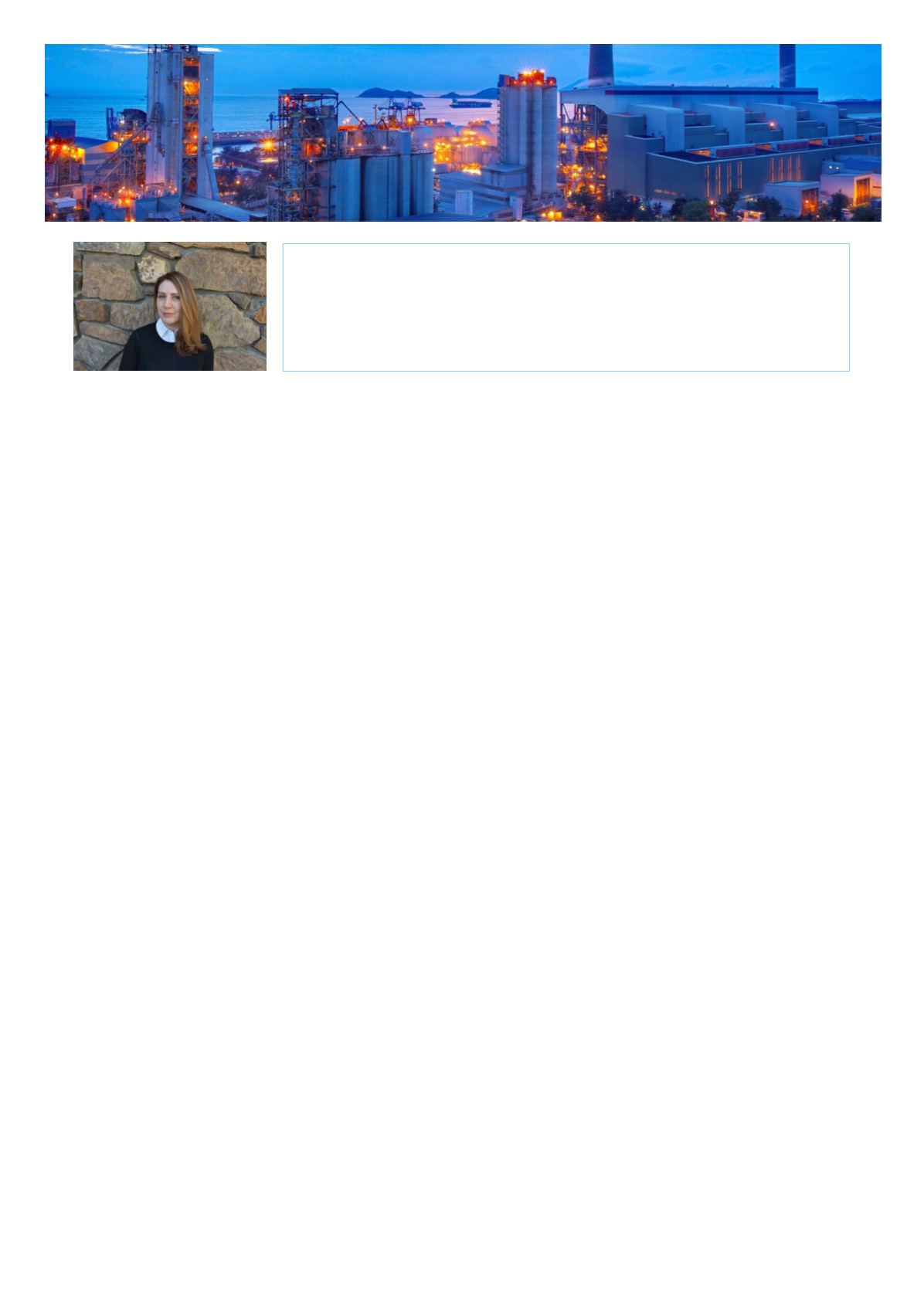
Kate Strachan, Exshaw Plant Manager, Lafarge Canada
Strachan has worked for LafargeHolcim for the past 18 years. Before her
appointment as Exshaw Plant Manager – the first woman to hold the post – she
was the plant’s Production Manager, helping to oversee its CAN$600 million
expansion. She has also held the Production Manager post at Lafarge’s former
Sugar Creek plant in Missouri, US.