


 5 / 140

The success story of LOESCHE plants, with their patented technology, is continuing.
The first LOESCHE LM 35.2+2 mill went into operation in 1994. Just 10 years later, a
total of 50 plants had been sold for the production of cement powder and granulated
blastfurnace slag. In the next two years, 50 more mills had been sold. In 2014, over
300 of our VRMS of this type were in operation or construction. In the last four years,
a further 100 mills were sold: these numbers speak for themselves. The LOESCHE mill
series LMCS revolutionised the cement industry.
For more information:
www.loesche.comPalladian Publications Ltd
15 South Street, Farnham, Surrey
GU9 7QU, ENGLAND
Tel
+44 (0)1252 718999Fax
+44 (0)1252 718992Email:
mail@worldcement.comWebsite:
www.worldcement.comVolume 49: Number 11
November 2018
ISSN 02636050
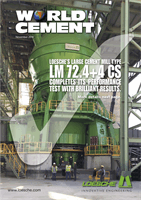
THIS MONTH’S COVER
www.loesche.comLOESCHE’S LARGE CEMENT MILL TYPE
LM 72.4+4 CS
COMPLETES ITS PERFORMANCE
TEST WITH BRILLANT RESULTS.
More details next page.
November2018
CONTENTS
07
Comment
09
News
136
Five minutes with... Kate Strachan
Exshaw Plant Manager at Lafarge Canada
REGIONAL REPORT: MENA
20
Adapting to Demand
Omar Rabia, FLSmidth, investigates whether dual production
of grey and white cement is an achievable ambition.
25
Addressing the Problem of Waste
Inji Khalil, Lafarge Egypt, discusses the co-processing of waste
and development of waste management in Egypt.
VERTICAL ROLLER MILLS
29
Grinding with MVR
Dr Caroline Woywadt, Gebr. Pfeiffer, discusses recent grinding
projects with MVR mills.
CALCINING SYSTEMS
35
Calciner Challenges
Tahir Abbas and Michalis Akritopoulos, Cinar Ltd, discuss the
challenges of substituting 100% alternative fuels in various
types of calciners.
BAGGING & PACKING
43
A Pallet-less Future?
Enrico Lanzini, FLSmidth, makes the case for adopting a
pallet-less cement transport solution.
47
Strong on Paper, Strong in Practice
Dominik Wörsdörfer, Windmöller & Hölscher, examines the
case of Ukrainian paper bag manufacturer Pamibro improving
production through automation.
/ 15
14 \
THE EU
KoenCoppenholle,
CEMBUREAU,
discusses
the ongoingparticularities
of thedebate surrounding
future climatepolicies in the
European cement industry
leading up to 2050.
Introducing the state of the industry
In Europe, the cement industry produced almost
170million t of cement in 2016, representing 3.6%
of global production. China currently accounts
for 52% of global production and has almost
quadrupled its production since the beginning
of the century. From an economic perspective,
the European cement industry is still on a path
to recovery, following the severe downturn in
themarket during the 2007 – 2013 period,when
EU production fell 40%. CEMBUREAU’sActivity
DEBATE
Report shows optimistic signs of cautious recovery
in cement production, as a result of construction
markets picking up again.
When one looks at the full value chain,
the cement and concrete industry directly added
E
20 billion in value and employs 384 000 people,
which almost equals the population of Florence, Italy.
Direct and indirect added value and employment in
the cement and concrete industry lift thesefigures to
E
45 billon added value and 848 000 employees,who
could almost entirely populate today’sAmsterdam.
A study carried out by Le BIPE has shown that
E
1 added value in the cement and concrete
sector turns into
E
2.8 added value for the overall
economy; the same equation holds true for jobs.
This 2.8multiplier effect is due to the high level of
intermediate domestic consumption (91%) in the
cement and concrete value chain and demonstrates
the need tomaintain the full value chain in Europe
and ensure its continued competitiveness.
Thesefiguresare justa fractionof the value that
cement in concrete creates inpeople’severyday lives.
/ 21
20 \
Introduction
In a climate of ambitious public housing
construction projects, SaudiArabian demand
forwhite cement is growing. Riyadh Cement
has turned to FLSmidth to realise its vision
of capturing 100% of the localwhite cement
market.
After its commissioni g in 2007, Riyadh
Ceme t Co. (RCC) quickly began tome t
a growing demand for grey cement in the
domestic SaudiArabianmarkets, aswell
as those of neighbouring countries.A
second grey linewas commissioned in 2010,
increasing combined production capacity to
11 000 tpd. In 2011, RCC became a subsidiary
of the SaudiWhite Cement Co. (SWCC).As
market demand forwhite cement increased,
RCC soughtways to increase its flexibility by
switching from grey towhite production.As
an established producer ofwhite cement,
the SWCC had pre-existing, easy access to
sufficient rawmaterials for this project.
Adapting
to demand:
flipping from
grey to white
production
OmarRabia, FLSmidth,
investigateswhether
dualproduction ofgrey
andwhite cement is an
achievable ambition.
20
/ 15
14 \
THE EU
KoenCoppenholle,
CEMBUREAU,
discusses
the ongoingparticularities
of thedebate surrounding
future climatepolicies in the
European cement industry
leading up to 2050.
Introducing the state of the industry
In Europe, the cement industry produced almost
170million t of cement in 2016, representing 3.6%
of global production. China currently accounts
for 52% of global production and has almost
quadrupled its production since the beginning
of the century. From an economic perspective,
the European cement industry is still on a path
to recovery, following the severe downturn in
themarket during the 2007 – 2013 period,when
EU production fell 40%. CEMBUREAU’sActivity
DEBATE
Report shows optimistic signs of cautious recovery
in cement production, as a result of construction
markets picking up again.
When one looks at the full value chain,
the cement and concrete industry directly added
E
20 billion in value and employs 384 000 people,
which almost equals the population of Florence, Italy.
Direct and indirect added value and employment in
the cement and concrete industry lift thesefigures to
E
45 billon added value and 848 000 employees,who
could almost entirely populate today’sAmsterdam.
A study carried out by Le BIPE has shown that
E
1 added value in the cement and concrete
sector turns into
E
2.8 added value for the overall
economy; the same equation holds true for jobs.
This 2.8multiplier effect is due to the high level of
intermediate domestic consumption (91%) in the
cement and concrete value chain and demonstrates
the need tomaintain the full value chain in Europe
and ensure its continued competitiveness.
Thesefiguresare justa fractionof the value that
cement in concrete creates inpeople’severyday lives.
/ 51
50 \
LarsGamborg,FLSmidth,
investigates thebenefitsofusing
smart filter technology inhigh-performingcementmills.
Introducti n
Asglobaldemand forcementproduction remainshigh, there is
increasingpressure to reduceemissions.Cementproducersare subject
to strictemissions standards,with the riskofheavyfines if limitsare
exceeded.Ensuringcompliance isa toppriorityandemissionsfiltering
systems shouldnotonlydeliver toperformanceexpectations,but
shouldalsobecost-effectiveandeasy tomaintain.
Inmoderncementproduction, fabricfilters forcementmill
applicationsaremorecomplex than simple steelboxesholdingfilter
bags,and technologymustcontinue toprogress tokeepupwith
productiondemand.Specifications requirements,however,often
remain focusedon severalkey factors, suchas the following:
z
Small sizeand lowweight,with flexible layout for customisation.
z
Lowenergy consumption,especially for the cleaning systemand
filter fan.
z
An intelligent filter controller.
z
Theexactdetectionofdustemissions.
z
Lowermaintenance requirements.
In thepast fewyears,FLSmidthhas launcheda seriesof specialised
fabricfiltersdesigned tocopewith the frequentvariationsofplantand
processconditions.Yet,ascementproducersareconstantly looking
to squeezemoreoutof theircapacity,bottlenecksoccurasahigher
output is forced throughafilter system thatwasnotdesigned todeal
with such loads.Thiscompromises the system’sfilteringefficiencyand
placescementplantsat riskof steepfines.Adding further to thiscost
is theneed to replacedamagedfilterbags thathavebeenpushed
beyond their limits.
R&D
Manyyearsof researchandexperience incementmillfilter
applicationshasmade itpossible to redesignanumberofparameters
in the fabricfilterand to refine thecontrolof fabricfilter systems. In
aneffort tomeet theneedsofmoderncementmills,FLSmidth sought
input fromcementproducers,whoaimed to increaseefficiencyand
50