



 46 / 108

Sensors that work in dust
It wasn’t so long ago that the roofs of silos at
cement plants were a graveyard of level sensors.
Plant managers were anxious to be more efficient
and proactive when managing inventory. Many tried
new products, but to no avail. The most common
complaints coming from the United States and
Canadian-based cement plants were inaccurate
readings, that the sensors did not work reliably
over time, and that they required far too much
maintenance.
Sensor manufacturers looked to new
technologies and product improvements that
could overcome typical challenges in cement silos.
Sensors have to work continuously in a dusty
environment and in sticky materials; while
traditional weight-and-cable-based sensors
would work reliably, the cement industry was
also demanding a non-contact sensor that
would measure continuously.
Two technologies emerged over the last
decade that could meet the demands of cement
plants. One is an acoustics-based sensor that
uses sound waves to measure multiple points
on the material surface in the silo. The other is
an updated version of the non-contact radar
using the 80 GHz frequency band to overcome
the shortcomings of its predecessors.
The 3D sensor
The acoustics-based 3D level scanner is a
level sensor that maps the surface topography
and provides a 3D image of what is in the silo.
The software not only renders a topographical
image, but also reports the lowest, highest,
and average level of material detected in the
silo. The 3D sensor is recommended for plants
that want very accurate volume estimates. It
is also unique in detecting sidewall buildup
that can cause structural stress to the silo
and cone up or down conditions. 3D levelling
sensing is advantageous in silos where
material piles unevenly, silos with multiple filling
or emptying points, or large diameter silos.
Because the technology is sound based, it
is not recommended for silos where there is
excessive noise from falling material or loud
equipment.
The non-contact radar
Non-contact radar has become a popular
product for silo measurement since
incorporating the 80 GHz frequency band
into level sensing technology. Older models
of non-contact radar performing at lower
frequencies did not perform as reliably in
dusty silos. The horn design of many radars
was prone to buildup and required frequent
maintenance or an air purge. Newer models of
non-contact radar focus the beam in a narrow
angle that easily avoids internal silo structure
and excels in high dust. Radar only measures a
single point of the material surface, so it does
not take topography into account when used
for estimating volume. However, it is known
for updating level data quickly when filling or
emptying a silo.
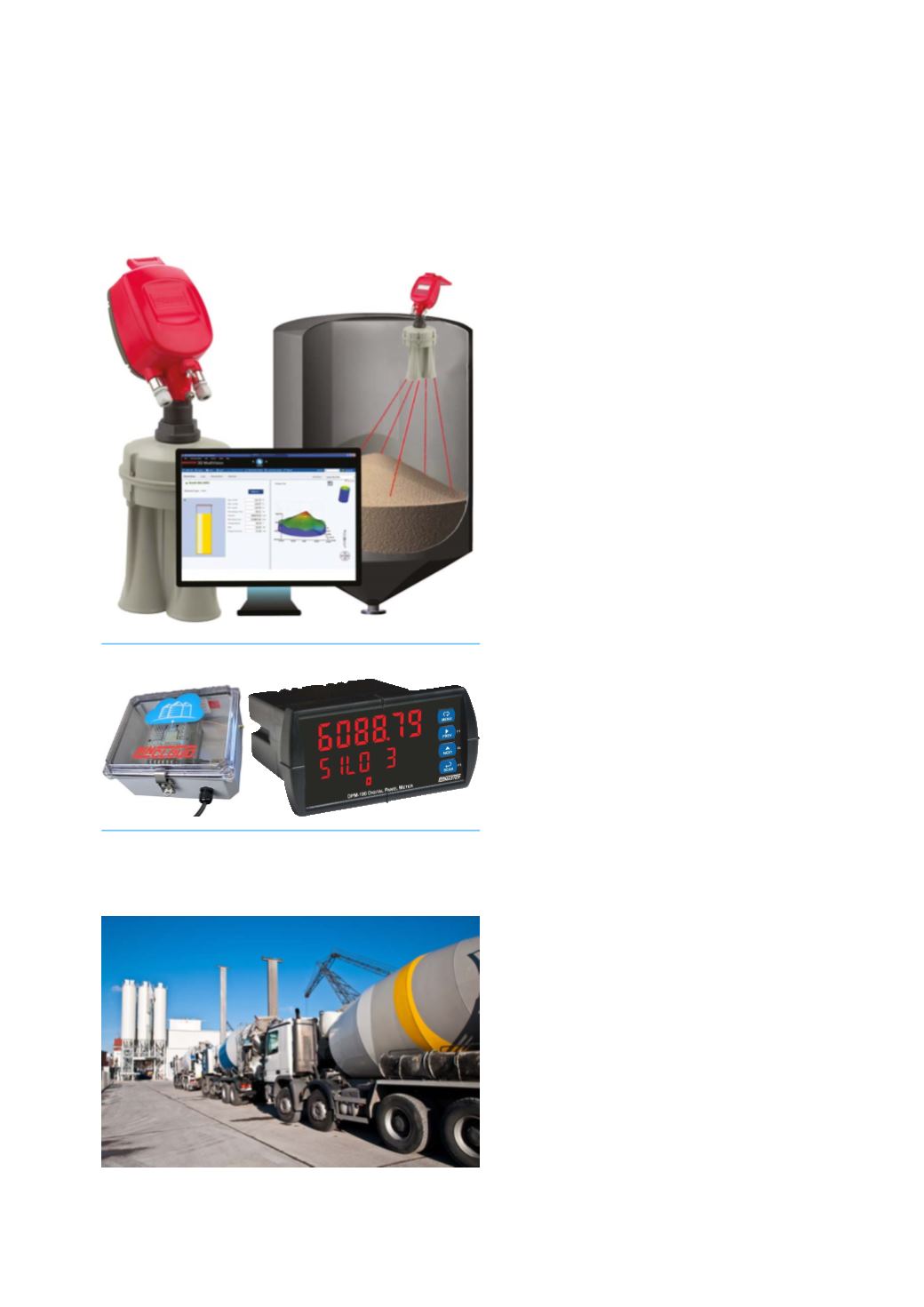
3D Scanners measure and visualise silo contents.
A single gateway (left) does the job of a wireless
access point, modem, and router, while a digital panel
meter (right) gives drivers and workers local access
to silo data.
Drivers can access silo level data without exiting their
vehicle.
44
World Cement
July 2020