



 49 / 108

acknowledge alarms. They can be used one
per silo or can be set up for viewing levels from
multiple silos on one meter.
Simplifying sensor replacement
A common theme among cement manufacturers
in the United States and Canada is a shortage
of qualified staff to get maintenance work done.
With unemployment at record low levels, it is
hard to recruit full-time staff. This has resulted
in outsourcing work to third-party vendors and
licensed electricians to keep operations running
smoothly.
A cement plant is tough on level sensors. Due
to the dusty, sticky environment, these devices
need to be maintained on a regular basis and
occasionally replaced altogether. But when you
couple a lack of staff and a rigorous preventive
maintenance schedule, you need a solution to
make the task go quickly with less qualified staff.
Quick Disconnect (QD)
Adding a Quick Disconnect (QD) has become
a real time saver for cement plants. These
inexpensive accessories can take the tedious
task of hard wiring a sensor and turn it into a
plug-in operation, with no licensed electrician
needed. Staff spend less time installing,
replacing, or maintaining a sensor. QD
connectors can be purchased separately for
retrofit, or some manufacturers will ship new
sensors with the QD option already installed.
These connectors are a convenient hard wiring
alternative for a point level sensor that may need
to be removed for cleaning or maintenance. A
QD connection consists of a male connector
installed into the sensor’s conduit opening and
a female connector that is field wireable. They
come in a variety of sizes with M12 or
7
/
8
in.
being among the most common.
QD connectors are often used with a rotary,
capacitance probe, vibrating rods, or tilt switch
utilised for high level detection. They can also be
applied in a daisy-chain of Modbus sensors or
flow detection sensors used on distributors or
chutes. QD vastly reduces the amount of time
someone needs to spend on top of a silo.
These five trends are just a few ways that
technology is simplifying plant management
and inventory monitoring, making cement plant
operations safer, smoother, and smarter.
About the author
Jenny Nielson Christensen MBA is the
Vice President of Marketing for BinMaster, a
division of Garner Industries. Her mission is to
train and educate industrial processors on how
to streamline operations, increase productivity,
and enhance profitability through sensor and
software technology using the IIoT.
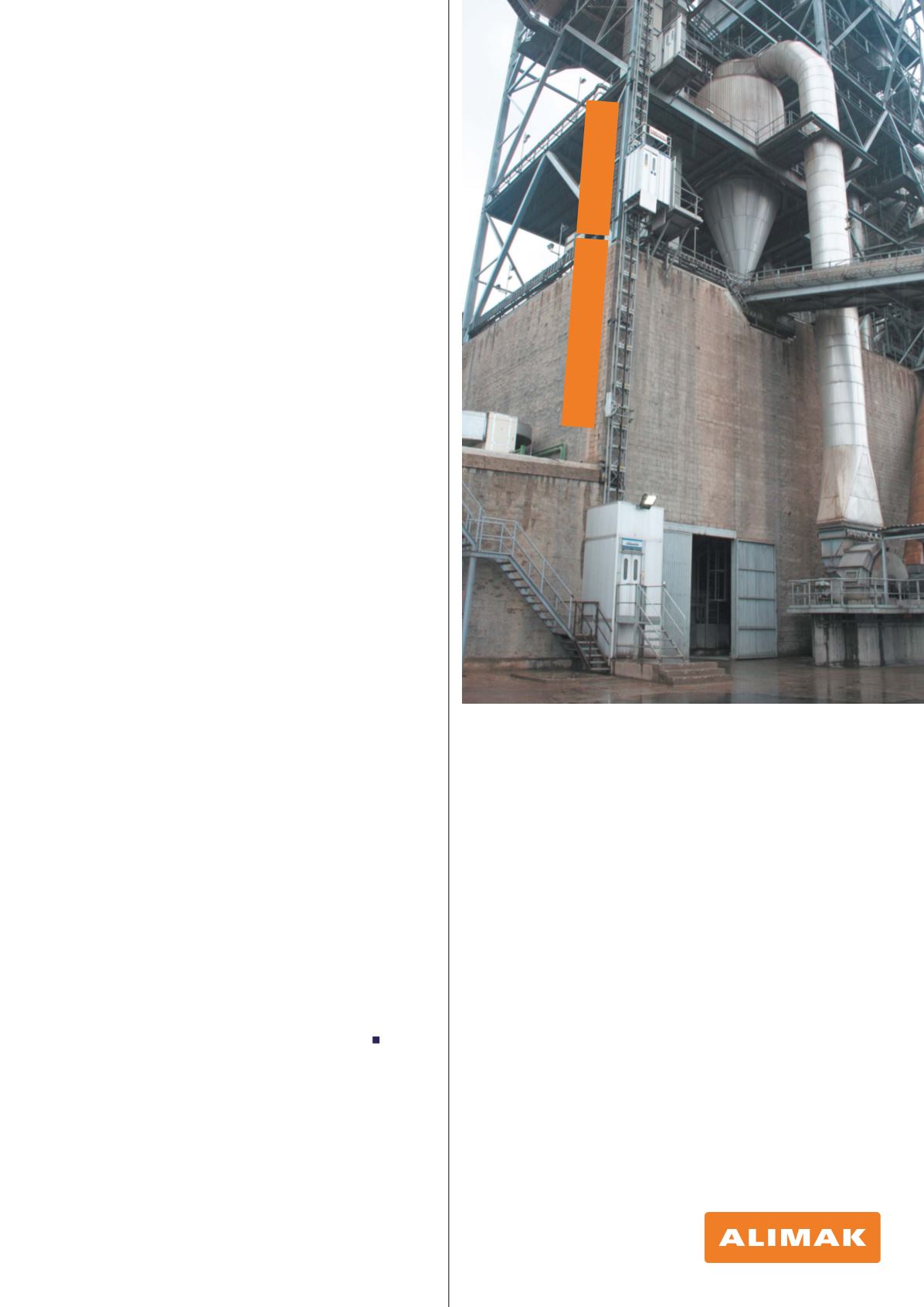
Cement plants all over the world rely on Alimak rack and
pinion elevators to provide reliable, efficient vertical access
for maintenance and inspection. Designed to operate in
demanding industrial environments, outdoors and indoors,
Alimak elevators require no expensive shafts or machine
rooms, and they can easily be installed on new and exist-
ing structures. Standard capacities range from 300 kg to
7,000 kg, with up to 24-ton capacity available upon request.
ARE YOU PAYING SKILLED STAFF TO CLIMB STAIRS
OR TO PRODUCE CEMENT?
DON’T CLIMB.
ELEVATE.
ELEVATE.
DON’T CLIMB.