



 13 / 84

North America 2018
/ 11
World Cement
BMI Research: a Canadian recovery
BMI Reseach expects the recovery of Canada’s
construction industry seen in 2017 to continue over the
next decade, forecasting annual average real growth
of 1.6% between 2018 and 2027. According to BMI’s
forecasts, the industry will slow over 2018, however,
with expectated for growth at 1.8%, following growth
of 3.9% in 2017. In 2019 the industry will surpass its
previous 2014 peak in real value terms.
Among the leading drivers of growth over the next
decade will be government investment in infrastructure
development. The Trudeau government has
prioritised investment in new infrastructure
since coming into office in 2015 as part of its
CAN$180 billion infrastructure strategy spread over
11 years. The rail sector in particular is set to see strong
levels of investment with both federal funding and
private investment supporting the development of a
number of large urban rail projects. Here we highlight
the CAN$6.3 billion Réseau électrique métropolitain
(REM) project in Montreal as a prime example of
positivity towards the Canadian infrastructure, as the
project has been successful in being developed as a
public-private partnership by pension fund Caisse de
depot et placement du Québec, with funding from
the federal and provincial governments. The project,
currently in the pre-construction phase, entails the
construction of a 67 km automated electric light rail
network with 27 stations, linking downtown Montreal
with the areas of South Shore, North Shore, and
West Island, as well as with the city’s main airport.
BMI also expect ports to see new investment,
supported by growing seaborne trade volumes. These
investements will originate from Asian and European
markets, following Canada’s adhesion to the EU Canada
Comprehensive Economic and Trade Agreement (CETA),
which entered into force in September 2017, and the
Trans-Pacific Partnership Agreement (TPP). Container
port facilities will outperform with the facilities at
Montreal, Vancouver, and Prince Rupert likely to draw
new investment.
Investment in residential construction will continue
to be a driver of construction industry growth. BMI
expects the sector will see a deceleration in investment
in 2018, compared to the elevated levels seen in 2017,
as a result, in part, of new government regulations
aimed at cooling off the housing market, which are
expected to soften housing demand. Rising interest
rates and elevated levels of household debt will also
contribute to the cooling of investment in the sector,
slowing the development of new projects. Over the
remainder of the forecast period, it is expected that the
sector will outperform the overall construction industry,
benefitting in particular from the continued growth of
the Toronto and Vancouver metropolitan areas, where
new housing will be concentrated.
Environmental and climate politics key
BMI’s forecasts represent the expectation that an
increased emphasis on environmental and climate
concerns in project decision will often dictate project
activity in Canada in the years ahead. The power sector
will be one of the areas most impacted by this trend, as
the government plans to phase out all coal-fired power
generation in the country by 2030. This will lead to a
sharp reduction in coal-fired power generation over
the ten-year forecast period (2017
–
2027) and support
growing investment in non-hydropower renewables.
Other sectors including the port sector, as well as the
oil and gas sector, will also be impacted by this shift
in government approach, with projects likely to face
greater legislative hurdles and political opposition.
Illustrative of this are the cases of Enbridge’s Northern
Gateway Pipeline, cancelled in 2016 after the Trudeau
government refused its approval, as well as the Kinder
Morgan’s Trans-Mountain Pipeline expansion project,
which has faced substantial opposition and has
struggled with delays.
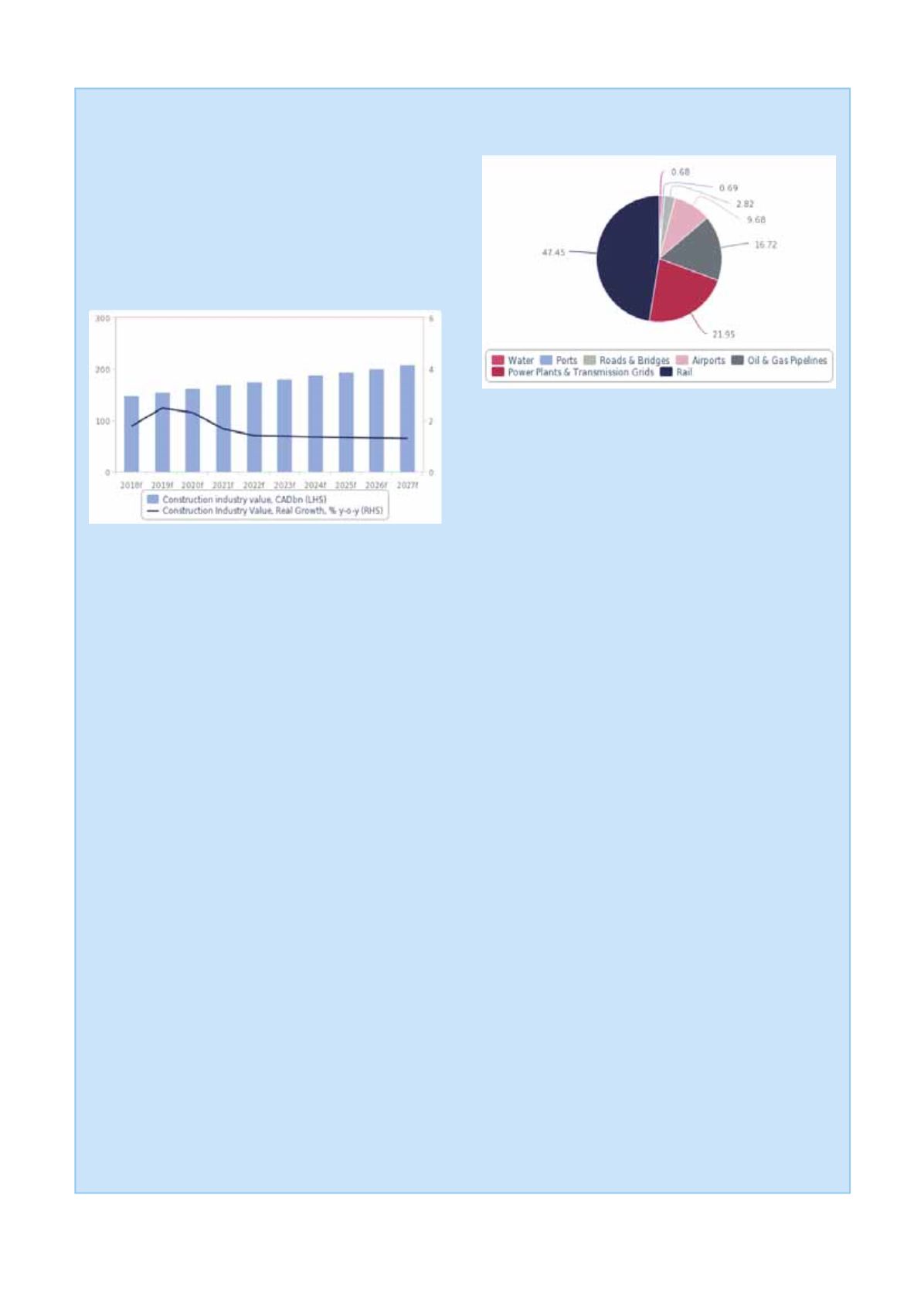
Canada: construction industry value and real growth
(f = BMI forecast).
Source: Statistics Canada, BMI.
Canada: projects in preconstruction phases: share of
project value by sector.
Source: BMI infrastructure key projects database.