


 28 / 140

November 2018
26 \
World Cement
“This year we aim to substitute 20% of the
thermal energy needs of Lafarge Egypt’s cement
plant by alternative fuels (AFs) generated from
wastes, and we have an ambitious plan to reach a
40% substitution rate by 2020” said Amr ElKady,
General Manager of Geocycle Egypt.
Starting with only four employees in 2011, the
company today employs 30 people. With the annual
generation of 30 000 t of AF for co-processing,
Geocycle Egypt is an integral part of Lafarge Egypt’s
operations, providing the plant with an optimised,
reliable, and flexible fuel mix.
In November 2016, the company expanded its
businesses and investments. Last year, Geocycle
Egypt grew to pre-process and transport more wastes
coming from agricultural, municipal, and industrial
sources thus generating more than
300 000 t of reusable fuels and more than 20 000 t
of alternative raw materials for the industry, while
drastically reducing the amount of waste that
would have otherwise been sent to dump sites or
incinerated. “My colleagues and I take great pride
in our work at Geocycle and that we are helping our
communities to manage waste safely” ElKady added.
That being said, Geocycle Egypt continues to face
many challenges, for several different reasons. To
start with, the lack of supply was unexpected given
that an average of 90 million t of municipal waste is
being generated annually but municipal collection,
the main source for AF, is at an average rate of 50%.
Another main challenge is the lack of financing.
Being in the waste management and recycling
industry, there is generally a lack of financial
support provided for waste sorting and processing
facilities. Moreover the lack of incentives granted to
those working in the sector in addition to its poor
reputation, being associated with wastes, makes it
an unfavorable sector to work in for many.
Nevertheless, Egypt has huge potential. With its
growing population rate, the amount of generated
waste is expected to continue to rise every year.
Additionally, in an announcement by the Egyptian
Minister of Environment earlier in April, he revealed
that there is a plan to replace traditional sources of
energy with AFs, especially those generated from
refuse. This comes as part of the Industrial Pollution
Control Project ‘Phase II’ that was launched by the
Ministry to support and assist Egyptian industries to
achieve environmental compatibility and abide by
the laws. Simultaneously, the use of AF in cement
production will support further growth for Geocycle.
Therefore, ‘Waste to Energy’ might be the future of
waste management as it requires large quantities of
collected waste. For instance, a station that generates
10 MW can consume around 200 000 t of waste/year.
Furthermore, the country is currently witnessing
waste management reforms, with a proposed new
solid waste management law that is currently being
discussed in the Egyptian Parliament with hopes
it gets enacted soon. The new law will include
incentive schemes to promote investments in the
waste management sector and opportunities to
introduce new and more sustainable solutions to
manage one of the country’s longstanding problems.
Focusing on creating a mutually beneficial
situation, Geocycle Egypt offers proper waste
management solutions to help reduce landfills as
well as support in generating more AF for industrial
use. The process also helped its partners, local
municipalities, and even the Egyptian government,
to properly manage their waste.
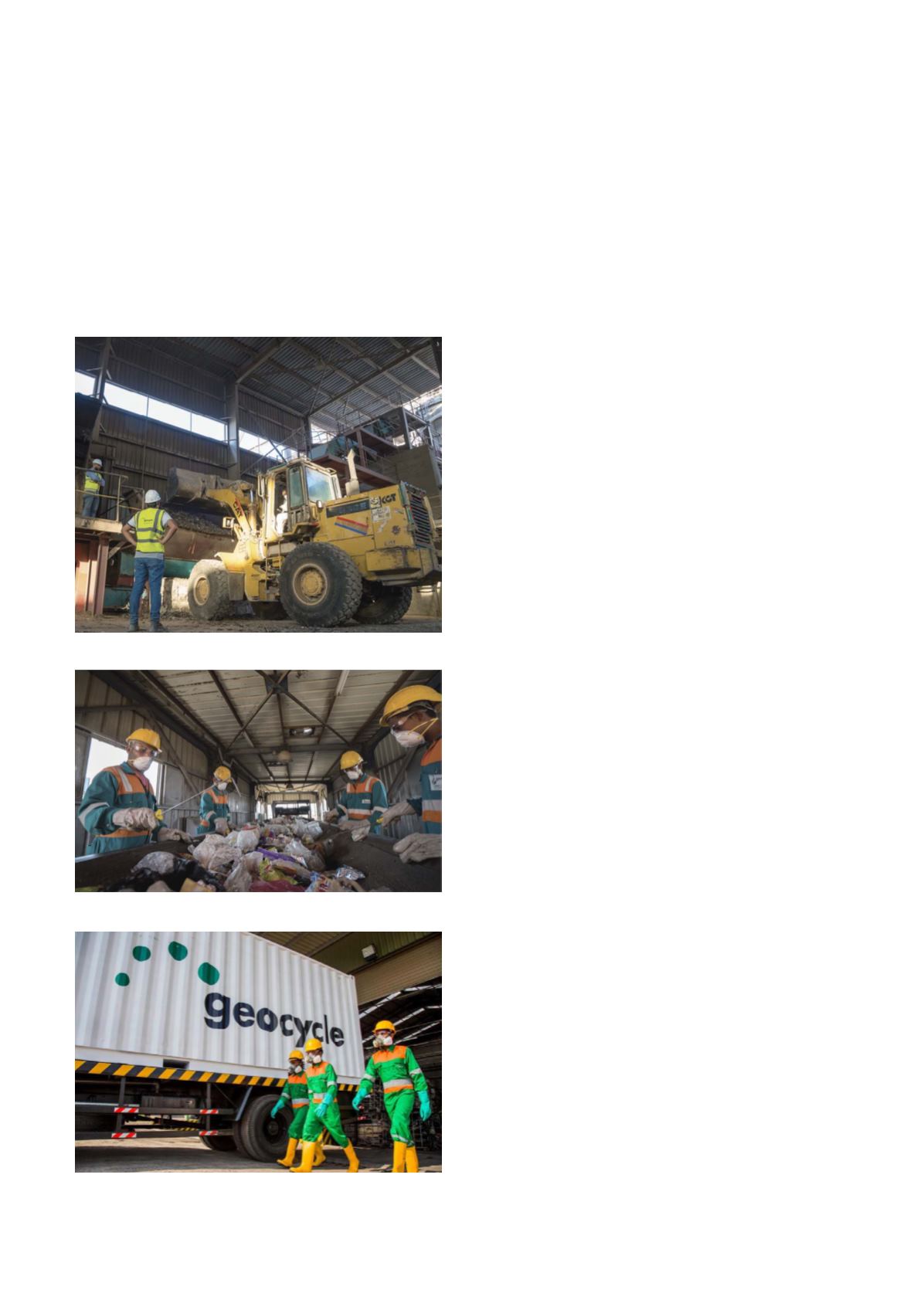
Geocycle co-processing.
Geocycle sorting.
A Geocycle waste truck.