


 32 / 140

November 2018
30 \
World Cement
The running times that have now been achieved with
completed plants and the satisfaction of the customers
confirm the correctness of the chosen mill and drive system.
The need for high plant availability and an optimised
maintenance concept is becoming increasingly important.
Contrary to high-capacity plants, very compact
systems with short time to market entrance are required
as well. The modular mill solution enables flexible
use in any place, bringing cement producers closer to
their customers. This compact system is suited to the
production of all types of cement: perfect for local
cement producers and market entrants, as well as for
large construction companies aiming to expand their
position by manufacturing cement on the spot.
The ready2grind plant from Gebr. Pfeiffer can be
transported and erected quickly and efficiently with
manageable costs, making it an ideal concept to respond
rapidly to the changing needs of the local cement markets.
In the last decade, more than 70 MVR mills have
been sold. The first MVR mills have been installed in
Europe for cement raw material and cement grinding.
These mills have been in operation since 2007 and
2008, respectively. Meanwhile, the MVR population has
increased continuously. In this article, operating data of
several MVR mills installed worldwide will be discussed
in detail. Operating results of the biggest cement mills
(MVR 6700 C-6) will be highlighted. The production of
portland cement with very high fineness of more than
5000 Blaine is possible with a smoothly running mill.
Design features
The design features of the MVR mill differ mainly
from the well-known MPS mill in the grinding element
geometry, the roller suspension, and the number of
rollers. All machine parts that are relevant in terms of
fluid dynamics, such as the hot gas channel, nozzle ring,
SLS high-efficiency classifier, and material feed, are of the
same design as the those parts in MPS mills.
The MVR mill is capable of producing high output
rates of up to 1000 tph raw material. The modular
design of the MVR mill, comprising four to six grinding
rollers, allows the continuation of mill operation, even
if one roller module is not available. The same applies
to the MultiDrive
®
design of the mill drive: the mill is
driven through a girth gear flanged to the grinding
bowl by up to six actively redundant drive units with a
total output of up to 18 000 kW. Each drive unit consists
of an electric motor, coupling, and gear unit. The
grinding forces are transmitted to the foundation via a
conventional plain bearing without placing any load on
the gear units; the gear units are therefore not exposed
to the grinding forces.
Projects and operational results
So far, the biggest mill with an 11 500 kW mill main drive
is in operation in Brazil. This MVR 6700 C-6 produces
portland slag cement (PSC) with different ground
blastfurnace slag (GBFS) proportions of up to 50%.
The civil works, as well as the mechanical and electrical
installation, were finished in September 2015.
Hot commissioning took place in April 2016. Table 1 shows
the operating data achieved during the performance test.
Table 1.
Operating data for slag cements produced in a MVR 6700 C-6.
CP III 40
CP II 32
CP V Ari
CP V Ari Plus
Mix
40% slag
3% limestone
34% slag
9.5% limestone
20% slag
2% limestone
0% GBFS
94% clinker
3% limestone
Product rate
395 tph
456 tph
349 tph
178 tph
SPC mill
28.5 kWh/t
21.9 kWh/t
27.3 kWh/t
41.4 kWh/t
Feed moisture
2.9 %
3.2 %
1.9 %
0.3 %
Fineness
4670 Blaine
3.4% R 38 µm
4420 Blaine
2.0% R 45 µm
4850 Blaine
2.1% R 38 µm
5500 Blaine
0.9% R 38 µm
Vibrations
0.8 mm/sec.
0.7 mm/sec.
1.2 mm/sec.
1.2 mm/sec.
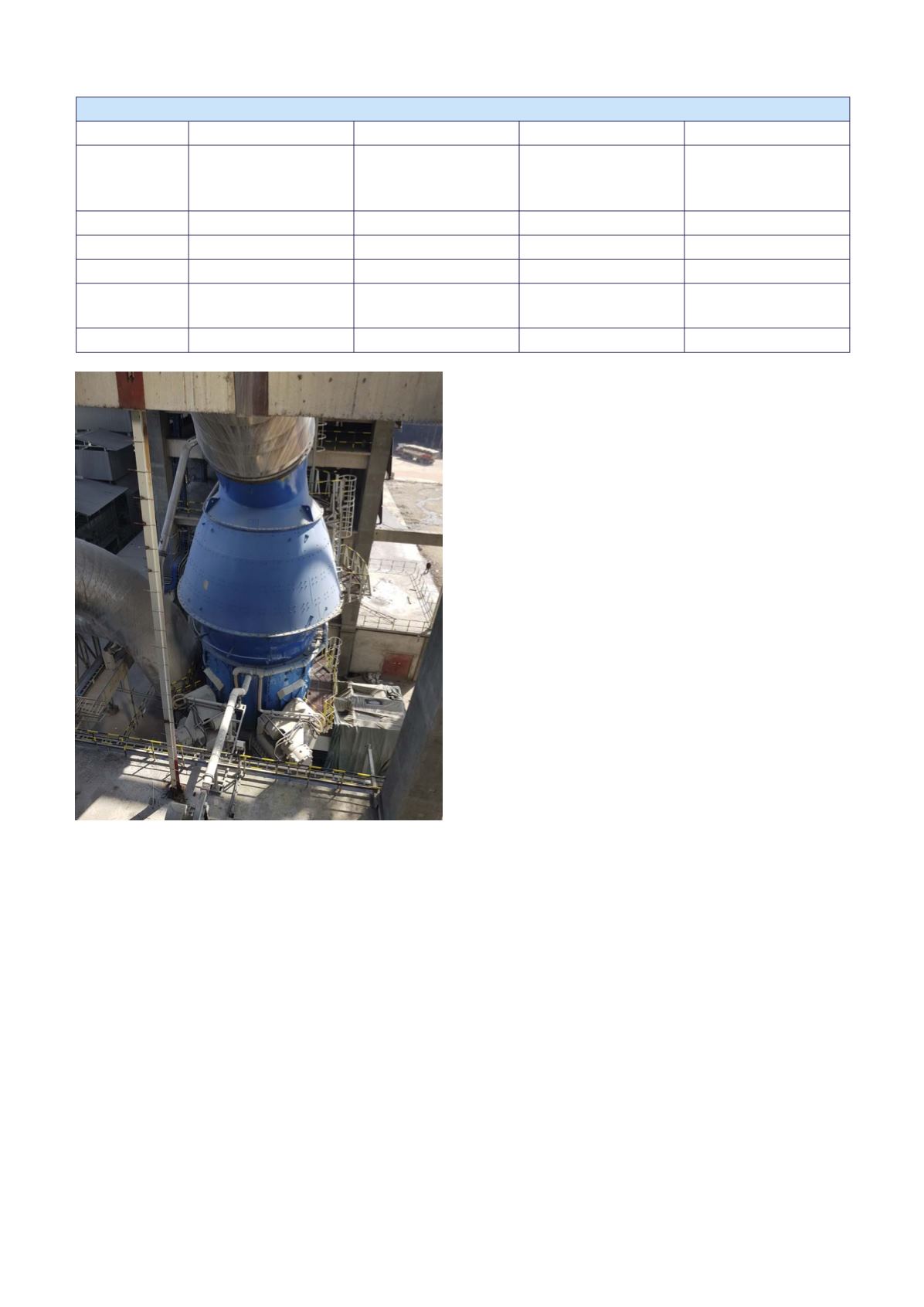
Figure 1. MVR 3750 C-4 in East Africa.