


 34 / 140

November 2018
32 \
World Cement
The flexibility of the equipment allows the production
of ordinary portland cement (OPC) up to at least
5500 Blaine, which was not defined in the project. The mill
operates with a smooth level of vibration. The plant was
running the mill without the supplier’s supervisor after
79 hours of commissioning.
The overall results achieved in all MVR mills show that
all required cement qualities can be produced in vertical
roller mills. The combination of drying, grinding, and
separation in one system is advantageous, especially when
it comes to clinker substitutes. A smooth and stable mill
operation with reduced water spray is possible; grinding
without external heat is thus dependant on feed moisture
of the material.
In all Pfeiffer mills installed in India for example, the
performance guaranteed could be achieved easily. The
clinker temperature impacts the process conditions: if the
temperature is low or ambient, the amount of water spray
has to be lower to fulfill the thermal process balance.
With a higher clinker temperature, the amount of water
injection or feed moisture can be higher. When laying out
a grinding plant, the installation of an external heat source
is recommended, even when starting the plant with OPC
or portland pozzolana cement (PPC) with dry flyash only,
because wet additives might be used in future.
Pozzolan cement
A grinding plant producing a
composite cement with pozzolana
as a clinker substitute has been
taken into operation lately in
Africa. The installed MVR 3750 C-4
(Figure 1) is rated to produce
between 150 and 180 tph PPC at
4000 cm²/g acc. Blaine, depending
on the grindability of clinker and
pozzolan. The mill is equipped
with a main drive power of
2900 kW. Table 2 show the results
achieved.
Pozzolanic materials do
not harden in themselves
when mixed with water but,
when finely ground and in the
presence of water, they react at
normal ambient temperature
with dissolved calcium
hydroxide (Ca(OH)
2
) to form
strength-developing calcium silicate and calcium aluminate
compounds. These compounds are similar to those that are
formed in the hardening of hydraulic materials. Pozzolanas
consist essentially of reactive silicon dioxide (SiO
2
) and
aluminium oxide (Al
2
O
3
). The remainder contains iron
oxide (Fe
2
O
3
) and other oxides. The proportion of reactive
calcium oxide for hardening is negligible. The reactive
silicon dioxide content shall be not less than 25.0% by mass
(EN 197-1).
In East African countries, the most available material
as supplement is limestone. Limestone dilutes the
clinker content of the cement and impacts the strength
development. If natural pozzolana is available, cement
manufacturing is more profitable due to the properties
of pozzolana. The definition of pozzolana includes any
volcanic material. In difference to that the term, pozzolan
does not describe the specific origin of the material.
1
Therefore, the term pozzolan also includes artificial
supplementary materials, such as flyash, bottom ash etc.
The great majority of natural pozzolans is of volcanic
origin. The global distribution of volcanic rocks can be
compared with the occurences of natural pozzolan
deposits. But not all volcanic rocks are suitable as pozzolanic
material. More siliceous magma produces more explosive
volcanism with better pozzolanic properties.
2
The activity of
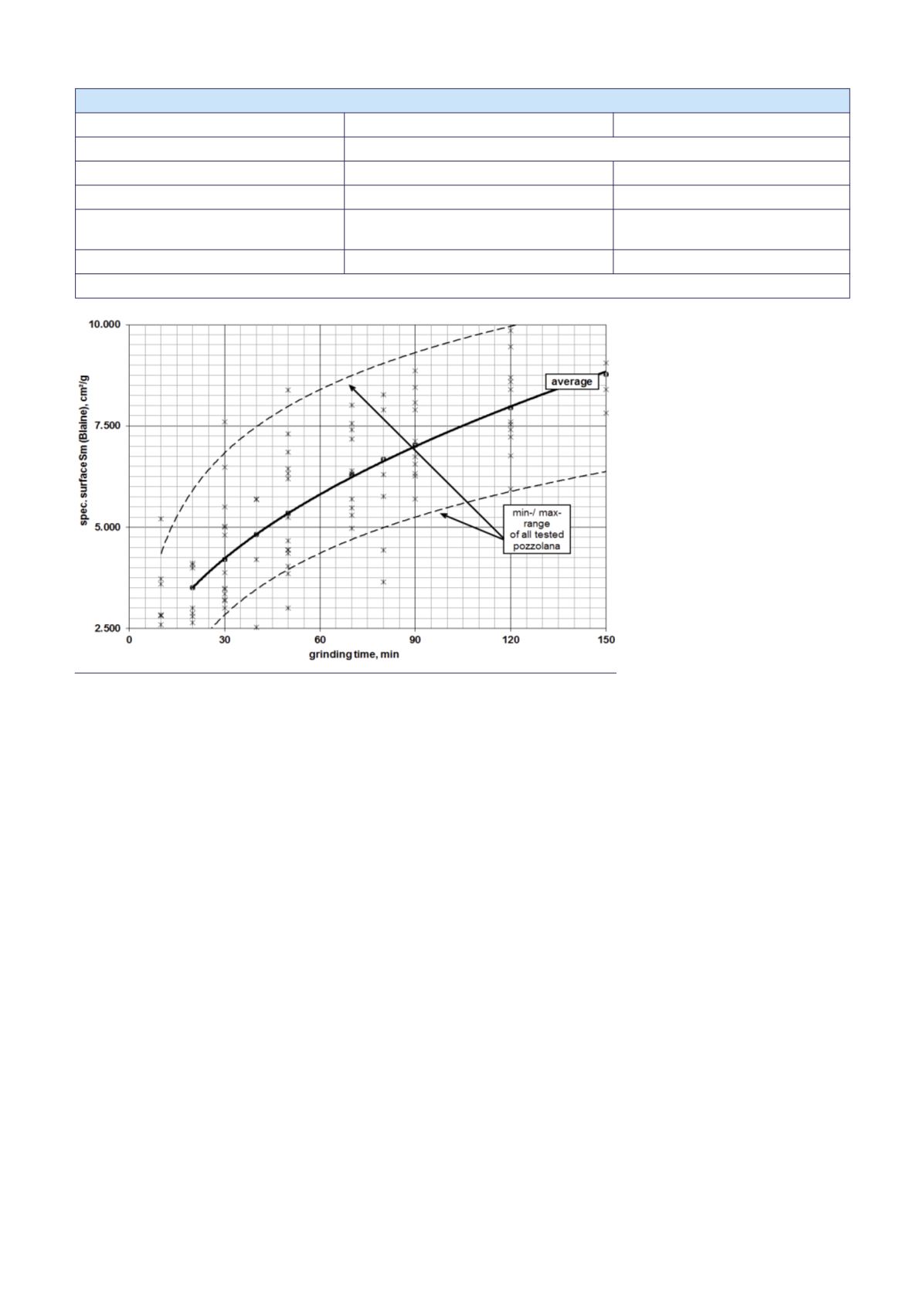
Figure 2. Grinding of pozzolana with laboratory ball mill: Blaine as function of
grinding time.
Table 2.
PT Data of MVR 3750 C-4 for PPC grinding.
Guarantee
Current*
Material
PPC (25 – 28% pozzolana)
Production rate
151 tph
156.5 tph
Blaine
4000 cm²/g
4190 cm²/g
Specific energy consumption (shaft:
mill, classifier, fan)
28.86 kWh/t
26.53 kWh/t
Vibration (gear box base plate)
n.a.
0.5 mm/sec.
*According to performance testing in June 2018.