


 58 / 140

November 2018
56 \
World Cement
Background
The cement plant in question has an excellent
environmental record, winning an environmental award
from the Portland Cement Association for its achievements.
Built in 2003, the 2.2 million tpy plant makes extensive use
of alternative raw materials and fuels, including hazardous
liquid waste, recycling more than 0.4 million t of materials
in a typical year.
The plant controls particulate matter (PM) emissions
from the pyroprocess line and the vertical roller mill by
operating a large reverse air baghouse equipped with 14
individual compartments of filter bags, each measuring
298 mm dia. and over 10.5 m in length. Each of the 14
compartments houses 336 filters for a total of 4704 filter
bags, equating to 46 000 m
2
of filter media. The baghouse
is responsible for cleaning 1.513 million actual cubic meters
of air per hour (acm/hour) (Figure 1).
The plant has utilised polytetrafluoroethylene (PTFE)
membrane filter bags in the baghouse and typically
achieves a 5 year bag life. The membrane is laminated
to a fiberglass fabric and the laminate is sewn into
the geometry of a typical reverse air filter bag with
anti-collapse rings. The filters are fitted over thimbles and
clamped into place in the baghouse.
PTFE membrane filter bags have many advantages
over non-membrane filter bags. The PTFE membrane
surface provides filtration efficiency, while ensuring the
PM does not become embedded in the support material
or substrate. By keeping the PM out of the substrate, the
filters often last significantly longer. Additionally, PTFE
membrane filters are highly efficient and can capture
significant amounts of dust, maintaining that efficiency
into the sub-micron dust range. Along with the benefit
of longer life and improved environmental performance,
PTFE membrane filters generally operate with a lower
and more stable differential pressure than non-membrane
filter bags. It is for these reasons that much of the cement
industry uses PTFE membrane filters as their standard
choice of filter media.
Though it is much less marked in membrane filters
than in non-membrane filter bags, it is true to say
that there is a seasoning effect over the lifetime of a
membrane filter bag. Typically, the filter cleaning cycle
must increase over time in order to maintain a consistent
flange-to-flange differential pressure, which subsequently
increases operating costs and, eventually, damages the
membrane structure. In an effort to avoid these pitfalls,
W.L. Gore designed a new type of membrane filter bag
that provides consistently lower filter drag over the entire
service life of the bag. In late 2016, the plant agreed to a
demonstration project to see how this could impact total
cost of ownership (TCO).
The definition of filter drag
Filter drag is the total resistance of the filter media and the
dust cake on the surface of the filter media. The higher
the resistance, the higher the energy consumption of the
baghouse fan and therefore the higher the cost to move
the necessary kiln process airflow across the filter media.
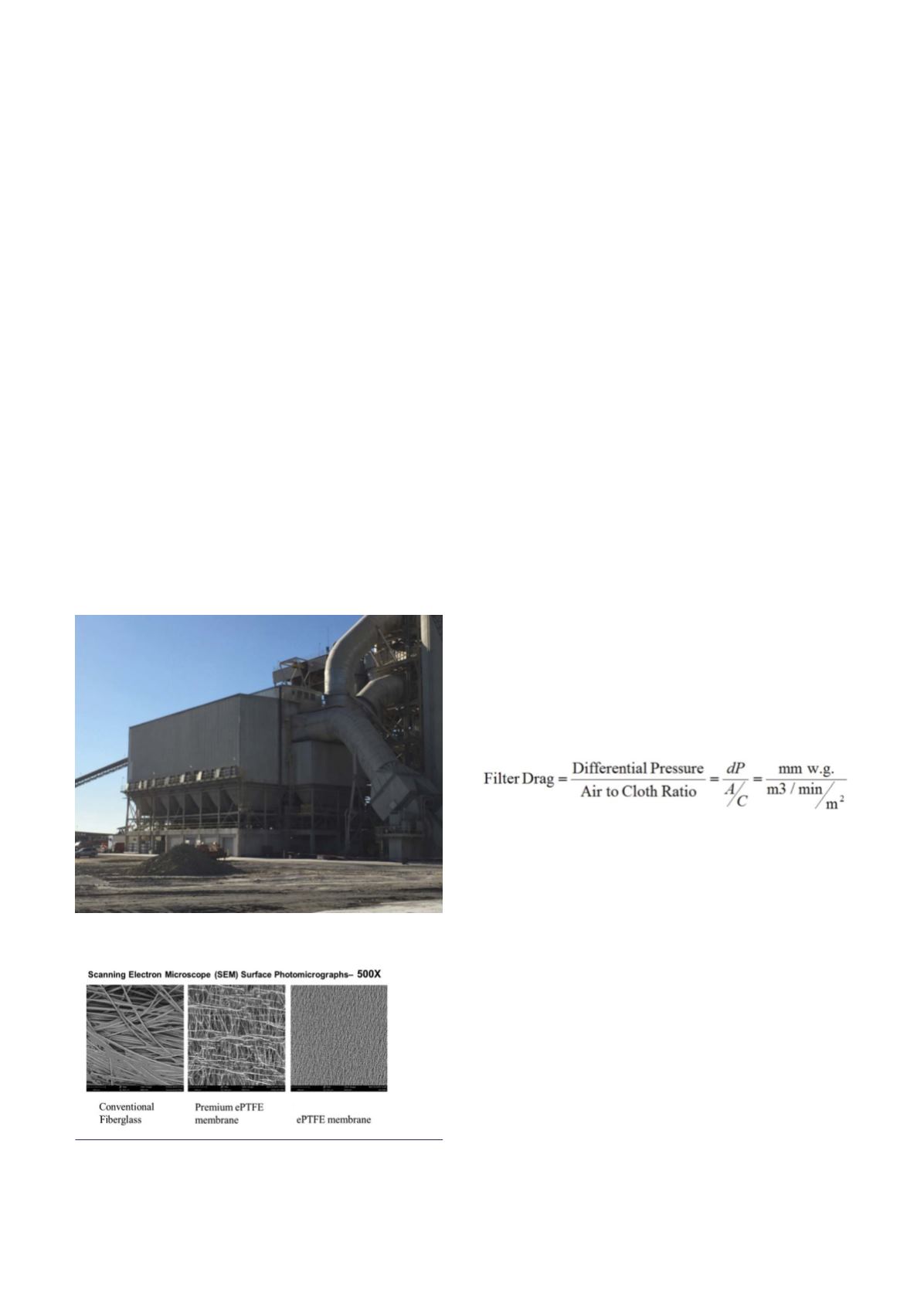
In a baghouse, filter drag is defined as the relationship
between operating differential pressure and the actual
air-to-cloth ratio at which the baghouse operates:
Given this relationship, achieving lower filter drag
brings with it the consequent benefit of either fan energy
savings, potential increased airflow, longer filter bag life,
or fewer installed filter bags. Furthermore, a plant could
change the benefit it wishes to receive almost at any time
to adapt to changing market dynamics.
1
So how is lower filter drag achieved? Essentially, by
keeping all the dust on the surface of the membrane and
not allowing it to find its way into the internal structure
over time, thereby alleviating the need for increased filter
cleaning frequency. In order to achieve this, an entirely
new membrane structure was required (Figure 2).
W.L. Gore developed the Gore LOW DRAG filter bag
to meet the needs of fume and fine powder applications.
The dense membrane structure captures particulate
matter on the surface and prevents penetration beyond
that, thus increasing cleaning efficiency compared to
standard membrane filters that reduce differential
pressure and increase air flow. Cleaner bags require fewer
cleaning cycles, resulting in less wear and longer bag life.
Figure 1. The reverse air baghouse cleans at a rate of
1.513 million acm/hour.
Figure 2. Scanning electron microscope surface
photomicrographs showing the structure of different
filter media.
Next Generation Reduced Drag