


 54 / 140

November 2018
52 \
World Cement
reduce the operational costs of filter systems. Cement
producers clearly required efficiently-controlled fabric filters
with low energy consumption and long filter bag lifetime.
In response to this demand and the input received from
producers, FLSmidth further developed the design of the
fabric filter. This resulted in the release of the FLSmidth
SmartBag
®
, which allows up to 15%more filtration area in
the same fabric filter. In addition, the filter’s steel weight
is up to 7% lower, yet it retains the same performance
capability of its predecessor.
Lighter is better
The designers and engineers responsible for the new filter
had clear design objectives in mind: reduce the filter size
and weight, improve its mechanical design, and streamline
control of the filter system. Thorough computational fluid
dynamics were applied in the design process, as well as
simulations and extensive testing in fabric filter installations
around the world.
Fabric filter weight is important because lighter
filters are more cost-effective. This new technology sets a
benchmark for new developments in FLSmidth filters in the
cement production industry.
Arabian Cement’s Rabigh plant in Saudi Arabia was
one of the first to install the new FLSmidth filter system.
“We have noted performance improvements in the mill’s
inlet pressure, as a result of the new smart bags’ increased
filtration area,” said Irfan Butt, Maintenance Manager of
the plant.
Applications
The SmartBag is suitable for retrofits, upgrades, and new
cement plants. The electrostatic precipitator (ESP) remains
a current standard technology in many cement mills across
the world, yet, as new technologies are developed, the ESP
is gradually being phased out. FLSmidth has completed
an average of ten ESP to fabric filter conversions annually
and it is gaining in popularity. This is likely to be because
the conversion of existing ESPs to fabric filters means
lower investment costs. Furthermore, the technology
implemented is comparable to an entirely new filter system.
Increasing the capacity of a filter is typically a costly
investment, involving an extension of the filter casing. In
a retrofit, the SmartBag reuses the same cleaning system,
control, dust extraction system, and filter casing. This solution
makes it possible to increase air flow capacity by 15%.
The SmartBag also offers cost-saving benefits for new
installations. In a new FLSmidth fabric filter system, the
SmartBag can reduce the footprint by up to 15% compared
to fabric filters and regular bags. Additionally, the overall
weight of the fabric filter is reduced by 5%. This results
in greater flexibility in existing layouts, lower foundation
costs, and, significantly, a lower upfront investment
requirement.
Advantages
The compact design of the SmartBag suits retrofits and
upgrades because it is adaptable to previously existing
infrastructure. These processes can be carried out during
maintenance downtime and take a maximum of two
months, causing minimal disruption to production. The
SmartBag also maintains emissions compliance in times of
disruption, such as when there are high carbon dioxide
levels or when power supply fails.
For cement plants wishing to increase baghouse filter
capacity, the SmartBag can be produced in lengths of up to
12 m, to maximise the common height of a filter box in old
ESPs. This creates up to 15%more filtration area compared
with regular filter bags.
Smarter control
While the technology backing the fabric filter is important,
an equally important factor is the way in which the filter
system is controlled. Today’s fabric filter controllers normally
only adjust to the differential pressure (dP) across the entire
filter. This means that the filter systemmaintains a certain
dP, without consideration for filter bag conditions and
actual dust load from the cement mill. This is not ideal, as
the main fan will have to maintain one pressure at all times,
despite fluctuating work conditions and loads. Under such
conditions, the main fan consumes an undesirable amount
of energy.
As filter bags age, the amount of dP required to
flow through them is often higher. However, traditional
controllers do not recognise changes in filter bag
condition and will not adjust accordingly. The result is
the requirement of constantly cleaning the filter system,
compromising the length of filter bag life and energy
consumption levels.
FLSmidth recognised this challenge and has developed
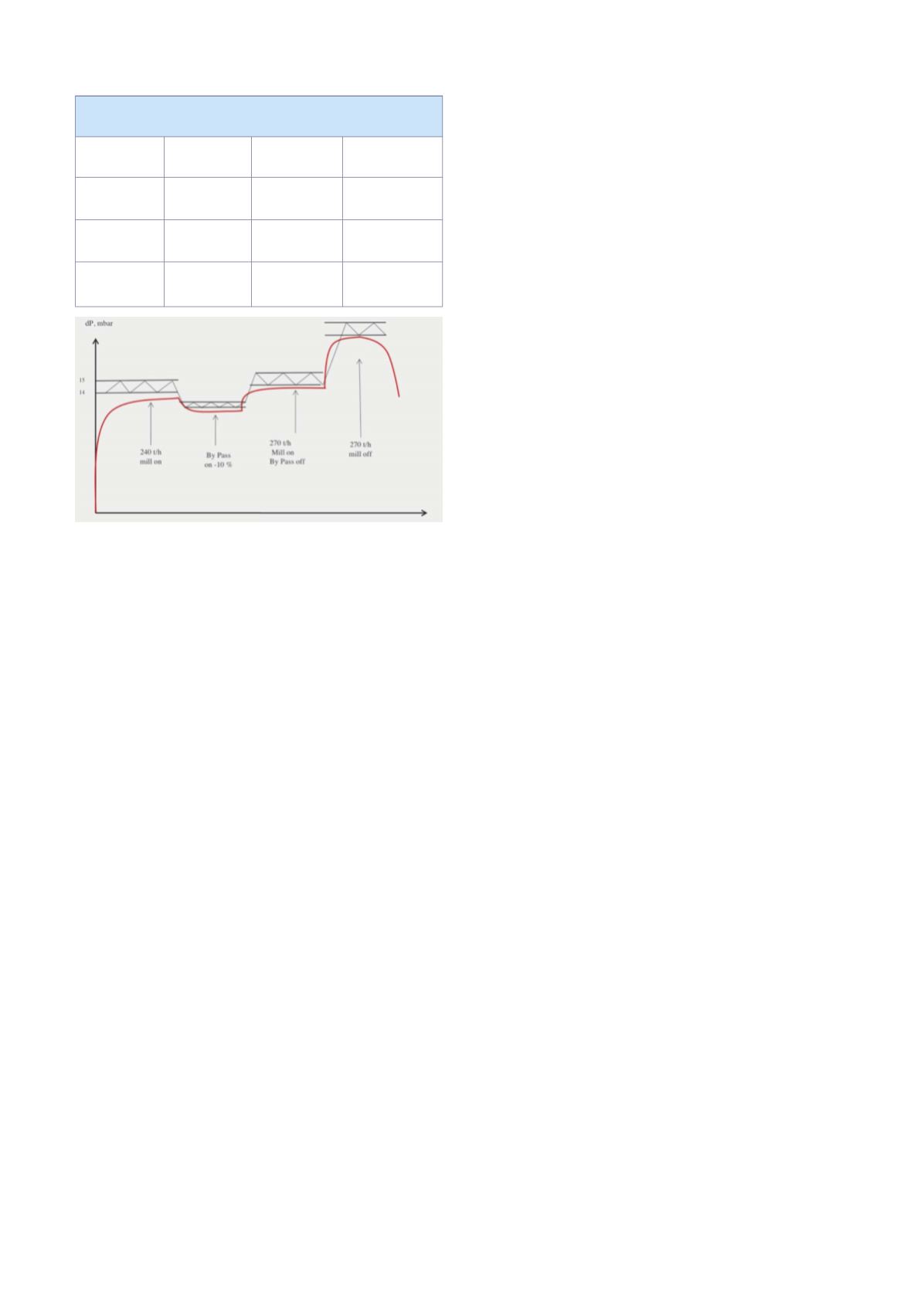
a next generation of air filter controllers. The SmartPulse
EVO ll
®
controller continuously analyses specific filter
operating conditions, based on the rate of change of
differential pressure across the filter, which is driven by the
load from the cement mill.
Figure 1.
Comparing the SmartBag to existing
solutions on the market
Bag size Length
(m)
Number of
bags
Cloth size
(m
2
)
147
SmartBag
10
1976
9129
5 in.
regular bag
10
2299
9152
6 in. filter
bag
10
1920
9216
Figure 2. Auto adjusting dP start and stop limits