



 14 / 108

How does one make the right decision?
Maintenance managers must often reconcile the
views of internal experts and third parties with
conflicting interests.
For the sake of efficient readability,
Klüber Lubrication (global leader in speciality
lubricants), NOVEXA (global leader in on-site
machining) and DALOG (global leader in
condition monitoring) have united in this article
to explain how to maximise the lifetime and
performance of the gear for peace of mind.
Machine monitoring
An objective machine health assessment of the
drive system builds the foundation for a cost
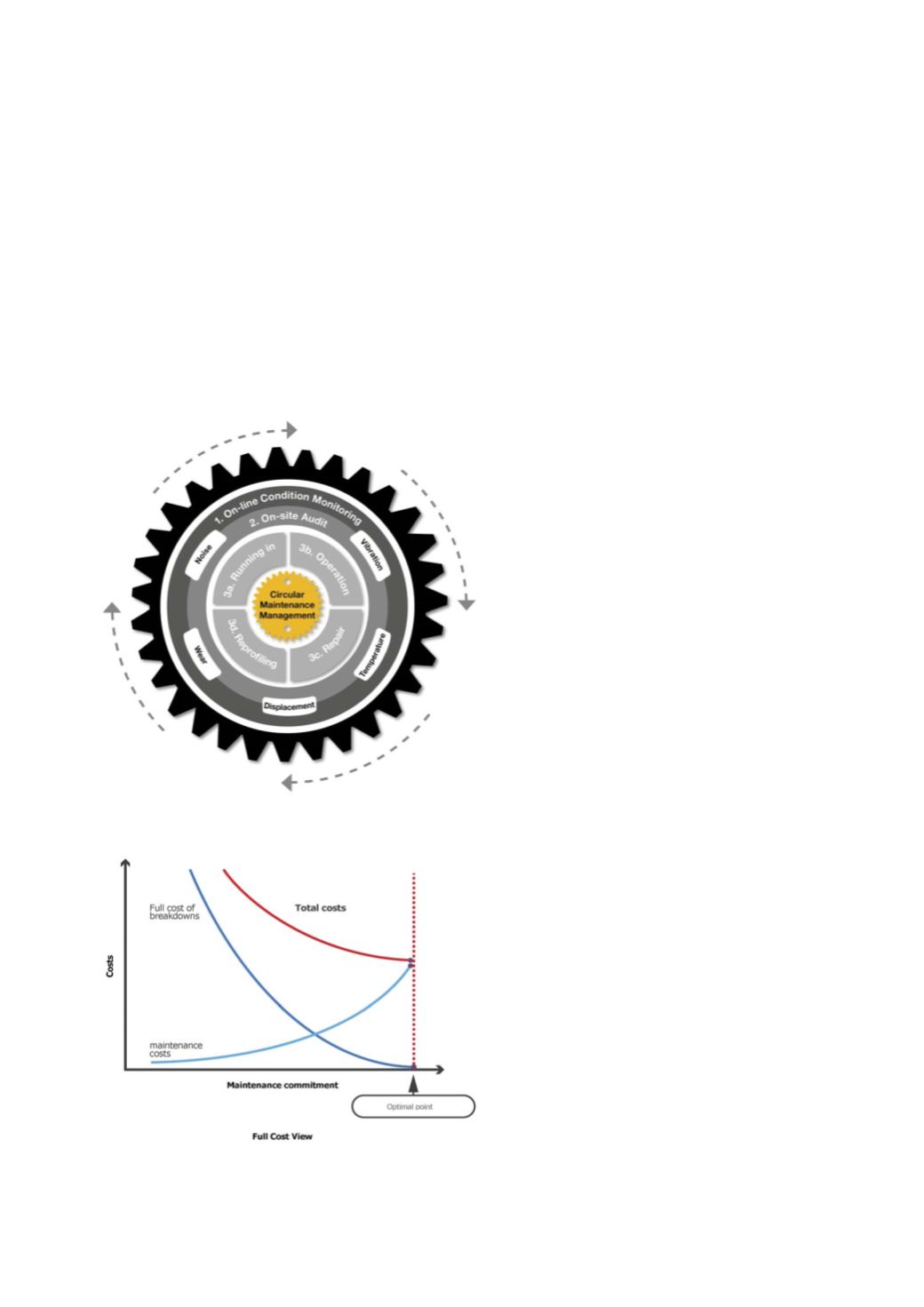
efficient TPM system (Figure 1). The goal is
to prevent any unwanted surprises during the
operation and plan maintenance interventions
based on the condition of the drive. Online
condition monitoring systems can give detailed
information about the health of the machine in
real time. Their main task is the early failure
detection of wear and cracks at bearings and
gears. In addition, it is possible to detect even
slight changes in the gear meshing to evaluate
the effects of repair works (e.g. repair lubricants,
reprofiling). Conventional vibration analysis at
low speeds generally fails to detect vibrations
issued from a faulty bearing due to its low energy,
high and variable loading conditions and to the
noisy environment generated by other mechanical
components of low speed machines such as
gearing systems.
DALOG uses a combination of acceleration
and speed sensors with a high performance
online condition monitoring system to detect
early stage failures at low speed girth gears
and bearings. The data logger system must
be able to sample the signals at a high rate
and perform signal filtering. The output of
the DALOG system is in the form of intuitive
component related indicators (e.g. pinion
bearing indicators) that can be visualised on
the operator screen in a reliability software
package and in the cloud to give access to
all interested stakeholders. This provides
time to act and plan. Plants benefit from
fewer unplanned stoppages and minimal
consequential damage (Figure 2).
The assessment of the failure is backed by
experts in the DALOG Diagnostic Centre.
Besides detecting the failure, their job is
to evaluate its criticality and determine
consequential actions. Many failures can
be rectified before they turn into a bigger
problem. Klüber Lubrication and NOVEXA
can quickly intervene and verify the findings
of DALOG with an on-site inspection.
Field inspection
Visual inspection is inseparable from the
accurate establishing of a diagnosis on a girth
gear. Regardless of the warning mechanisms
available to a maintenance team, only an
on-site inspection will allow the detected fault
to be confirmed or not confirmed.
Vibration and temperature are indicators
of the proper functioning of equipment,
but they are also warning indicators that
allow on-site audits to be planned when
the warning thresholds are reached. In
itself, DALOG’s expertise and the level
of technology they can develop makes it
possible to ensure technical monitoring of
the equipment and to react as quickly as
possible.
Figure 1. Open gear circular maintenance
management.
Figure 2. Plants benefit from less unplanned
stoppages and a minimisation of consequential
damage.
12
World Cement
July 2020