



 16 / 108

For example, a recurring speed variation
detected on a gear by a sensor should trigger an
immediate visual inspection. This variation may
be caused by excessive deformation of the tooth
profiles due to a high wear rate. By reacting as
quickly as possible, from the first warning signals,
wear management is better controlled, and
maintenance costs and the risks of unexpected
shutdown are reduced.
A complete inspection of the girth gear must
take into account several parameters, including:
f
Lubrication conditions (quality, consumption,
lubricant distribution, lubrication system,
etc.).
f
Meshing conditions (root clearance, contact
pattern, pinion and gear alignment, etc.).
f
Gear surface faults (pitting, spalling, scuffing,
etc.).
f
Vibration measurements.
f
Temperature measurements.
f
The kinematic wear state (bearing
clearances, pinion/gear box alignment, etc.).
The on-site inspections carried out by
Klüber Lubrication and NOVEXA are
complementary as they combine all the
parameters of an inspection. If these two types
of inspections share common parameters
(vibrations, load distribution, temperatures),
Klüber Lubrication inspections are more oriented
towards the analysis of lubrication conditions,
whereas NOVEXA inspections are focused on
the inspection of gears and shaft geometry.
The right lubrication and correct gear geometry
(including correct alignment setting) are two
essential parameters in the efficient monitoring
of a piece of equipment. Without the right
lubrication, equipment wear progression will be
rapid and exponential. Likewise, without good
meshing conditions ensuring sufficient load
distribution, equipment lubrication while meshing
will not operate optimally.
From running-in to repair
Large girth gear drives are ubiquitous in cement
processing. The reliability and operational
safety of the drives, and in consequence
their lubrication, is of the utmost importance.
Functional reliability and damage-free operation
of large gear drives highly depends on the
correct lubrication. Outstanding gear protection
starts long before the actual first revolution,
i.e. during transportation, storage and assembly,
and accompanies the gear set over its entire
lifetime. To ensure optimum lubrication at all
life stages, Klüber Lubrication has developed
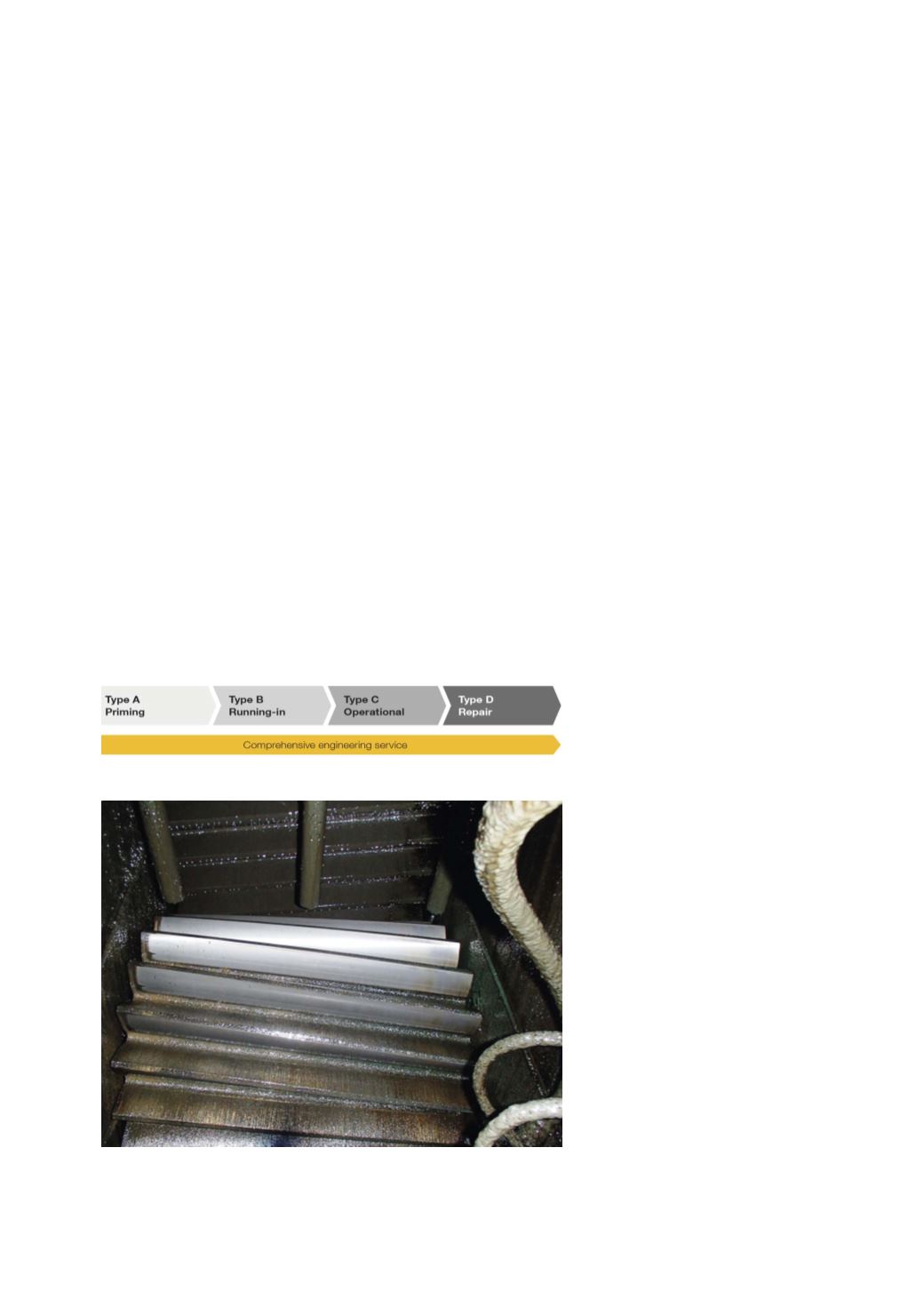
a systematic four-step lubrication method for
large gear drives, which has been known for
many years under the name ‘A-B-C-D system
lubrication’ (Figure 3).
Priming lubricants protect the
tooth flanks in the first life stage
from damage during storage and
initial alignment of the gears.
Lubricants can be applied
manually by brush or spatula.
Running-in lubricants are applied
to new gear drives or after
repair lubrication. Due to their
special additives, they cause a
controlled, minimum amount of
chemical wear. Thereby, they
improve the surface condition by
smoothening rough surfaces and
enlarging the contact pattern.
Both reduce the possibility of
gear damage in subsequent
stages. During the regular
operation of a large girth gear
drive, operational lubricants are
the lubricants of choice. They
are modern adhesive lubricants
tailored to suit the operational
conditions of girth gear drives.
They meet all extreme pressure
requirements of gear drives at
very low consumption rates while
keeping up wear protection.
Hereby, two different lubricant
technologies are distinguished.
Figure 4. Pinion/girth gear with transparent open gear lubricants
– inspection and documentation made easy with strobe light or
high-resolution digital camera while running.
Figure 3. A-B-C-D system lubrication.
14
World Cement
July 2020