



 18 / 108

High viscosity fluids
To meet the demands of large girth gear drives,
Klüber Lubrication invented a range of
transparent open gear lubricants. With a wide
range of available viscosities, the Klüberfluid C-F
Ultra series can be used in spray, circulation, and
immersion systems in all climates. The modern
high-viscosity fluids offer low consumption in
combination with the best gear protection.
Inspections can be conducted easily with a
strobe light or a high-resolution digital camera
while running the gear drive (Figure 4).
Gear greases containing solid lubricant
These open gear lubricants are based on soaps
and mineral or semi-synthetic base oils with
solid lubricants. They offer operating reliability
in different environments around the world.
Furthermore, these lubricants are the first choice
if cost efficiency is a target. Another advantage
is to visualise the contact pattern easily by the
contrast with the gear material.
Flank surfaces often become damaged
for a variety of reasons, which can lead to
an inadequate contact pattern. To prevent
breakdowns, Klüber Lubrication has a solution to
repair the gear while remaining in operation under
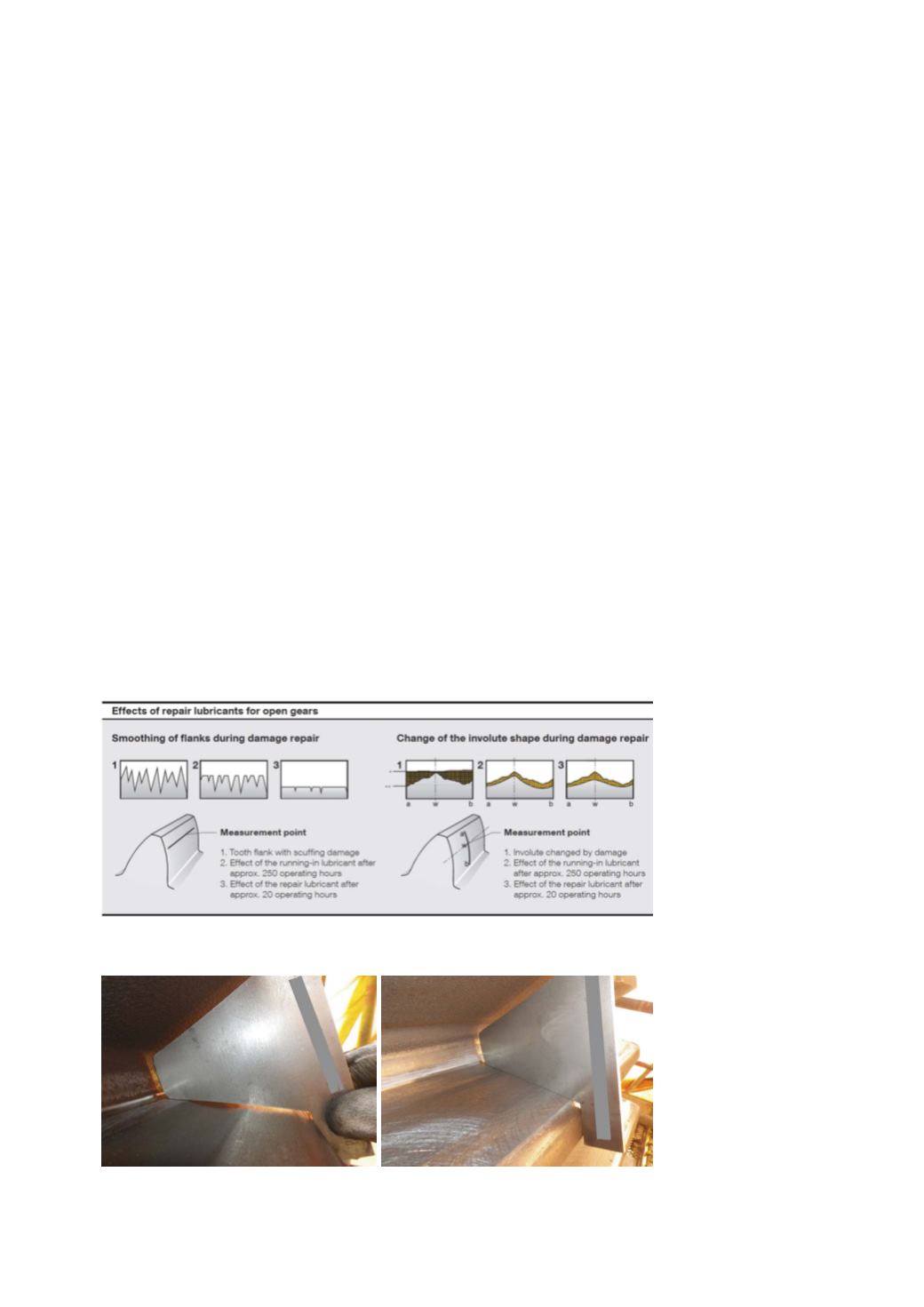
full load. Repair lubricants re-condition the tooth
flank surface (Figure 5). They incrementally and
evenly remove asperities, scratches and scorings
to improve the contact pattern and to avoid
peak loads. Even pittings and plastic deformation
can be smoothened up to a certain level.
However, when the tooth flank damage is too
excessive, chemical smoothening is often no
longer sufficient and a mechanical intervention
is required (in order to restore the initial
involute profile and right meshing conditions)
as load and lubricant distribution and lubricant
circulation deteriorate. This condition is present,
for instance, if profile deformation, vibration
level and/or temperature difference between
fixed bearing and loose bearing side, on pinion
and/or girth gear exceed certain levels. In such
critical situations, the reprofiling is one of the few
applicable options.
Reprofiling
Even though the wear speed and lifespan of an
open gear can be managed, mechanical wear is
inevitable. Year after year, pinion and gear wear
out due to metal to metal contact during meshing.
Gear profiles are slowly deteriorating, thus
creating similar wear on each tooth. Pinion/gear
wear always shows in the form of:
f
A pinion root step.
f
A recess below the pitch diameter area.
f
A hump on the tooth’s head, above the pitch
diameter area.
This profile deformation generates modifications
in the meshing conditions and contact ratio.
When wear
reaches a critical
level, one can also
notice:
f
An excessive
vibration level.
f
In some cases,
and without
intervention:
appearance
of fatigue
cracks with
risk of tooth
breakage.
The replacement
or reversal of
damaged gears
(when possible)
is not the only
available option.
An intervention
called ‘reprofiling’
represents an
alternative solution
(assuming that the
remaining thickness
is sufficient) which
is faster and
Figure 5. Repair lubricants are not applicable when profile deformation is
excessive.
Figure 6. Profile deformation before intervention: 4.7 mm (left) and profile
deformation after reprofiling by NOVEXA: accuracy 0.07 mm (right).
16
World Cement
July 2020