BMHR 2016
60 \
World Cement
systems. CDM provides a uniform application through
the marketing, sales and delivery process thereby
reducing the training investment by the enterprise.
CDM incorporates best practices from the cement
loading industry abstracted through an ERP interface
that accommodates business rules and localised
practices. This can drastically reduce the complexity
and cost of implementing cement specific shipping in a
general-purpose financial system.
Recent mergers and asset divestures have highlighted
the challenges integrating existing logistics infrastructure
in the cement industry. Using an abstracted model of
cement logistics, Process Solutions has helped several
companies successfully incorporate new assets and reduce
the cost of ERP customisation. Deploying trucker operated
loading systems reduces the cost of extending product
sales into new areas.
The right tool
ERP and financial systems are the correct tools for
basic transaction management such as invoicing and
purchasing. The cement industry introduces complexities
that can be difficult or expensive to reproduce as
enterprise customisation. Transactions such as diversions,
swaps, preloads and stock transfers can challenge financial
systems and inventory management. Inventory for
cement is difficult to measure until material is physically
weighed into vehicles. Integrating local process control
and scales ensures accuracy, often providing the most
reliable production and inventory information. The use of
standardised automated loading practices linked directly
to the product delivery (CDM) software ensures that
equipment and personnel are protected.
Preloads, or pre-positioned loads, (also referred to
as spec loads) are shipments that speculate on need to
have product available in a region. The truck is loaded
and sent to an area of expected sales especially when
there are long distances between the terminal and end
user. Custody of the shipment is transferred to the House
Carrier at the point of pickup. In addition to handling
customers at long distance, preloads allow the carrier to
have product ready to deliver first thing in the morning
before traffic rushes. A preload requires legal transfer of
custody documentation with the shipment, and an easy
mechanism to allow a customer service centre to find
the preload and assign it to a customer for invoicing.
Typically the financial system does not need to record the
transaction until the load has been assigned to a customer.
CDM applications from Process Solutions manage all
aspects of the preload creation, tracking and assignment.
Preloads can be configured for driver loading and may not
require an attendant at the site.
At the enterprise level, it is not common to maintain
inventory to the silo level. Most manufacturers track only
total inventory by product for each site. CDM applications
add a layer of inventory tracking that tracks inventory at
the silo level as well as tracking uncommitted inventory
in transit as preloads and stock transfers. Because CDM is
integrated with the site’s automation, silos are selected
automatically. This prevents the incorrect loading of
vehicles, either with the incorrect product, or with product
that has not yet been released by the site’s quality control
procedure. CDM can also handle inventory and raw
materials receiving transactions, updating the ERP system
daily with batch or summary inventory transactions.
Stock Transfer is not unique to the cement industry
but there are particular challenges. Rail is commonly used
to move inventory from plants and import terminals to
regional terminals. CDM incorporates industry standard
RFID tags on rail cars to ensure accuracy. Rail cars are
preloaded and then assigned to trains as a sales order to
a customer or stock transfer to another site. Most railways
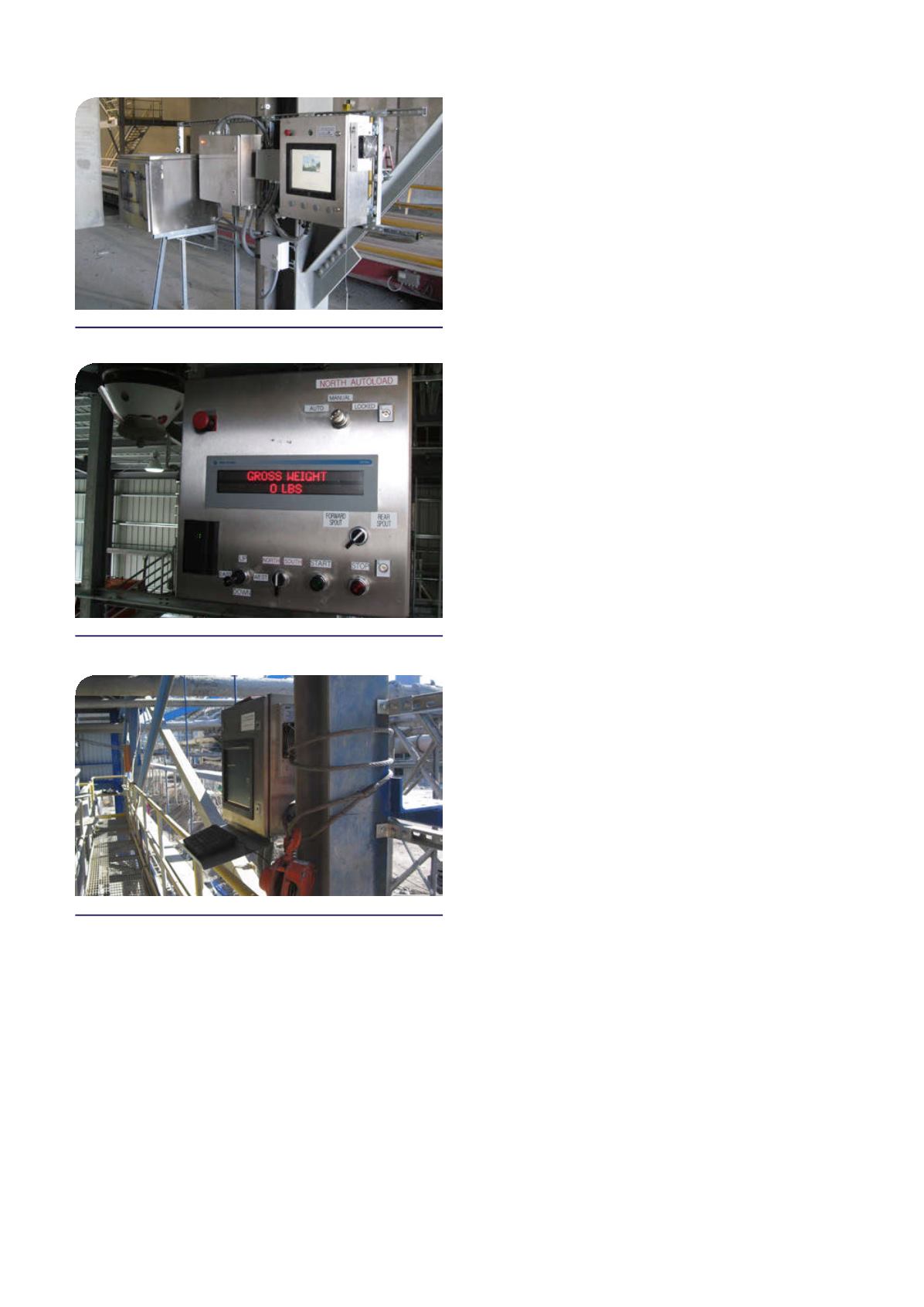
Kiosk assembly.
Autoloading.
Rail station.


