BMHR 2016
64 \
World Cement
and aftershocks in 2010 (stuff.co.nz, 2010) are ever present;
as well as the even more devastating 6.3 aftershock a few
months later in February 2011 which killed nearly 200
people (New Zealand Government, 2012) followed by a pair
of 6.0 and 5.2 quakes in June (Staff, 2011). All told, these
events did an estimated NZD$40 billion (USD$27.65 billion)
worth of damage (New Zealand Treasury, 2015). With
such devastation in mind, finding a bulk storage structure
sturdy enough to handle seismic events and a company
with a verifiable track record of building such buildings was
paramount.
Seismic concerns were not the only criteria used when
choosing domes. Social concerns were also considered. They
needed to store over 30 000 t of cement in as aesthetically
pleasing, environmentally friendly, cost effective and
sustainable an operation as possible. The Auckland site
in particular was on the port near the city center, shops
and residential areas. The dome won out again due to its
unobtrusive shape and its clean, waterproof, high solar
reflective index (SRI) DomeSkin™ air form. Domes are
hermetically sealed so fugitive dust is avoided. Also, the
reclaim system selected is energy efficient, and the facility
is contained within a small footprint. Overall, the dome
system provides decades of efficient, usable service life.
Holcim’s team found their ideal building in a bulk storage
reinforced concrete dome and found their preferred
vendor in Domtec whose culture, quality, reputation for
independent engineering and a history of zero structural
failures, including several domes built around the Pacific
‘Ring of Fire’ met these conditions.
The dome storage building went through a strict peer
review process that involved structural engineers in five
countries on three continents. The dome was engineered
using ACI and Eurocode standards and codes to ensure
all peer review engineers had a good understanding of
loads and forces. After looking through the peer-reviewed
drawings, the owner and founder of Domtec, who has
been in the dome business for over thirty-five years
remarked, “Wow. This will be the most stoutly constructed
cement dome in the world.”
Two sites were chosen for Holcim’s domes. On the
South Island the dome was to be built in
Timaru, a port city about 150 km (93 mi)
south of Christchurch. The other dome
would be located on the North Island in
the most populous city in the country,
Auckland, with a regional population of
over 1.4 million (New Zealand Goverment,
2013). The project site in Timaru had a layer
of basalt a few meters below grade which
was used to provide a firm foundation.
The Auckland dome however, was to be
built on reclaimed land and therefore need
to be built on two hundred and sixty-one
(261) 600 mm x 12 – 13 m deep concrete
piles and a 600 mm thick pile cap (Downer,
2016). Downer noted the volume of the
pour was 732 m³ of concrete and was
completed in one eight hour shift with
two pump trucks and twenty-two concrete
trucks running continuously. “That
equated to one concrete truck through the
site gate every three minutes for an eight
hour period (Downer, 2016).”
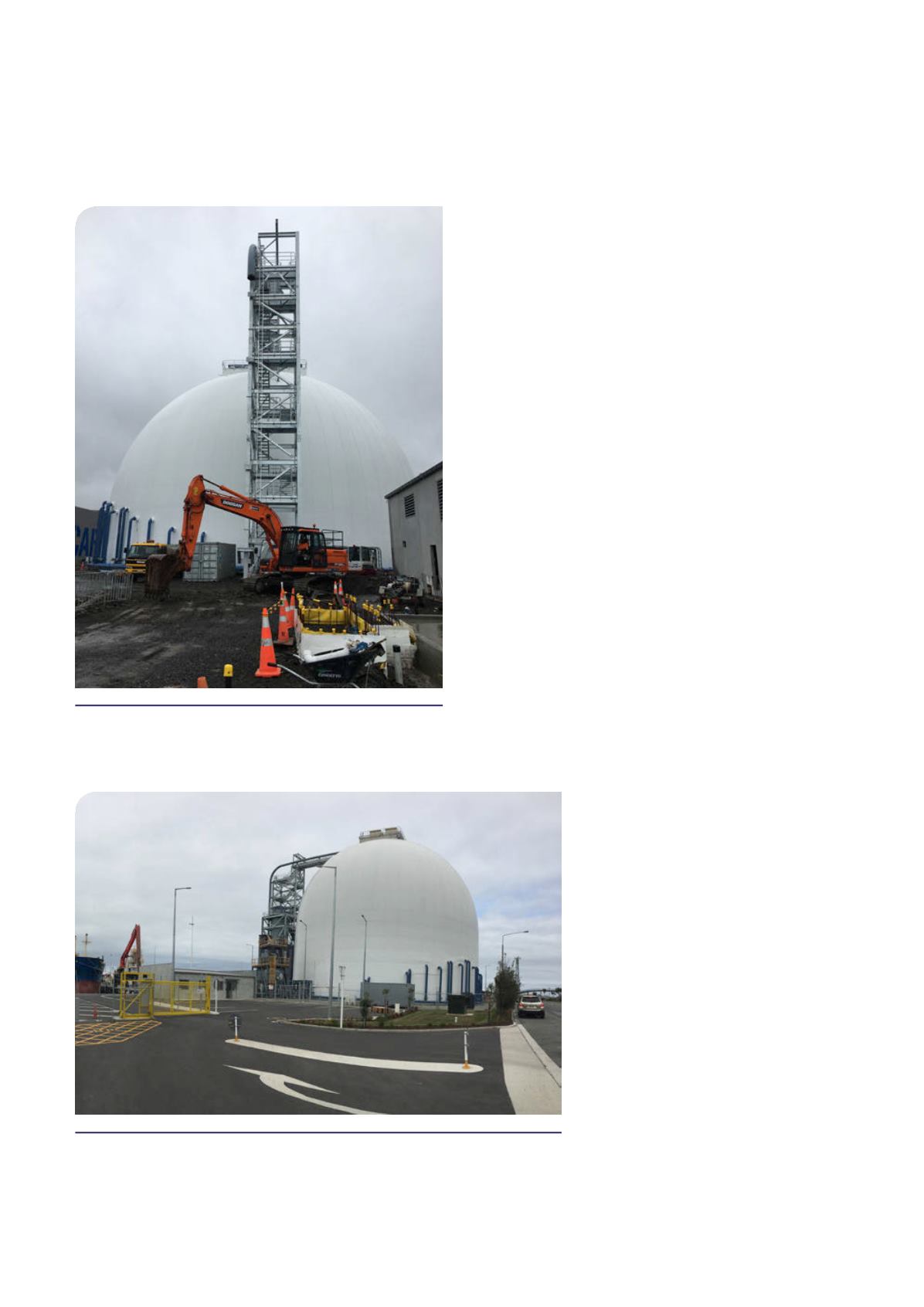
Holcim’s 41.2 m dia. by 27.5 m tall, 30 000 MT cement
storage dome in Auckland, under construction in
1Q16.
Picture by Domtec International.
Holcim’s 36 m dia. by 31.5 m tall, 30 000MT cement storage dome in
Timaru following its grand opening in February 2016.
Picture by Domtec
International.


