BMHR 2016
56 \
World Cement
The supply of bulk material within a network
of multiple plants, depots and customer sites is
usually performed by a heterogeneous vehicle fleet.
Trucks have different capacities and characteristics,
may have a single or multiple compartments and
different auxiliary equipment. Customer demands
are typically larger than the vehicle capacities, so
that most customers are visited several times within
the planning period (split deliveries). While most
transports are for full truck loads, small orders for
partial loads may lead to multi-drop tours. Often, the
haulier payment schemes may mean that some trucks
are more attractive on certain routes than others.
The goal is to maximise the service level, measured
by the order volume delivered on-time and in full,
while at the same time minimising transports costs.
Given the sheer size of the planning task, the
many complicating side constraints, and frequent
changes in the input data, building a good plan
is not easy – it can even be incredibly complex.
If done manually, optimisation opportunities are
usually not used to their full potential.
The input data, however, can be used to
optimise and speed-up decision-making processes
in transport planning. Buzzwords like big data,
business intelligence and analytics promise
to channel data streams into knowledge,
transparency and insights. However the
optimisation of processes often requires more
than just channeling a flood of data. For those
who work under pressure, quick action is needed.
There is no time to analyse huge amounts of data.
Quick and wise decisions are required.
Powered by algorithms
Quick and wise, but how? A giant leap forward
in planning technology is the use of intelligent
optimisation software packages. They are
equipped with algorithms that analyse a virtually
endless number of scheduling decisions in
real time and identify those that are ideal for
minimising costs and maximising service quality –
based on the business criteria defined.
Transport optimisation software can be used
as an add-on to an existing ERP system, following
a best-of-breed strategy for selecting the
solution that is most suited for a particular task.
Optimisation software benefits from the enormous
advances in computer hardware over the past
two decades. But gains in processor speed pale in
comparison to the progress made by algorithms:
hardware power has increased by the factor 1200,
Table 1: Comparison of annual savings with different optimisation methods
No Optimisation
Intelligent Optimisation
Advanced Optimisation
Annual transport volume
1 687 500 t
1 687 500 t
1 687 500 t
Number of Trucks
100
93
88
Annual transport volume per
truck
16 875 t
18 145 t
19 176 t
Annual costs per truck
g
97 500
g
98 585
g
99 360
Costs per t
g
5.77
g
5.43
g
5.18
Annual transport costs
g
9 736 875
g
9 163 125
g
8 741 250
Annual Savings
g
0
g
573 750
g
995 625
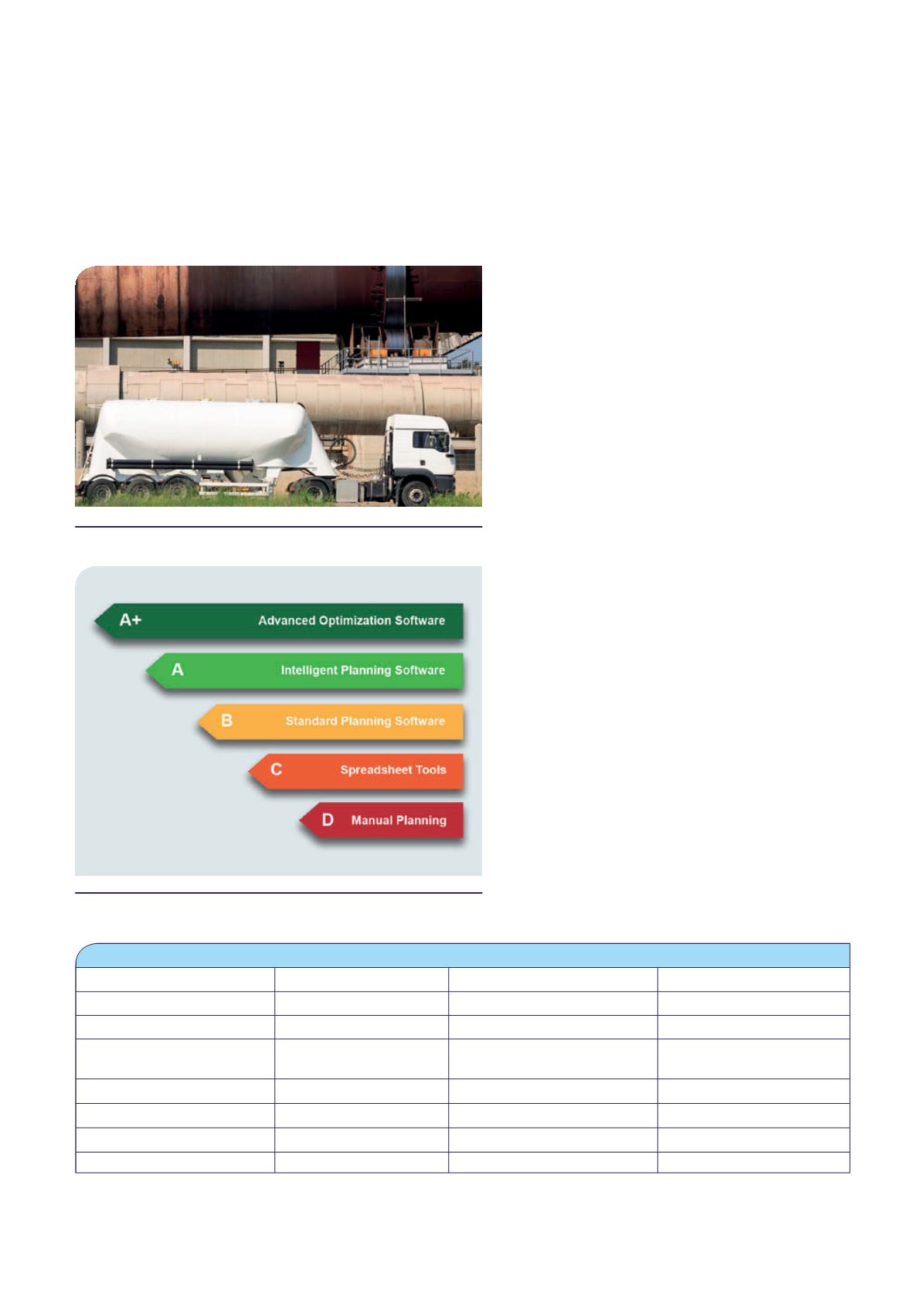
Advanced optimisation reduces fleet costs.
The power and quality of transport planning tools.


