


 70 / 84

North America 2018
68 \
World Cement
which minimises abrasion to the material placed in the
kiln. A smooth surface also provides optimal flow in
and out of the kiln with little resistance.
Wet shotcrete
In addition to cast-in-place, the use of the wet
shotcrete process is popular when lining a large area,
but is the preferred method when installation speed
is critical to maximising productivity and profits.
Contractors use the same mixing and pumping
equipment as for the cast-in-place process but omit the
forms, thus the common name of ‘formless concrete’.
The wet shotcrete method also requires contractors to
use materials specifically designed for being sprayed.
One key difference between the cast-in-place and
shotcrete methods is the need to add an accelerator to
the material as it is discharged through the nozzle and
out the delivery line. This liquid chemical allows the
material to begin setting immediately upon impact as
it is sprayed in place, speeding up installation time and
enhancing quality. Accelerator is pumped to the nozzle
and controlled by the nozzleman, meaning this person
must have adequate knowledge and experience with
chemical accelerators to ensure the material will
adhere to a vertical surface properly and not slump.
One of the biggest advantages of the wet shotcrete
method is that the process is less labour intensive
than cast-in-place methods since no forming is
involved. However, there is more skill required on the
nozzleman’s part to add the accelerator correctly and
properly place the material.
Dry shotcrete
The oldest process used to place shotcrete, or formless
concrete, is the dry shotcrete method, also known as
gunite. The versatility and low cost of rotary gunite
machines have helped simplify this method that for
years used pressure vessel tank machines. Rotary guns
offer some key advantages, including easy portability.
They are also affordable to purchase and maintain,
and it is easy to adjust material flow through the
machine.
In recent years, the introduction of no-cement,
colloidal silica refractory materials has enhanced the
use of the dry process for cement kilns. The gunite
process was typically only used in hard-to-reach
areas of the kiln. Thanks to colloidal silica and its
alkali resistance and bonding properties, gunite
equipment can be used to install refractory in more
areas of cement kilns, where smaller, more specialised
installations are necessary.
Like the wet shotcrete method, the dry shotcrete
process also requires a skilled nozzleman since the
water is added at the nozzle of the gunite equipment
as the material passes through a water jacket.
However, contractors using colloidal silica material
will find that the liquid addition at the nozzle is more
forgiving and therefore is less dependent on the
nozzleman’s skill.
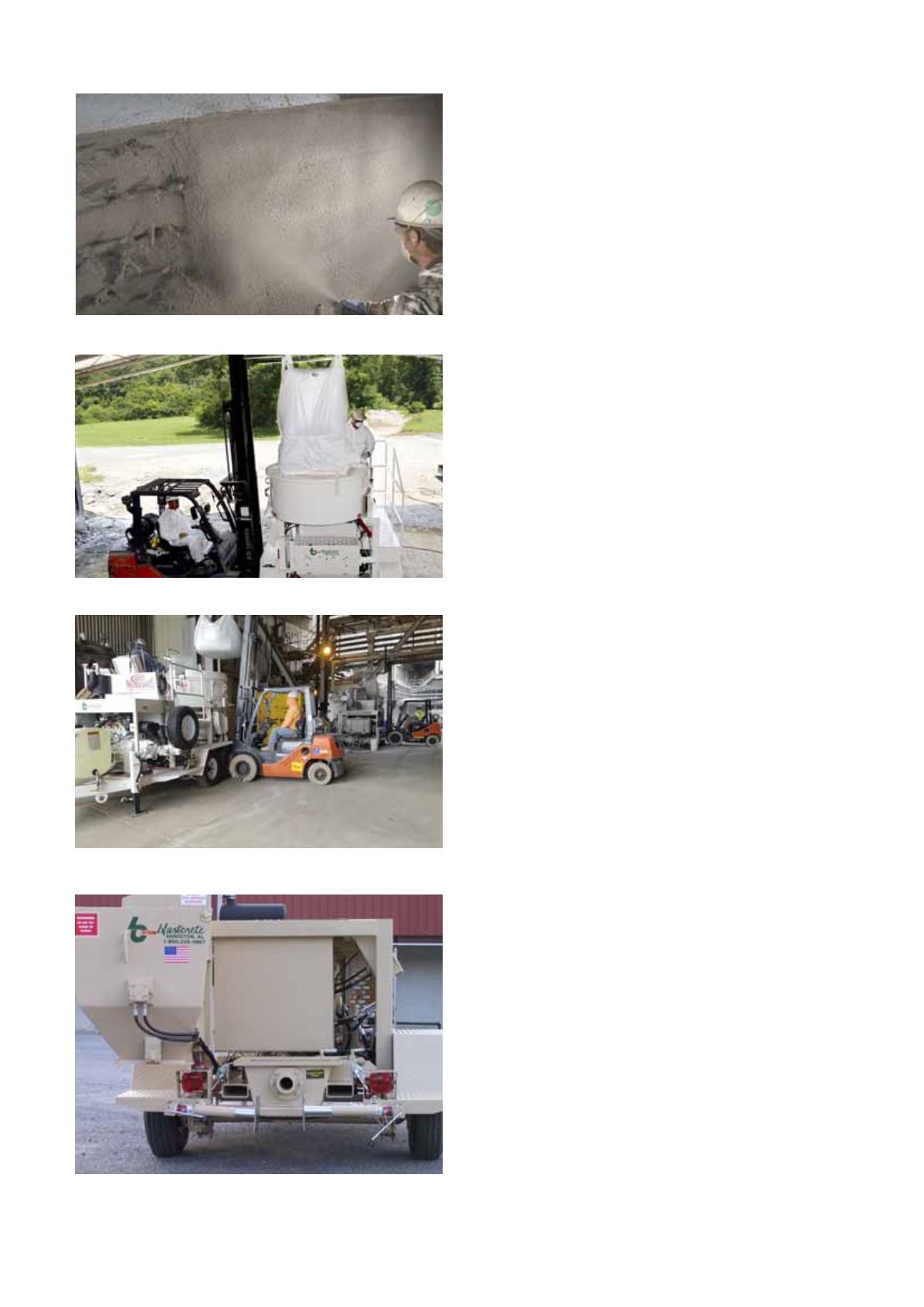
Blastcrete wet shotcrete application.
Blastcrete dust remediation.
Blastcrete one unit.
Blastcrete swing out hopper.