



 66 / 84

North America 2018
64 \
World Cement
measurements and advancing to broader operations.
This paper will explore the evolution.
Of bins and bunkers
The day-to-day life of a cement producer largely
occurs within the bins and bunkers that feed the
plant. Measuring more frequently helps ensure that
supply is readily available and that logistics will
be smoother all the way to the delivery site. Until
recently, however, accurate measurements inside
those bins and bunkers were hard to come by. Low
confidence led to inventory overages and routine
monitoring was difficult.
With the advent of fast and accessible
measurement technologies, a new era of
management is now possible. Beyond just
measurement, materials management becomes a
reality. Here, systems can intelligently interpret data
and convert data insight into action.
For example, data alone might inform operators
of the absolute weight of cement in Bunker B, but
an intelligent system can proactively alert them
when a threshold of inventory has bottomed, telling
the operators just how much more to produce,
based on sales forecasts and orders. This creates
meaningful connections between production and
sales and timing delivery by the job.
Leaders, such as Ozinga and Irving Materials, are
now balancing sales, production, and operations,
which has become as core to their business as
monitoring the mix of cement, aggregates, and water.
As effort and cost falls, more frequent measurements
are a reality to smooth the dreaded inventory
adjustments, financial spikes, and write-offs.
Trend 1: More frequent measurements:
annual becomes hourly/continuous
Stockpile Reports has found that daily measurements,
presented in a pile-centric dashboard, allowed
managers to make adjustments on a day-to day basis,
flattening out spikes and leading to smaller amounts
of ‘just-in-case inventory’ on the ground. They were
also seeing which site or piles needed attention,
addressing those earlier. Viewing how a pile changes
over a week gave them new visual insights that
older, infrequent images could not. By removing
the barriers to frequent and cost-efficient pile
measurement, leaders were gaining a competitive
advantage, allowing them to grow their businesses
with more control and less waste and storage cost.
Stockpile Reports predicts that this will lead to
more frequent measures until – in the near future
– real-time data will be available, wherever and
whenever it is needed.
Trend 2: Evolving measurement
methods
Half a million drones have been registered with
the Federal Drone Registry since December. Over
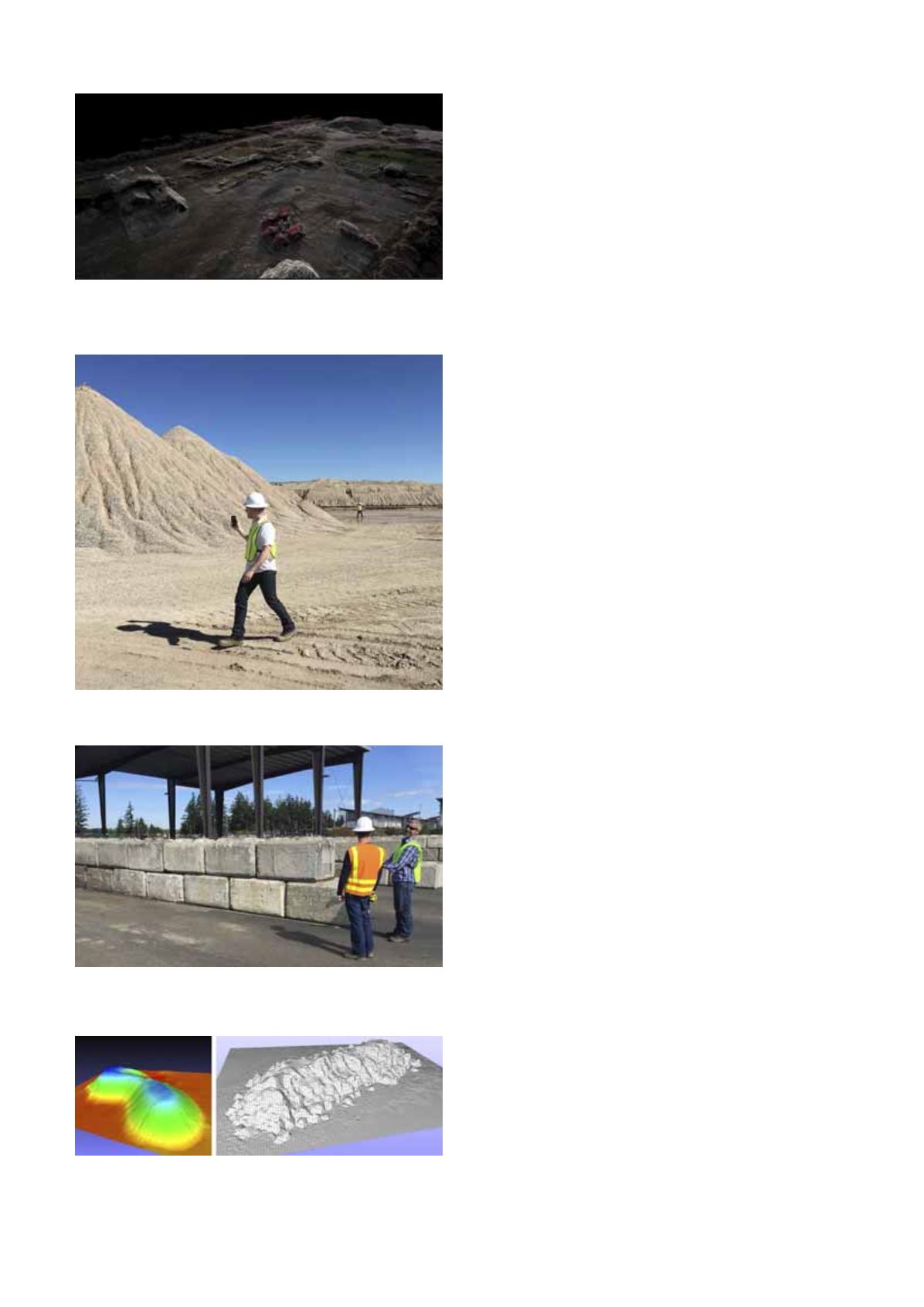
Photogrammetric image of a cement manufacturer’s
site, gathering millions of points in 3D to calculate
characteristics, such as inventory volume and weight.
Circling a pile with an iPhone for accurate inventory
measurements.
It took 65 sec. to measure the contents of this bunker,
after the cones and wall dimensions were entered into
the app.
Additional views of 3D modelling used with density
calculations.