



 77 / 84

North America 2018
/ 75
World Cement
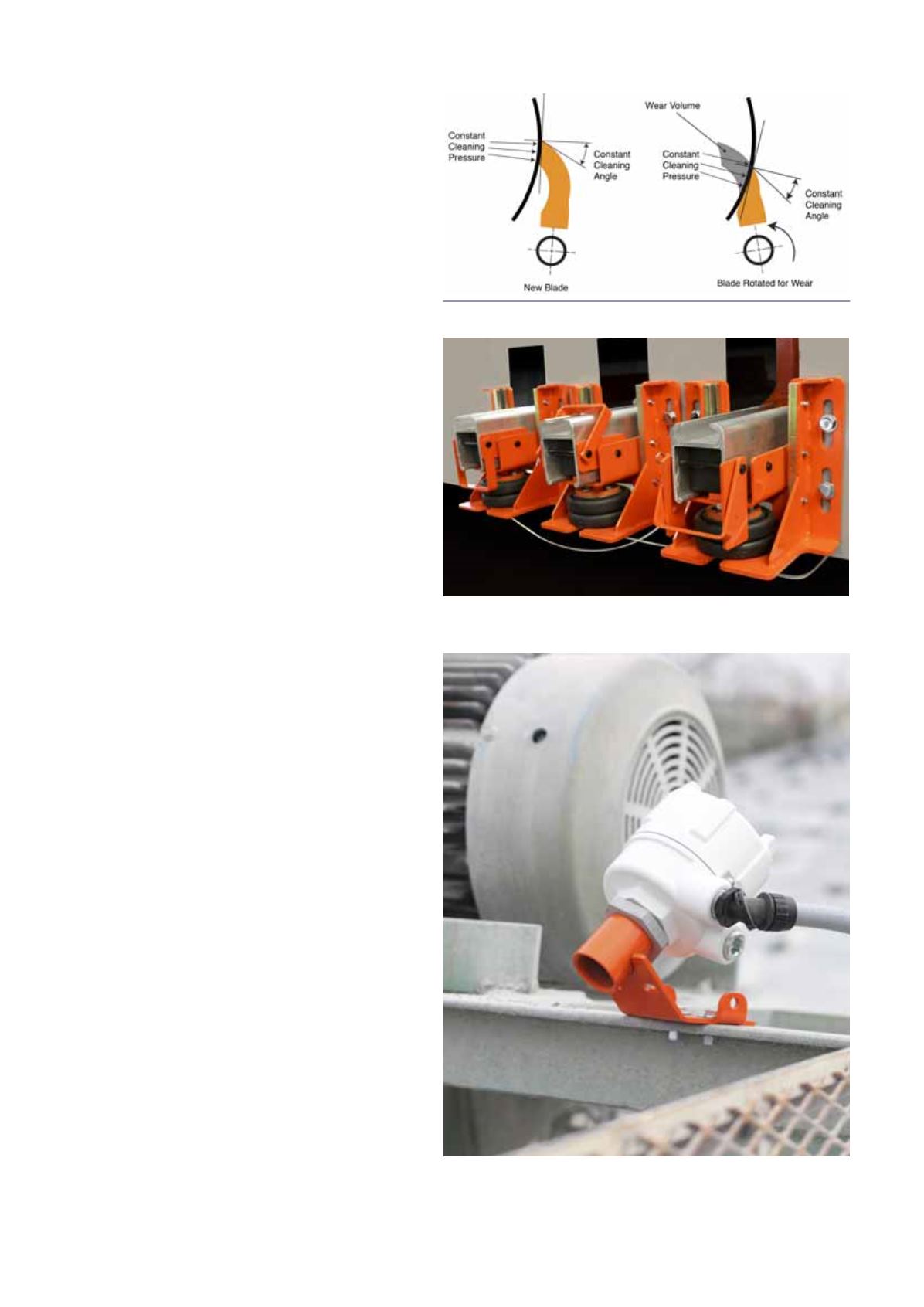
belt cleaner can be designed with a specially
engineered curved blade, Constant Angle Radial
Pressure (CARP). With this design, the changes
in contact angle and surface area are minimised
as the blade wears, helping to maintain its
effectiveness throughout the cleaner’s service
life (Figure 4).
Air tensioning
Mechanical tensioner designs work well, as
long as they are properly adjusted, but in most
cases this requires periodic attention from
maintenance crews as the cleaning blade wears
down. In addition, some operators will loosen a
mechanical tensioner to reduce drag at start-up,
which reduces the cleaner’s performance if it is
not correctly re-adjusted afterward.
In contrast, pneumatic tensioners have
some advantages compared to mechanical
construction. The air tensioner keeps the blade
in contact with the belt. For linear adjustment,
the air tensioner maintains a constant force on
the blade that results in a consistent cleaning
pressure. However, with radial tensioning, the
pressure must be reduced as the blade wears to
keep constant cleaning pressure (Figure 5).
For sites without electricity, systems are
available that can be engineered to generate
their own power from the moving conveyor belt,
creating the energy to run a small compressor
and store the pressurised air in a reservoir tank
to maintain constant blade tension.
One automated pneumatic tensioning system
engineered for belt cleaner applications is now
delivering precise monitoring and tensioning
throughout all stages of blade life, extending
the effective service life of both the cleaner and
the belt. Also equipped with sensors to confirm
that the belt is loaded and running, the system
automatically backs the blade away during
stoppages or when the conveyor is running
empty, minimising unnecessary wear to both
the belt and cleaner. The result is consistently
correct blade tension, with reduced power
demand on start-up, all managed without
operator intervention. Automatically tensioning
cleaners also deliver significant savings in
labour hours, allowing personnel to concentrate
on core business activities (Figure 6).
Installation
A critical ingredient in the performance of any
belt-cleaning system is its installation. Improper
installation will have an adverse effect on how
well the cleaner works, reducing both blade
life and cleaning efficiency. Most performance
problems with belt cleaner systems are due to
improper installation, lack of maintenance, or a
combination of both.
Figure 4. Constant cleaning angle and pressure.
Figure 5. Automatic cleaner tensioning uses pneumatic power
to maintain correct and consistent blade pressure.
Figure 6. Sensors are used to back the blade away during
stoppages or when running empty.