



 120 / 140

November 2018
118 \
World Cement
Techniques (BAT) Reference Documents (BREFs).
6
In the
BREF guidance for cement kilns (CLM BREF), mercury
has a BAT-associated emission level of 50 µg/ Nm
3
for
the half-hour average. However, some countries, such as
Germany, have adopted stricter emission limits.
It is interesting to note that the draft waste incineration
BREF (WI BREF) requires continuous mercury monitoring
and currently stipulates a daily average of 5 – 20 µg/Nm
3
mercury emissions to air for new plants and 5 – 25 µg/Nm
3
for existing plants.
In the US, the Environmental Protection Agency (EPA)
published the final amendments to the National Emissions
Standard for Hazardous Air Pollutants (NESHAP), which
included the Portland Cement Maximum Achievable
Control Technology (PC MACT), in 2013.
7
This required
cement plants to continuously monitor mercury emissions
from September 2015. In 2013, the EPA also published the
final amendments of the Mercury and Air Toxics Standards,
establishing national emissions limitations and work
practice standards for mercury and certain other hazardous
air pollutants from coal-fired and oil-fired electricity
generating units.
The mercury emission standards in the PC MACT apply
to all new and existing cement kilns and are based on
clinker production rates. The limits are 55 lb/t for existing
kilns and 21 lb/t for new kilns. These limits apply to normal
operation and are assessed on a 30-operating-day rolling
average.
Why monitor mercury emissions
continuously?
It may be possible to estimate mercury emissions with
a mass balance calculation but, increasingly, stack
measurements are preferred. In some circumstances,
continuous mercury monitoring will be specified in a
plant’s permit or it may be required by regulations such as
NESHAP; in other circumstances, non-continuous methods
may be allowed. Plants employing continuous monitoring
can generally choose between a continuous monitor or the
sorbent trap method.
Sorbent traps extract a measured quantity of
representative gas through a sorbent filter over a specified
time period. The sorbent is then sent for laboratory analysis
and the final result is determined in conjunction with
measurements of the trap flow and stack flow. The result is
therefore an average emission for the sampling period and,
as such, would not be suitable for shorter measurement
periods. For example, this method would not be suitable if
hourly or even daily averages are required.
Isokinetic sampling can also be undertaken to
deliver a sample for laboratory analysis. All operating
parameters should be captured during the tests,
including gas flow rates, materials used, and system
temperatures.
The recording of process conditions and all testing
parameters during non-continuous monitoring is
essential because this data could help to explain the
cause of any unexpected results.
The main advantage of isokinetic and sorbent trap
sampling is that the initial purchase cost is less than a
continuous mercury monitor (CMM). However, there are
a number of important advantages to be gained from a
CMM:
z
Measures emissions during all process conditions.
Mercury emissions can vary widely for a number
of reasons. As discussed previously, mercury
concentration in the kiln exhaust is affected by
temperature and the return of collected dust to
the kiln. Similarly, the use of kiln exhaust gases for
raw material drying results in mercury adsorption
and contributes to the kiln’s mercury cycle. When
the raw mill is not operating, the exhaust goes
directly to the main filter with little or no mercury
adsorption. Consequently, there will be a rapid
increase in mercury emissions. The mercury content
of the raw material (and fuel) can also vary between
sources and between batches, which will have a
significant effect on emissions. A CMM provides
data alongside all of the process variables, so that
the causes of higher mercury emissions can be
quickly identified.
z
Real-time data.
A CMM provides a constant data
feed without any delay in the provision of results.
Consequently, this data can be used to raise alarms
and inform process control.
z
Less opportunity for error.
Effective stack sampling
relies on the training and skills of the stack tester,
the sample handler, and the laboratory analyst. At
all stages, the sample must be stored correctly or the
result will be misleading or invalid. In contrast, an
automatic CMM offers significantly less opportunity
for human error.
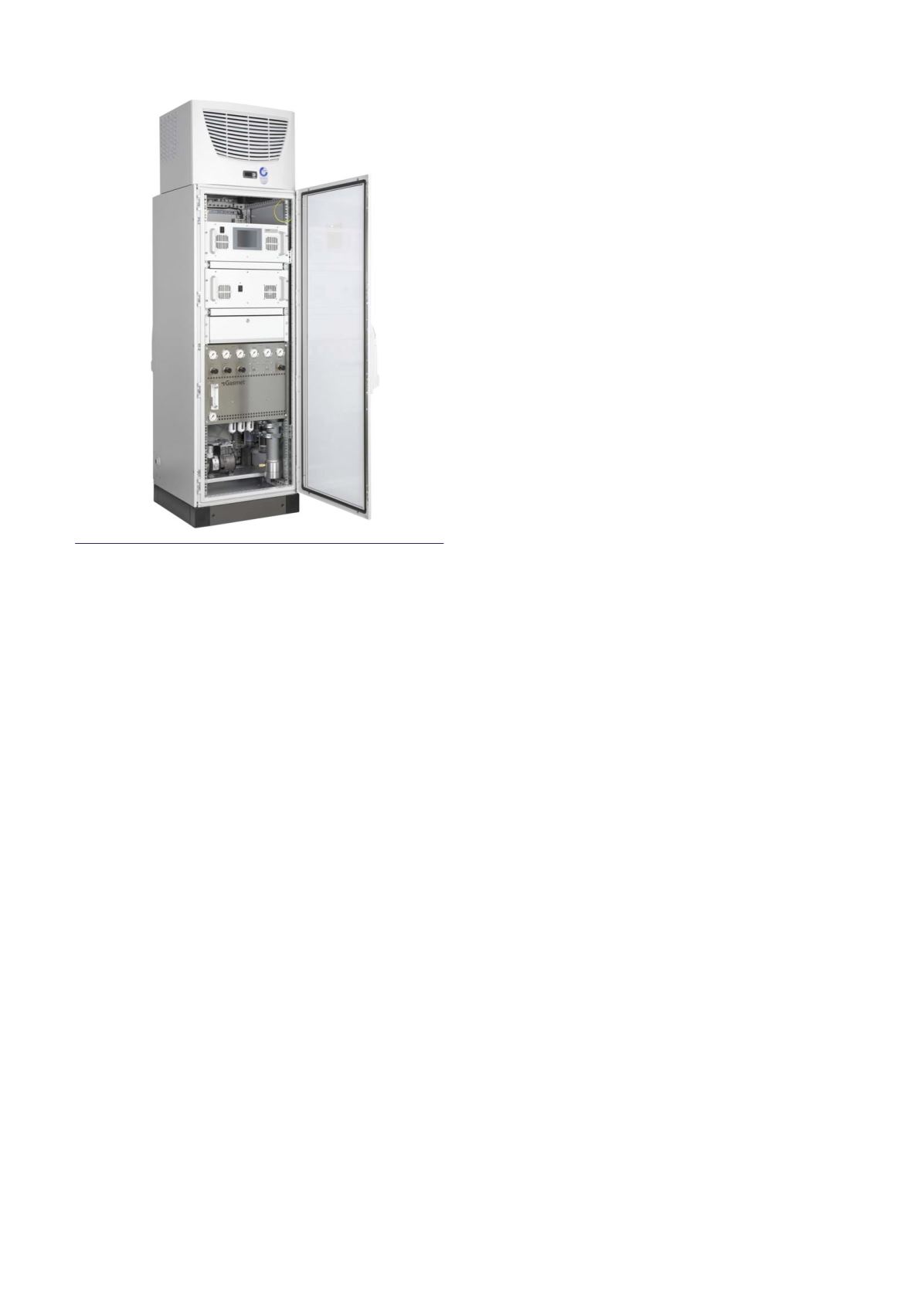
The Gasmet continuous mercury monitor has the world’s
lowest certified range