


 44 / 140

November 2018
42 \
World Cement
As a result of this modified design, the AF
material spreads quite effectively within the lower
calciner section in the presence of adequate oxygen,
as the tertiary air enters at two different heights.
The heavier AF fraction descends into the lower
calciner section, where chips are suspended within
the higher velocity regions of the kiln riser duct,
leading to some reduction of kiln NO
X
.
The light AF fraction, however, is quickly
entrained by the upward flow and commences
burning. The calciner top-section is designed in
such a way that the unburnt AF chips will cycle
round several times in the top SCC section until
a higher burnout of chips renders them light
enough to be entrained by the gases and flow to the
exit.
The AF substitution discussed so far is confined
to small and medium chip sizes. For bigger chips
or whole tyres, several technologies may be
considered for new and existing plants, e.g., the
FLSmisdth hot-disc, Polysius step-combustor, and
AFS’s Skewers.
5
The worldwide applications of these
technologies is limited, not only due to technical
constraints, but also due to other factors, e.g. the
transportation costs of whole tyres, the availibilty of
other AF fractions, and the complexity of efficiently
mixing the fuel and its combustion products with
the riser/tertiary streams, so as to minimise flow
stratification issues. The application of these
technologies also needs careful plant-dependent
assessment for best results, not only to achieve
higher AF TSR, but particularly to optimise the
return on investment.
Conclusion
A 100% AF substitution target, although desirable,
is by itself an insufficient performance criterion.
Optimised performance is highly dependent on
several variables related to the AF, local conditions,
and calciner configuration. Some examples of
recently studied calciner designs and ratings show
achievable AF substitution rates that are wide
ranging. The application of detailed combustion
and calcination concurrent calculations (e.g. MI-CFD)
enable plants to analyse and further optimise AF
firing on short and long term bases. Usually, small
scale and tailored alterations, e.g. fuel injection
location(s)/angles, meal split, or riser venturi bumps,
can be identified to improve the AF substitution
rate and overall performance of a given calciner.
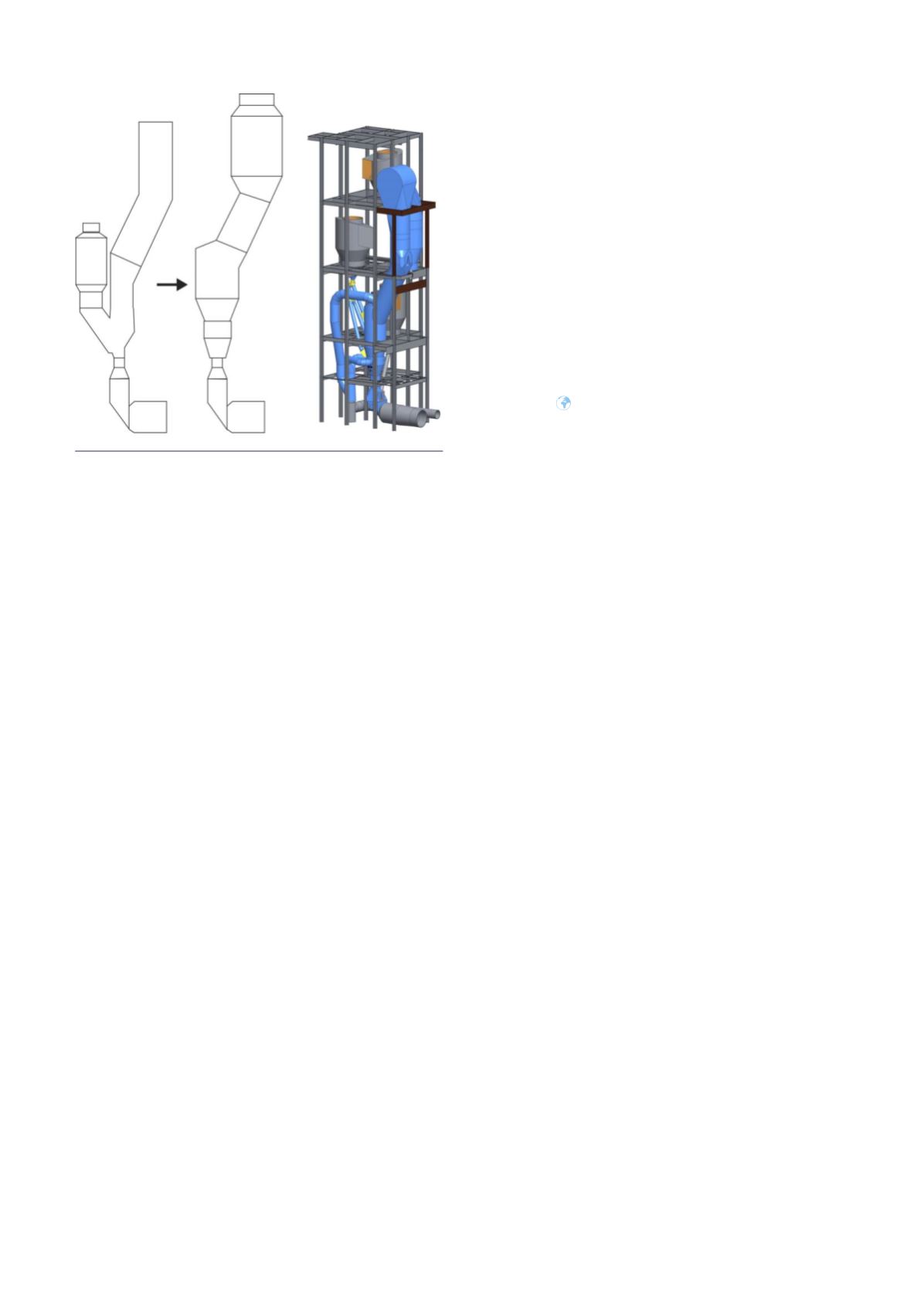
In RSP-type calciners, it is advantageous to modify
the combustion chamber to achieve higher AF
substitution rates, as well as to reduce NO
X
emissions.
References
1. FARUQUE, A., ASIM, M., ABBAS, T., and
AKRITOPOULOS, M.,“Calciner Predictions: Calciner
Performance Improvement Through MI-CFD”,
World Cement
(August 2012), pp. 87 – 96.
2. ABBAS, T. and AKRITOPOULOS, M., “Fuel-Mix
Challenges”,
World Cement
(February 2016),
pp. 41 – 48.
3. AKRITOPOULOS, M. and ABBAS, T., “Insight to the
Inner Workings of the Calciner”,
World Cement
(August 2011), pp. 83 – 89.
4. ABBAS, T., BRETZ, J., GARCIA, F., and FU, J., “Putting
SO2, CO and NOX to the Test”,
World Cement
(August 2015), pp. 57 – 62.
5. AKRITOPOULOS, M. and ABBAS, T., “Thermal
substitution of AF in Calciners: Combustion or
Gasification?” (ECRA, Bradislava; November, 2016).
About the authors
Dr Tahir Abbas is an expert in combustion, emissions,
and process and has been involved in providing technical
services to combustion and mineral industries for the last
25 years. He has worked in industry as a plant engineer,
production manager, R&D manager, and is currently
working as Technical Director for Cinar Ltd.
Dr Michail Akritopoulos studied for an degree in
metallurgy engineering (Mining and Metallurgy
Department, N.T.U.A) and an MSc in environmental
technology (Chemical Engineering Department, UMIST).
He then worked as a researcher for Prof. F. Lockwood’s
Combustion Group, obtaining his PhD in Computational
Modelling of Two-phase flow Combustion in 2005
(Mechanical Engineering Department, Imperial College
London). Following this, he joined Cinar Ltd, and is
currently working as a Senior Project Manager. He has
worked on various projects, mainly conducting CFD
and MI-CFD analysis and consultancy in cement and
lime industry projects (dealing with optimisation of kiln/
calciner burner design, fuel efficiency (conventional and
alternative), NO/CO reductions, and other process related
problems).
Figure 6. Modified configuration of an RSP design, with
an inline concept and SCC chamber at the top.