


 83 / 140

the provision of faster and more regular deliveries, as well as
increased reporting and real-time communications. However,
this was typically expected to be achieved without driving up
transport costs, so it seems that companies face the unenviable
task of having to continually improve service levels, without
eroding already tight margins.
By taking advantage of connected technology that delivers
added transparency using real-time information, it is not only
possible to offer more accurate estimated times of arrival but
also to provide more meaningful customer communications.
Live warnings of any discrepancies – caused by unexpected
issues, such as heavy traffic, vehicle breakdowns, or delays
at a previous delivery point – mean that steps can be taken
to mitigate any potential negative impact. Automated email
or SMS communications are also a useful way to provide
customers with regular updates regarding the delivery status.
Sustainability
According to the Carbon Disclosure Project, cement production
accounts for 6% of global emissions. This has led to calls for
cement companies to invest and innovate to minimise the
environmental impact of their businesses. MPA Cement, part of
the UK Mineral Products Association, has launched a strategy
for the UK cement industry, which targets a reduction in
greenhouse gases of 81% by 2050. The reduction plan will be
met through a series of measures, including cutting transport
emissions, so there is a clear requirement to improve the
efficiency of deliveries to distribution centres and end-markets.
Optimising a transport operation reduces vehicle mileage by
creating the most efficient routes. This not only results in lower
fuel usage and the associated cost savings, but also provides
the added benefit of cutting carbon emissions. On top of this,
the ability to model scenarios using real-world data makes it
possible to see the impact of potentially expensive changes,
such as new depots or the introduction of hybrid vehicles,
before making the investment.
The cement industry is an important element of the
construction sector and is therefore critical to economic growth
in many countries. However, the profitability of the sector is at
risk and it faces significant challenges over the coming years,
as it is forced to adapt and evolve. With this in mind, cement
businesses will need to look at all aspects of their supply chain
to identify clever ways to reduce overheads and their carbon
footprint, while delivering an enhanced service to customers.
Transport management has an important role to play
in meeting these objectives. By optimising planning using
advanced routing and scheduling software, companies can
create a more streamlined operating model to enhance
performance, while keeping costs and emissions to a
minimum.
About the author
As Managing Director of Paragon Software Systems, William Salter
ensures that the company remains committed to developing,
implementing, and supporting software solutions that meet real
business needs. With more than 3400 systems in 61 countries, he is
responsible for directing company strategy, as well as exploring new
business opportunities and new markets.
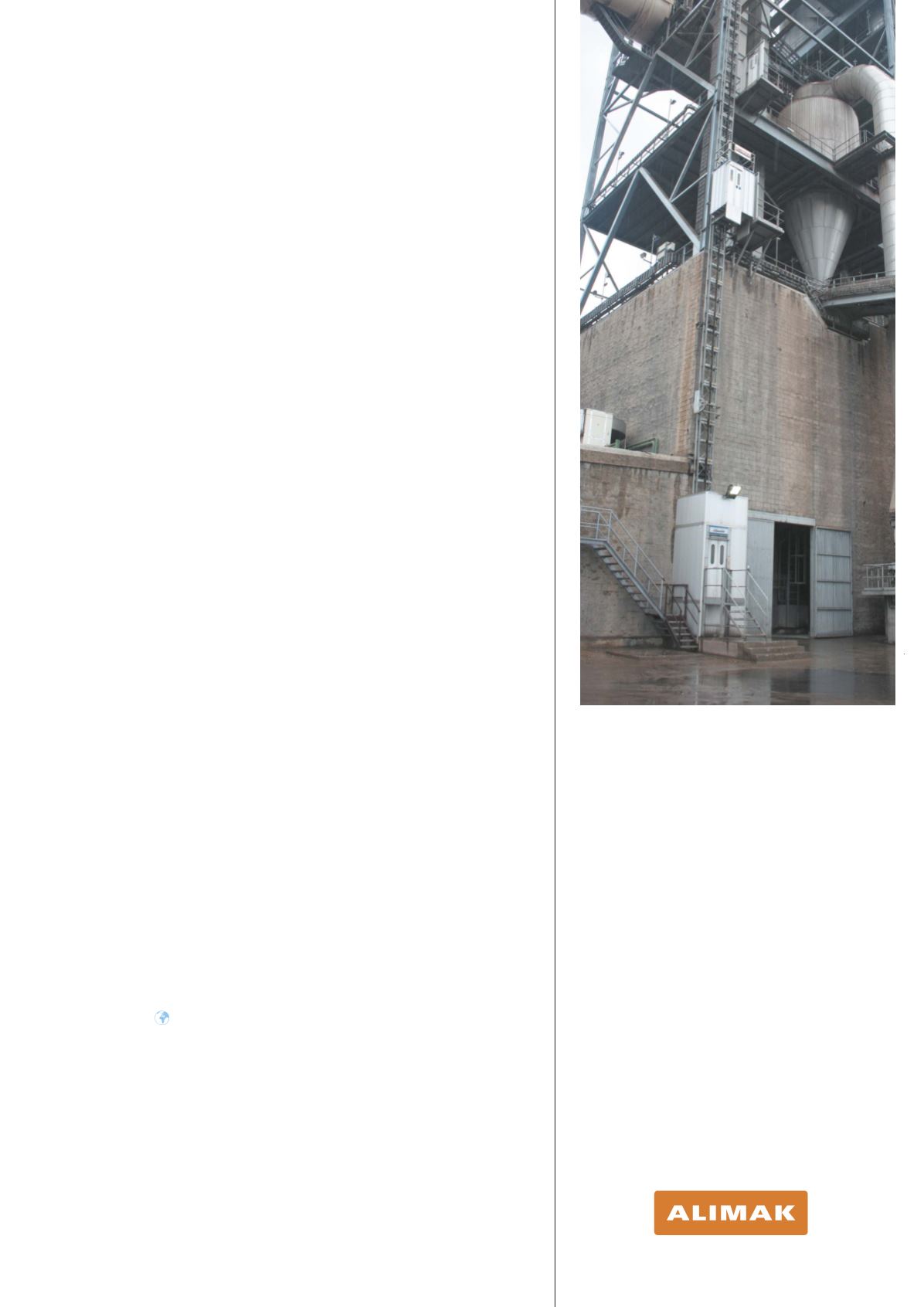
Don’t climb.
Elevate.
Are you paying skilled staff to climb
stairs or to produce cement?
Cement plants all over the world rely on
Alimak rack and pinion elevators to pro-
vide reliable, efficient vertical access for
maintenance and inspection. Designed
to operate in demanding industrial envi-
ronments, outdoors and indoors, Alimak
elevators require no expensive shafts or
machine rooms, and they can easily be
installed on new and existing structures.
Standard capacities range from 300 kg
to 7,000 kg, with up to 24-ton capacity
available upon request.