


 86 / 140

November 2018
84 \
World Cement
Project challenges
In 2015, urbanism service in the city of Rochefort
limited maximum construction height to 15 m. With this
limitation, the parallel piped flat silo was designed and
adopted to replace the normal cylinder silo. From field
investigation, scheme development, discussion, and plan
adjustment, through to final confirmation, the silo spent
a total of six months with tight collaboration between
several parties, ultimately conquering the difficulty in silo
shape.
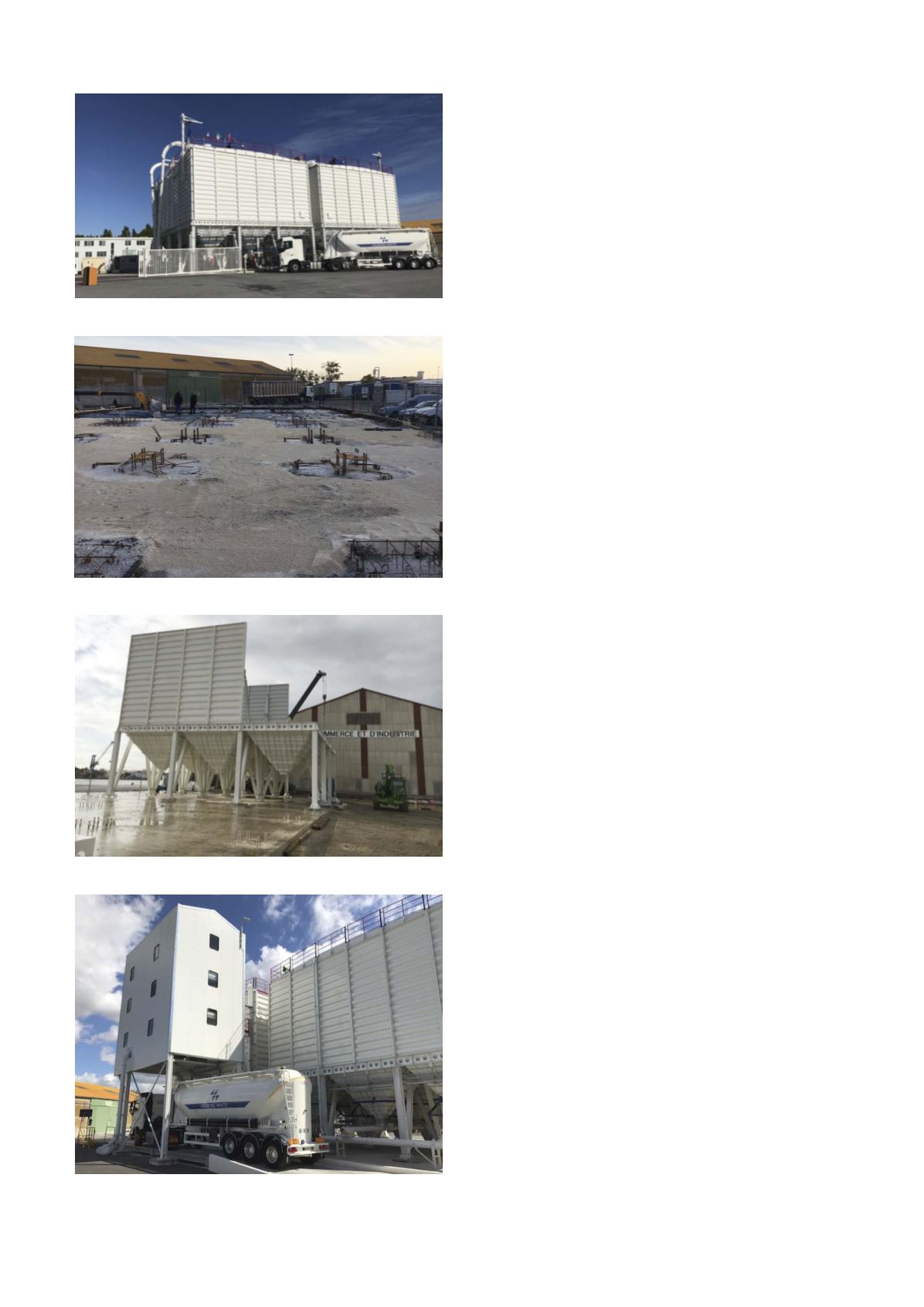
The final plan was to erect two 2450 m
3
metallic cells
next to each other. The unique structure required a 600 m
2
concrete slab to be poured as a foundation. Each foot of
the silo was attached to a concrete block of about 10 m
3
,
which itself rested on between one and three metal piles of
30 m, in order to reach the hard rock under the surface. In
total, 100 piles were used to ensure 6500 t of cement could
be held when the silo was full.
High efficiency and a green white cement
terminal
The construction of terminal foundations started in
August 2016 and lasted for three months. Assembly of
the “huge Meccano” began in December 2016, with 24
bottoms that collect cement. This project was completed
in the middle of 2017. During the same period CCI,
the public administration of the port, installed the
underground pipeline, which connects the shore to the
silo at a 70 m distance.
Up to 3800 t of cement could be loaded from either
traditional bulk carriers or self-unloading vessels to a
cement silo, via an underground pipeline.
A self-discharging vessel could deliver its 3500 t of white
cement in 20 – 22 hours without stopping.
In order to load trucks, the station is fed by two vertical
screws, each of which collects cement from Silo 1 or Silo 2,
via three horizontal screw conveyors placed under each silo.
Thus, the loading of a 30 t cement tank could be completed
in less than 20 min. The aim of the vertical screws is to
convey large quantities of cement, with the purpose of
space saving, easy maintenance, and being pollution free.
High-pressure dense-phase pneumatic conveying
systems are the key technique used to transfer white
cement from ship to silo. To keep a green and dustless
loading process, three air extraction machines pump
6000 m
3
/hour of cement, with inside dust filters, are
installed on top of the two silos. This system successfully
filters out 99.9% of dust.
Unlike grey cement, colour is the most crucial quality
index of a white cement product. This strict quality control
is managed by the Aalborg Cement Quality Center. White
cement quality, including its white colour, is monitored
and controlled in the Aalborg plant throughout the whole
production process. A cement sample is taken to the boat
for conformance testing before being shipped to the
Rochefort Terminal. The cement pipeline is dedicated to
white cement product conveying, meaning there is no risk
of cross pollution. A sample survey of each silo is required
four times each year by the Aalborg Cement Quality Centre
to ensure cement quality.
Aalborg White Terminal in Rochefort, France.
Installation of cement silos.
A safe and reliable automated operation system on
truck loading.
Construction of terminal foundations.