BMHR 2016
10 \
World Cement
approximately
8.15 kcal/kg mixed with 7% sulfur is
dosed and fired for the production of white cement.
Coal dust with a calorific value of approximately
6.20 kcal/kg and 15% flyash is used instead for the
production of ‘grey clinker’, explains Rajesh Khanna,
Head-Technical & Operations of J.K. Cement. Only
two pneumatic rotor weighfeeders Pfister
®
DRW 4.10
are needed for both fuels and manufacturing
processes which are also located in the fuel tower.
One of these is feeding into the kiln, the other one
into the calciner. This flexibility in fuel dosing of
these German-engineered rotor weighfeeders is just
one of the reasons the choice of the plant operators
fell on this brand.
For grey clinker manufacturing the Pfister
®
DRW
rotor weighfeeder for dosing coal dust is laid out
for dosing a capacity of 8 tph into the kiln
and 11 tph into the precalciner burner. For the
production of white clinker the same machines
dosing petcoke are able to dose 8 tph into the
kiln and 8 tph into the precalciner.
Dosing challenges with petcoke
Compared to coal dust, petcoke is far more
difficult in its handling. Petcoke possesses a
higher rate of humidity and has to be ground
much finer than coal dust. Both factors
contribute to its difficult flow characteristics:
petcoke does not flow easily and thus tends
to clog the pre-hoppers. Here, the special
engineering of the Pfister
®
pre-hoppers shows
its full advantage. For J.K. Cement Works
those pre-hoppers were equipped with special
agitators.
“These stirrer-like agitators improve the
material flow by keeping the fuel in motion,
mixing it with air and thus providing for better
flowability,” explains Hassan Jradi, project manager
at FLSmidth Pfister.
What exactly is the trick which enables
these German rotor weighfeeders to dose
these and other pulverised fuels like coal dust,
lignite, petcoke or oil shale with widely varying
characteristics with great stability and constancy?
The trick is actually a combination of the
following technical features.
Firstly, the rotor weighfeeder is engineered
with an inside rotor with chambers. After the
material is extracted out of the silo into the
rotor weighfeeder, it is weighed and dosed
while being transported to the rotor’s outlet.
The number and size of the chambers inside the
rotor are designed and arranged in a proven way
to hold a large quantity of bulk material at the
same time. The rotor body is suspended on two
bearings forming the eccentric weighing axis and
one load cell. The weighing axis is positioned
eccentric to the rotor shaft, and goes through
the middle of the rotor inlet and outlet. The load
cell mounted at the third suspension point weighs
the content in the rotor wheel gravimetrically before
being discharged.
Dosing into continuous process requires a
predictable, reliable material flow that can be
adjusted precisely in order to achieve a stable
production. By the weighing electronics the rotor
speed is controlled inversely to the measured force.
Depending on the set point, the higher the force,
the slower-going the rotor; the lower the force, the
faster turning of the rotor. The prospective control
algorithm ProsCon
®
ensures a precise dosing by
anticipating the variation in flow rate caused by
material density and flowability. This is enabled by
measuring the material weight a long time before
dosing at the measuring point. Taking into account
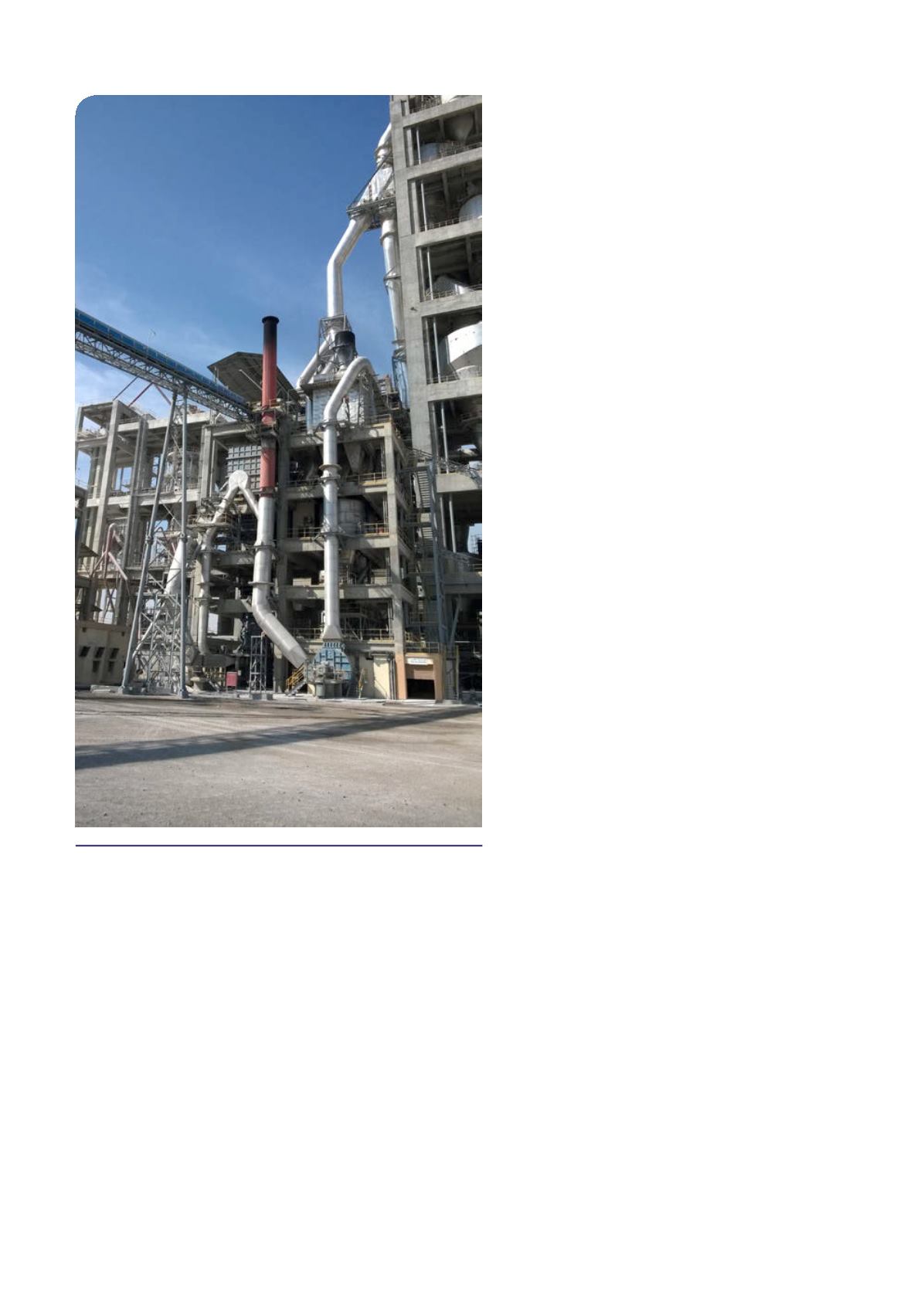
The calciner tower at the J.K Cement Works in Fujairah.


