BMHR 2016
16 \
World Cement
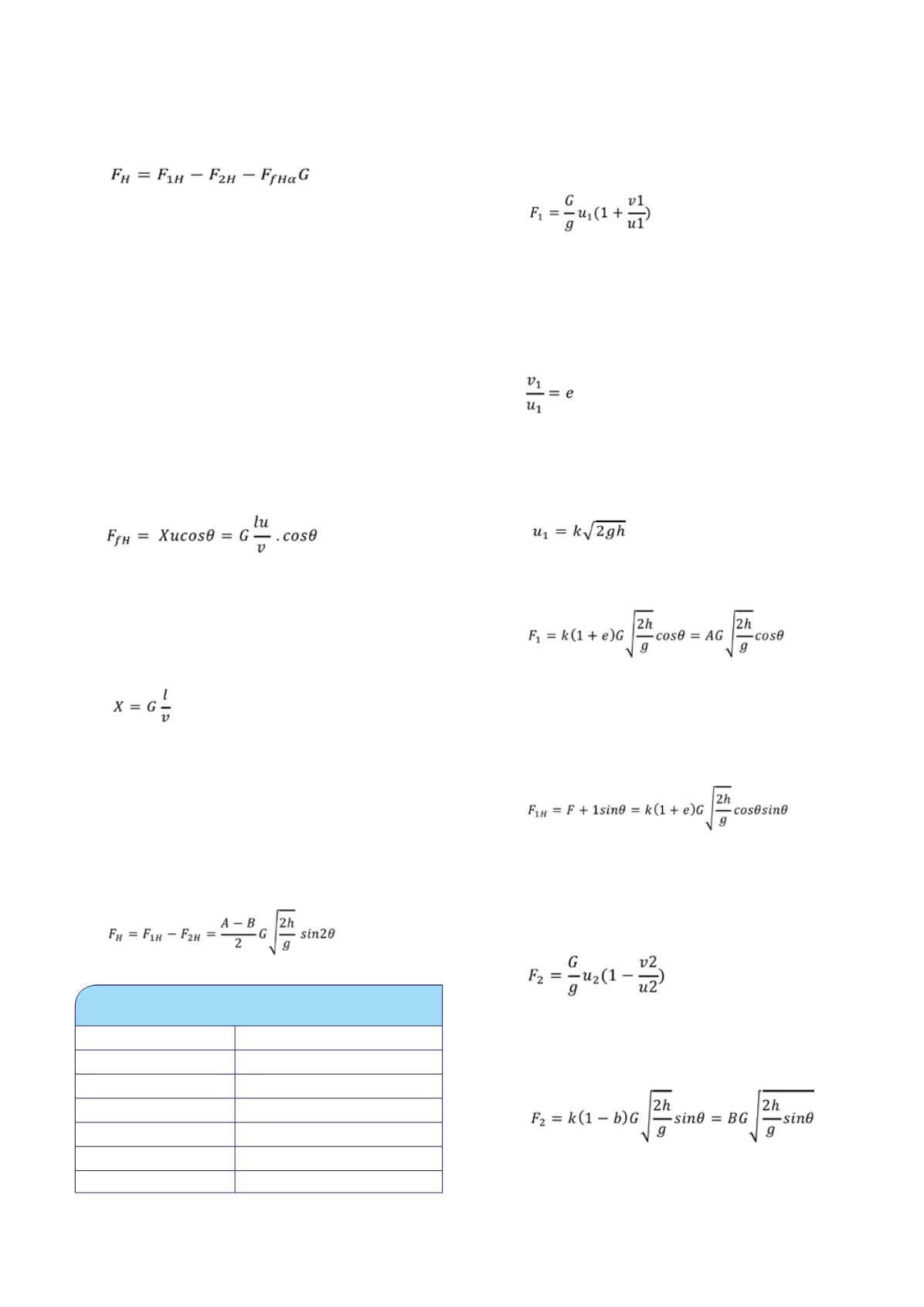
The horizontal force applied to the sensing plate in
applications with material buildup is calculated using
the following equation:
If height (h), the angle at which the impact plate
is inclined (
Θ
), the distance material flows down on
the sensing plate (l), and material properties are
constant, total horizontal force applied to the impact
plate is proportional to the mass flow rate (G) of the
material.
Gravity is vertically exerted at angle
Θ
, and a
horizontal force is not included in the calculation.
Friction between free flowing particles and the sensing
plate generates force (F
r
), which is applied to the
plate in the direction in which the particles flow. If the
coefficient of friction between particles and the plate
does not change, the force is related to the number
of particles that flow (X). The horizontal component
(Fr
H
) of this force (Fr) is calculated using the following
equation:
where u = coefficient of friction.
In applications where particles hit the sensing
plate and flow onto it, some may remain on the plate
(material buildup). Weight (X) of such particles is
calculated using the following equation:
where:
l = distance that the particles have moved on the
plate
v = average velocity at which particles flow on
the plate
The horizontal force applied to the sensing plate
(FH) is calculated using the following equation, based
on the horizontal component of F1 (F1
H
) and F2 (F2
H
).
Horizontal component (F1
H
) of the vertical force
(F1)
The vertical force applied to the plate (F1) is calculated
as follows, taking momentum into account:
where:
u = velocity of impact applied to the sensing plate
v = resultant velocity of sensing plate to initial
position
Assuming that
where ‘e’ is defined as the coefficient of restitution.
Taking air friction into account, and using
coefficient ‘k’ (0<k<1), impact velocity ‘u’ is as follows:
Therefore, the vertical force component will be:
where
Θ
= angle of inclination
Coefficient A = k(1 + e)
The horizontal component F
1H
is calculated using
the following equation:
Horizontal component (F
2H
) of the force parallel
to the plate (F
2
)
The following equation is obtained in the same
manner as above.
Assume v2/u2=B. This is the coefficient mainly due
to friction.
where coefficient B = k(1-B).
Table 1.
Material examples used to determine impact
forces
Material
Impact force (per tph)
Milk powder
21 g
MSG
25 g
Middle bran
30 g
Sand
36 g
Pellet
45 g
Nominal
45 g


