the need for reinforcing the metal parts. The base of the
blade is held in place inside an aluminium cassette.
Metso has also introduced a secondary belt cleaning
system with a tensioning device, the smart, compact
Trellex
®
ABC Z-tensioner, which provides the right pressure
and optimises the secondary cleaning. Fitted immediately
behind the drive pulley, the system removes dirt, dust
and other unwanted material without over scraping or
damaging the belt.
Designing steel structures
Metso has paid attention to the design of elevated steel
structures to support the belt conveyors.
The STAAD.Pro software is used for structural analysis
and design computer programs. It is an FEM analysis and
design tool for any type of project (Figure 4).
Another available software is TEKLA, which creates,
combines and distributes detailed, constructible 3D models
(Figure 5). Models with plenty of information can be
created, allowing production control, collaborative and
integrated project management and delivery.
TEKLA provides a model interface with machinery and
project management. These models represent a true view,
detailed shop drawings and as-built structures.
This software handles all kind of structures. It compiles
all information in an offshore project M4D, allowing the
visualisation of structural members, welds, bolts, weights
and the centre of gravity.
Another consideration is modular fabrication and
construction that offers a number of advantages. The
fabrication and assembly of steel structures is performed
by a shop manufacturer close to the customer job site.
This ensures that all work is performed according to high
standards under controlled working conditions. Reducing
fieldwork also helps minimise the project impact at the
customer’s site.
The modular construction results in fewer fitting errors
and rework because all necessary components can be
pre-fitted prior to shipment. Requirements for highly skilled
labour onsite are minimal, an advantage in areas where
skilled labour is either costly or unavailable. In addition, the
modular construction can shorten schedules by allowing for
concurrent processes, such as fabrication, permitting and
logistical arrangements.
Conclusion
Year over year, the market for belt conveyors is requiring
longer transport distances and larger material volumes
to be carried. This increases the demand for strong and
efficient conveyor systems that can reliably operate 365
days a year under the most extreme operating conditions
around the world. Conveyor systems continue to be the
most efficient means of transportation, as they are still
the least expensive method to handle bulk materials with
a relatively small power consumption. There is no doubt
that more research and innovation will be carried out
in upcoming years to enable conveyors to become even
more efficient. However, belt conveyors will continue to
retain a strong role for a long time to come.
SOME THINK
LONG-DISTANCE
TRANSPORT IS
INFRASTRUCTURE-
INTENSIVE.
WE THINK
DIFFERENT.
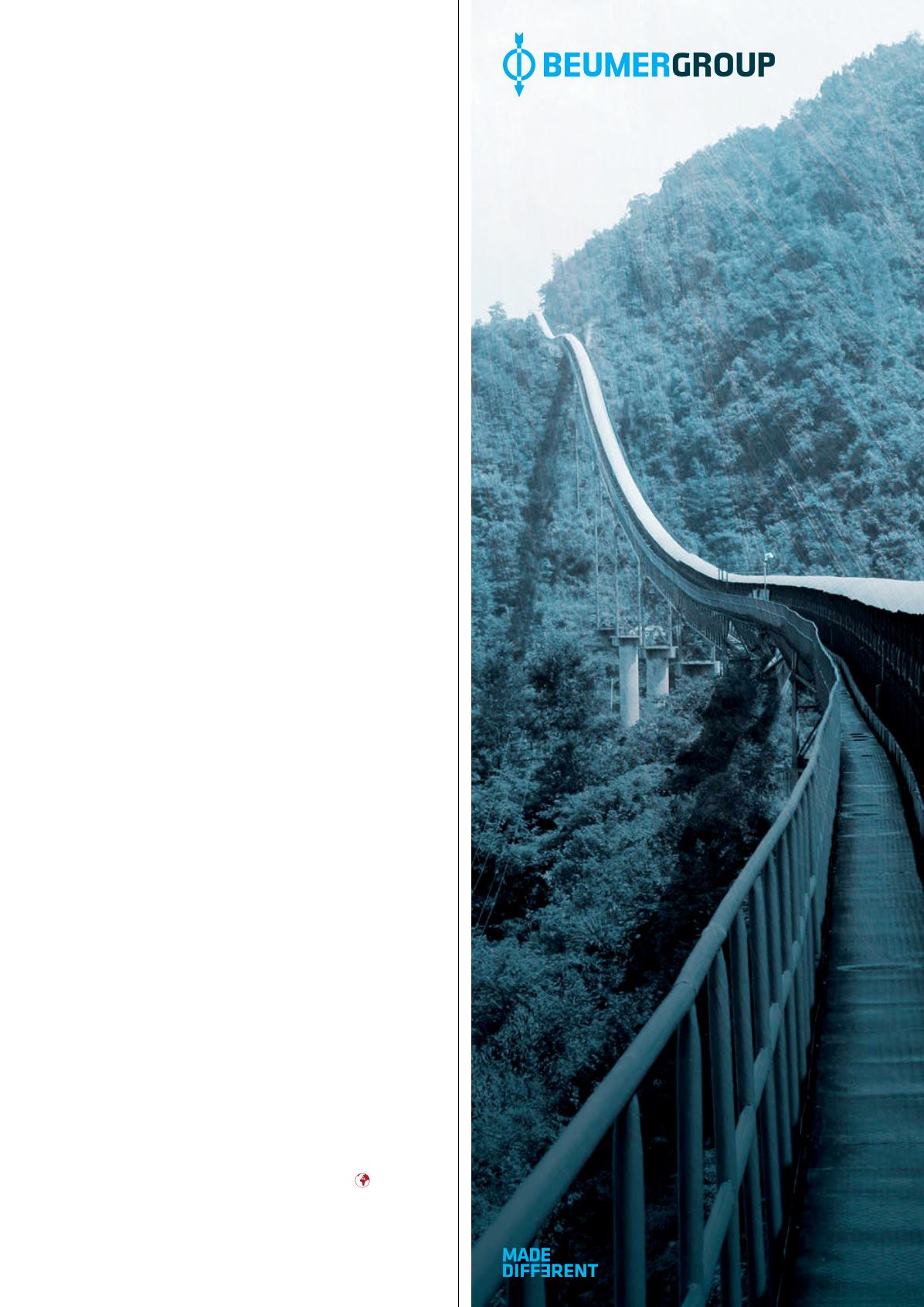
Transporting materials from remote locations has tradition-
ally required significant infrastructure investments in road
or rail links, vehicles, personnel and fuel. BEUMER oers
an economical, ecient and environmental alternative –
long-distance overland conveying. This gives you a dedicated,
around-the-clock transport link at the fraction of the cost
of infrastructure development. The reduced noise and air
pollution minimises environmental impact and improves
personnel safety. Add to that a high degree of design flexi-
bility and customisation and you can see why overland
conveying makes a big dierence to operational eciency
and environmental protection.
For more information, visit


