


 50 / 84

North America 2018
48 \
World Cement
Cement mills
Four identical VRM systems are used for cement grinding.
Each system can produce approximately 165 tph of
Type I/II cement at 3800 Blaine. The installed gear
reducers and motors are identical in size to the raw mills,
thereby enabling commonality of spares.
The system utilises recirculated gases and bleed
air to make up the required volume for drying and
conveying the ground material through the mill. The use
of de-dusting cyclones
–
and corresponding large recycle
rate
–
reduces the system bag filter size requirement. Hot
gas generators are available for start-up and wet additive
or extreme winter conditions.
Emission control systems
The plant is designed to meet emission limits that are
among the most stringent in the world. In addition to
the pyroprocess being inherently designed for low NO
X
and CO emissions; selective non-catalytic reduction has
been incorporated in the system. NO
X
emission levels
as low as 380 mg/Nm
3
at 10% O
2
(1.6 lb/STcl) during the
summer ozone season are required. A hydrated dry lime
injection system is used to reduce SO
2
emissions created
in the preheater by the combustion of pyritic sulfur in
the raw materials.
The preheater system diverts up to 20% of the kiln
feed to each string directly to the calciner for the control
of volatile organic compounds. By this method, VOC
emissions that evolve from the meal are completely
burned in the calciner.
Substation
The 160 MVA substation is completely redundant in that
either transformer lineup can fully supply the plant. Power
is supplied from the national grid at 345 000 V, creating
an extremely stable supply at plant working voltages.
Incoming voltage variation averages less than 0.2%.
Central control room
The control room, which handles all plant operations
except for cement loading, has a direct view of the
pyroprocess line and monitors other systems via cameras.
Normal shift staffing is two operators with an additional
trained team leader providing leadership in the field.
Quality control laboratory
The fully robotic laboratory includes 10 field samplers with
associated sending stations and two cross belt analysers.
The first cross-belt analyser checks incoming limestone
for calcium and silica content and wirelessly directs each
100 t haul truck to the proper loading area. The second
cross-belt analyser controls raw-feed mix by weighfeeder
control of clay, fly ash, sand, mill scale, and limestone. The
10 sample points include blended raw meal from each
silo, kiln feed from each preheater string, clinker from the
cooler, and cement from the four finish mills.
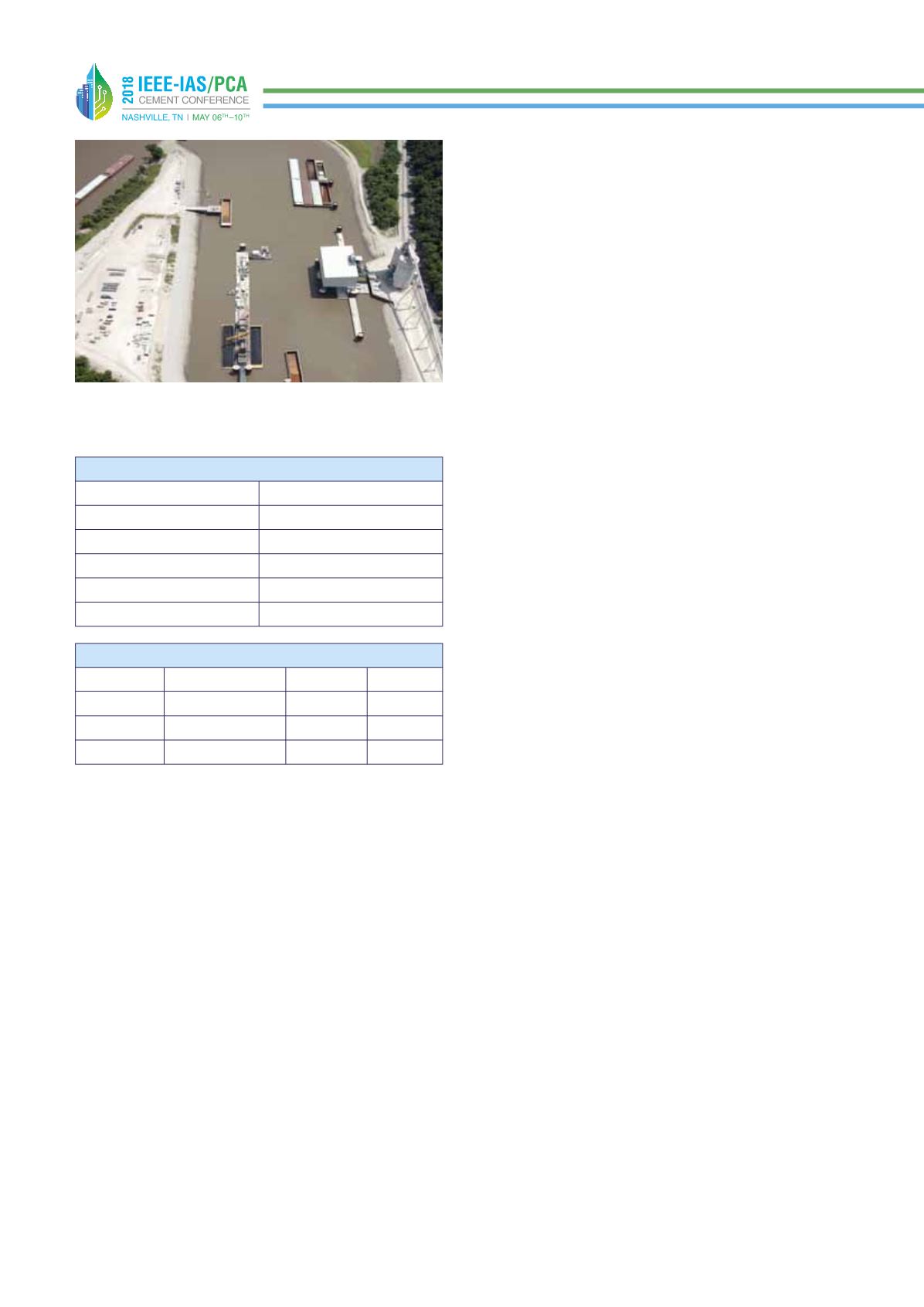
Slack water habour
The plant has a 1000 ft by 400 ft terminal on the
Mississippi River for loading/unloading up to 6 million tpy
of materials. For in-bound materials, the slack harbour
facility can unload more than 2 million tpy through a
pneumatic system for fly ash and hydraulic crane for
granular or lumpy materials, which are then transported
to plant stockpiles via conveyor belt systems.
For cement loading, a four-spout, two-lane
barge-loading system simultaneously loads two 1500 t
capacity river barges side-by-side at approximately
700 tph each. During peak shipping season, the harbour
operations can usually load and dispatch around
12 barges (18 000 t) in two 12 hour shifts. Rail
loading is also handled at the harbour at a rate of
approximately 500 tph.
Environmental stewardship
“The plant is performing exceptionally well and
has met and continuously exceeded all operational
compliance requirements since its commissioning,”
said John Goetz, Ste. Genevieve Plant Manager.
The plant’s 600 ft wide by 1500 ft long harbour on the
Mississippi River can load/unload up to 6 million tpy of
materials.
Table 1.
Ste. Genevieve construction facts.
Man-hours
>7 million
Excavation
>6 million m
3
Structural steel
>15 000 t
Concrete
>18 000 yd
3
Preheater height
>400 ft
Equipment
>26 000 t
Table 2.
Some of the largest slip form silos ever built.
Rated capacity Diameter Height
Raw mill
2 x 15 000 t
60 ft
275 ft
Clinker
2 x 90 0000 t
150 ft
200 ft
Cement
8 x 32 500 t
74 ft
274 ft