


 46 / 84

North America 2018
44 \
World Cement
Bajaj. This programme has had upper management
support from its conception and has sustained and
matured along with the plant. Part of Nissan Smyrna’s
success can arguably be attributed to the partnership
with ENERGY STAR and its ability to break down
traditional barriers, allowing Nissan to benchmark
energy projects and strategies against its competitors.
In addition to energy, Nissan Smyrna has a strong
focus on employee engagement and operational
energy improvement. “We have achieved this
through methods, such as general awareness training,
internal communications, energy treasure hunts,
in-plant training by the US Department of Energy,
and ISO 50001 certification,” added Bajaj.
Better building, better plants challenge
Nissan is committed to reducing its energy intensity
by 25% by 2020 and achieved its initial target of 25%
six years early back in 2014. In addition to energy,
Nissan Smyrna participated in the Better Plants
pilot for water, and achieved its initial 2% target
in one year. In 2017, it recommitted to the Better
Plants Challenge with an additional 15% decrease in
reductions in energy and water intensity by 2022. This
commitment aligns with Nissan’s global programme
for environmental performance, the Nissan Green
Programme (NGP).
“We plan to achieve our new NGP and Better
Plants Challenge targets by continuing to look for
ways to improve our active management of energy
consumption through behavioral education and
discipline,” said Bajaj. “This will be achieved by
implementing capital projects to improve the energy
efficiency and reduce the amount of energy required.”
Community spirit
Nissan has worked hard to foster and develop a
lasting and mutually beneficial relationship with
its surrounding community. “We have a very good
working relationship with the middle Tennessee
community and Rutherford County where the Smyrna
plant is based,” stated Bajaj. “In the 35 years Nissan
has been in Smyrna, we have worked closely with
the local and state government officials, the local
business community, and the non-profit organisations
to ensure a good understanding”.
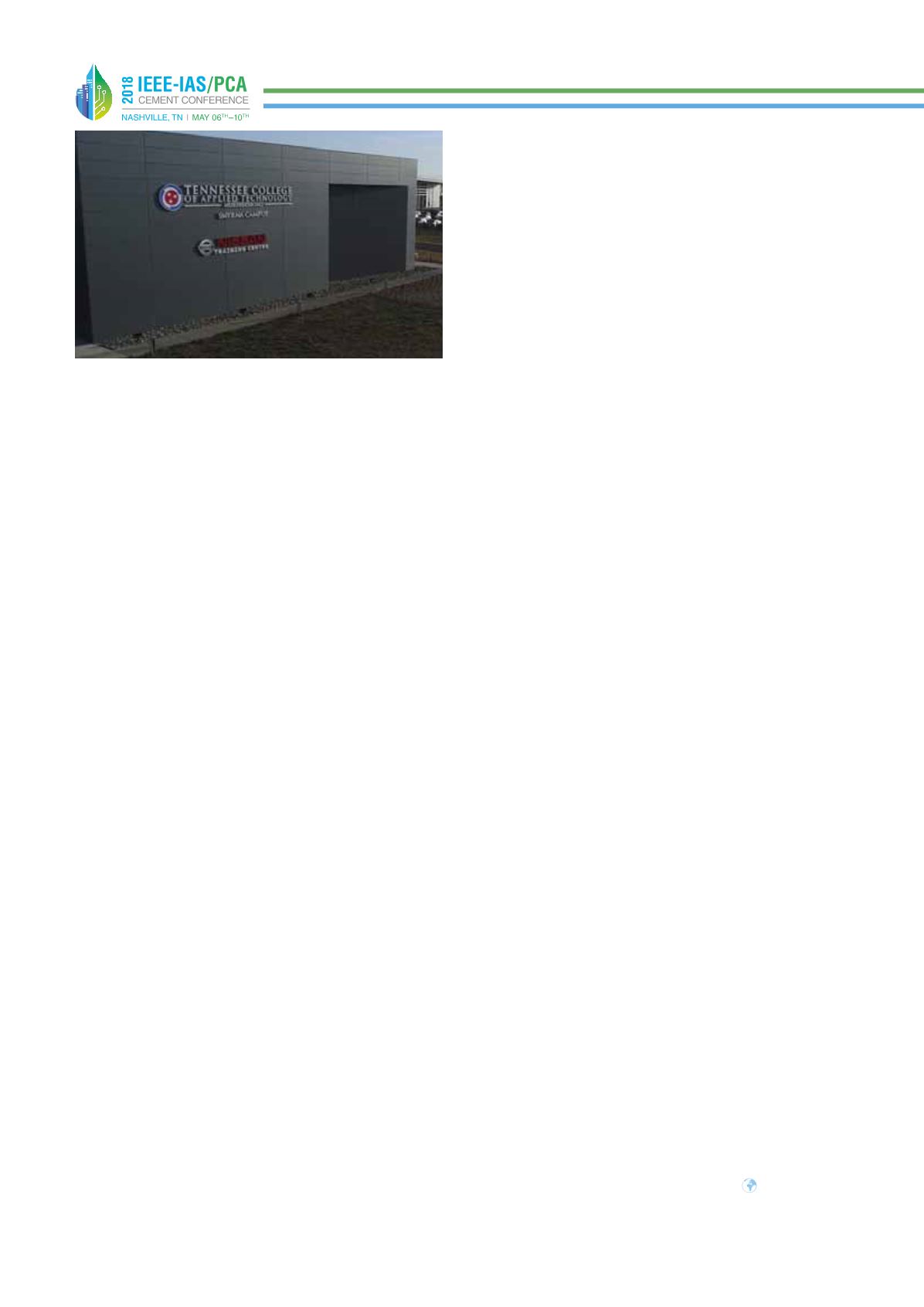
In 2017, Nissan and the state of Tennessee opened
the new Tennessee College of Applied Technology
Smyrna Campus and Nissan Training Center directly
opposite the plant. The state-of-the-art centre is a
public-private partnership that creates educational
opportunities that are closely aligned to Nissan
Smyrna’s current workforce needs. It is jointly
occupied by Nissan and the College of Applied
Technology.
Nissan also works closely with various local
community projects and charities, including United
Way of Middle Tennessee, Habitat for Humanity, and
Second Harvest Food Bank, to develop closer bonds
with its neighbours. Nissan employee volunteers
devote thousands of hours annually with area
schools mentoring children, building homes in
Rutherford County through Habitat for Humanity
and assisting a wide variety of other community
organisations.
Core values
At the heart of Nissan Smyrna’s values is a strong
focus on the safety of its workforce. “Health and
safety is our core value and top priority,” stated Bajaj.
From management to individual employees, Nissan
commits itself to reinforcing its strong safety culture
through focus on prevention, guidance by standards
and policies, and embracing best practices. “We
maintain a safe and healthy working environment
by incorporating built-in safety ergonomics in our
operations”, added Bajaj.
Leadership engages employee participation in
safety with the mechanisms, time, and resources
necessary to participate in safety committees, safety
days, and focus groups. “Safety training, auditing,
risk assessments, buy-offs before equipment
commissioning, implementing control measures, and
leadership floor walks are some of the various tools in
our safety tool box here at Symrna,” concluded Bajaj.
Employees are also empowered to address and initiate
potential safety improvements through participation
in safety committees.
Conclusion
After its celebration of the production of 150 million
vehicles globally, Nissan’s growth is represented in
the successes of Nissan Smyrna. With a workforce of
over 8000, an annual capacity of 640 000 vehicles,
and a community impact of over US$290 million,
Nissan Smyrna has developed a long-lasting and
economically stable connection within the automotive
world and the Tennessee community.
Nissan and Tennessee Board of Regents joint facility to
train the manufacturing, automotive, and technology
workforce in mid-Tennessee.