



 64 / 84

North America 2018
62 \
World Cement
to the fluidising of the entire amount of material in
the storage space. This changes the way the material
behaves and how it exerts force on the silo structure.
This can lead to issues of overstress of silo walls.
Hopper connections to the wall
Depending on the material stored, the silo is likely
to have a conical hopper constructed of steel plates.
The connection of this steel cone has caused issues
as well. Some engineers try to resolve the forces in
the silo wall with embedded plates, and significant
reinforcement in the wall. This can be problematic,
as the construction of the silo wall, whether slip
or jump formed, is a difficult process, and heavy
reinforcement and embedments are difficult to place
properly and have to be consolidated by concrete.
Additionally, the silo wall is almost never perfectly
round. A further problem is that the conical hopper,
which is constructed of many individual pieces of
steel plate that have been cut and bent, will often
not fit together properly, a problem when the silo
is already not perfectly round. Cases of joints that
were to be ¼ in. wide being more than 1 in. or more
have been seen.
If this is the type of silo you have, it should be
closely monitored. However, if you are building new
silos, use a reinforced concrete ring girder and have
the hopper attached to the ring girder with headed
studs, or use an elevated floor. Pilasters or columns,
depending on the silo size, arrangement, and other
considerations, can support these.
Interstices
Interstices are the spaces that are formed between
silos when arranged in a group. Typically, these are
star shaped when four silos are placed in contact
with each other orthogonally. These spaces, which
naturally arise when building a group of silos, are
tantalising to owners for use as storage.
But it is not free, as the use of interstices
completely changes the behaviour of silo walls. Now,
instead of material uniformly applying pressure on a
circle outward, material is pushing against a quarter
of the silo wall in the opposite direction. Some
engineers in the past believed this caused the silo
wall to act as an arch with infinitely stiff ends
(at the common walls), but the reality is that the
wall bends, with only partial fixity at those common
walls. This has disastrous results, which are sometimes
manifested only when an owner realises that product
A that is stored in an interstice, is coming out of
adjoining silo B. Upon inspection, it is realised that
the interstice wall has failed, allowing material
contamination and causing significant structural
issues. Additionally, silos with interstice use can lead
to issues with roof beam bearings, which could cause
collapse of the entire silo roof.
How to solve this problem? First, if you are stuck
with an older group of silos, you may be lucky and
not have issues. Otherwise, the abandoning of
interstices is typically the solution of choice: repairs
to interstices typically do not provide significant
return on investment, and continued use of
interstices threatens the silo groups as a whole.
Or, when you are designing a new group, ensure you
have an engineer who understands the issues and
design methodologies.
Conclusion
There are more discussions to be had, including
concrete walls versus steel, differential settlement,
whether to use single silos or groups, large diameter
clinker silos or multiple silos, attachments/platforms
on the side or underside of silos, and more could be
raised. But the point is clear: silos are complicated,
and require qualified and experienced engineers,
contractors, operators, and inspectors to work
together.
About the author
Gerry Lynskey started SSI Consulting five years ago with
one goal: being a trusted partner of industrial clients. His
experience includes the inspection of thousands of silos with
multiple cement production companies, as well as design for
both new and repair projects.
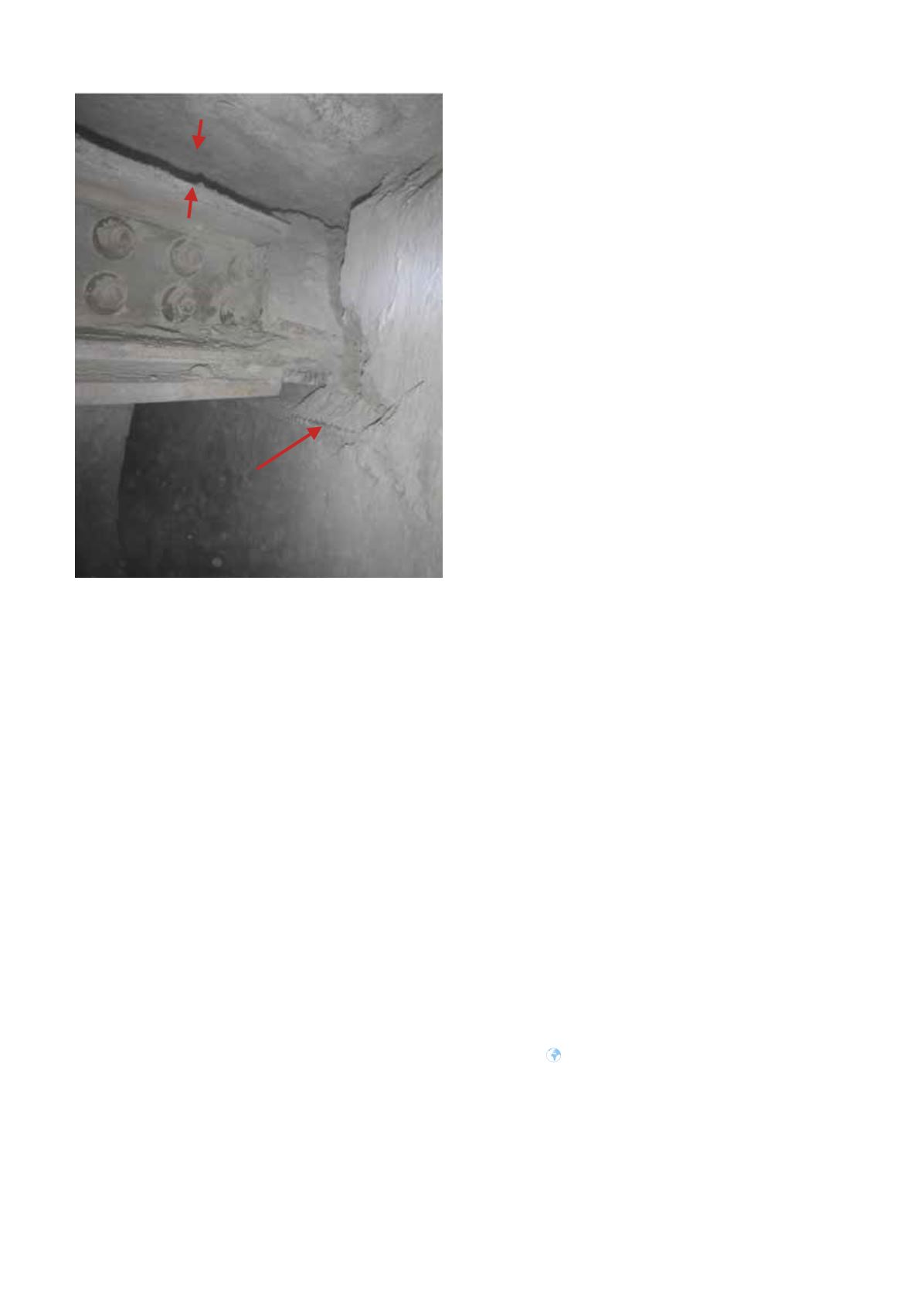
Roof support beam bearing deterioration is a serious
issue that can be caused by several factors, including
asymmetric flow, differential settlement, use of
interstices, and more. It can lead to loss of support for
the roof slab which has caused the collapse of the silo
roof in certain circumstances.