


 100 / 140

November 2018
98 \
World Cement
environmental challenge posed by the need for a
quarry expansion at the plant in Troutville, Virginia.
New quarries often result in impacts that ordinarily
require mitigation bank payments to the regulators.
In line with Titan America’s corporate sustainability
doctrine, RCC developed a ‘local impact, local
mitigation’ philosophy that earned plaudits from
regulators and community critics alike.
The resultant mitigation project, beginning in
2013, was a yearlong creation of a 200 ft riparian
buffer along each side of a two-mile stretch of
Catawba Creek, which runs through the RCC plant
property. However, the buy-in from the Virginia
Department of Environmental Quality and other
onlookers began years earlier, through its familiarity
and comfort with RCC’s environmental stewardship.
Titan America’s RCC plant is located in the pristine
Roanoke Valley, between the Appalachian and Blue
Ridge Mountains – a popular destination for biking
and hiking enthusiasts. The plant can be seen from
nearby hiking trails and locals and visitors accept its
presence in the landscape, speaking approvingly of
RCC’s interest in the value of outdoor activities.
One of the earliest steps RCC made, in 2001,
was to establish a right of way for hikers to
cross its property on the Andy Layne Memorial
Trail, named for a legendary Appalachian Trail
hiker. RCC’s generosity is the main reason hikers
have accessibility to this restored section of the
Appalachian Trail and the nature settings they
desire. In turn, the feedback that employees received
from this good deed provided added incentive for
change on the plant campus.
After evaluating the cement-making process with
programmes and procedures in place to mitigate
potentially adverse effects on the environment, the
plant staff pinpointed mineral extraction, energy
consumption, and air quality as areas with the
greatest potential for impact. In the early 2000s,
plant managers and staff began meeting biweekly
to discuss progress in these areas and spot possible
future issues.
“RCC’s plant sits in the Roanoke Valley, in
the shadow of the Blue Ridge Mountains,” said
Chris Bayne, Roanoke Cement’s Energy Manager.
“The stakes are higher for us, surrounded by all that
beauty, to perform at the pinnacle of the cement
industry in energy efficiency.” The sustainability
programmes were driven by Titan America’s
Corporate Social Responsibility values and led by
managers within the company and the plants, who
take positive environmental impact seriously.
Developing ecosystems
Specific examples, like the ones at RCC, demonstrate
the commitment of Titan to its sustainability efforts. At
the Virginia plant, a long-abandoned onsite limestone
quarry was developed, through ground water inflows
and rainfall, into a six acre lake. Trout have prospered
in the new lake and provide a compelling recreation
site for employees, community guests, and students
at an annual fishing day, as well as during workshops
with Trout Unlimited. The reclaimed pit provides
another 8400 ft
2
of land for restoration.
In 2009, the reclaimed quarry became the
centerpiece of RCC’s Trout Pond Restoration
Project, a longer-term initiative to create a
sustainable ecosystem. A local college consulted
on a biodiversity study, leading to soil placement
and selected native plant species. Birdfeeders,
birdhouses, and beehives have been installed to
attract wildlife. Across the plant’s campus, an
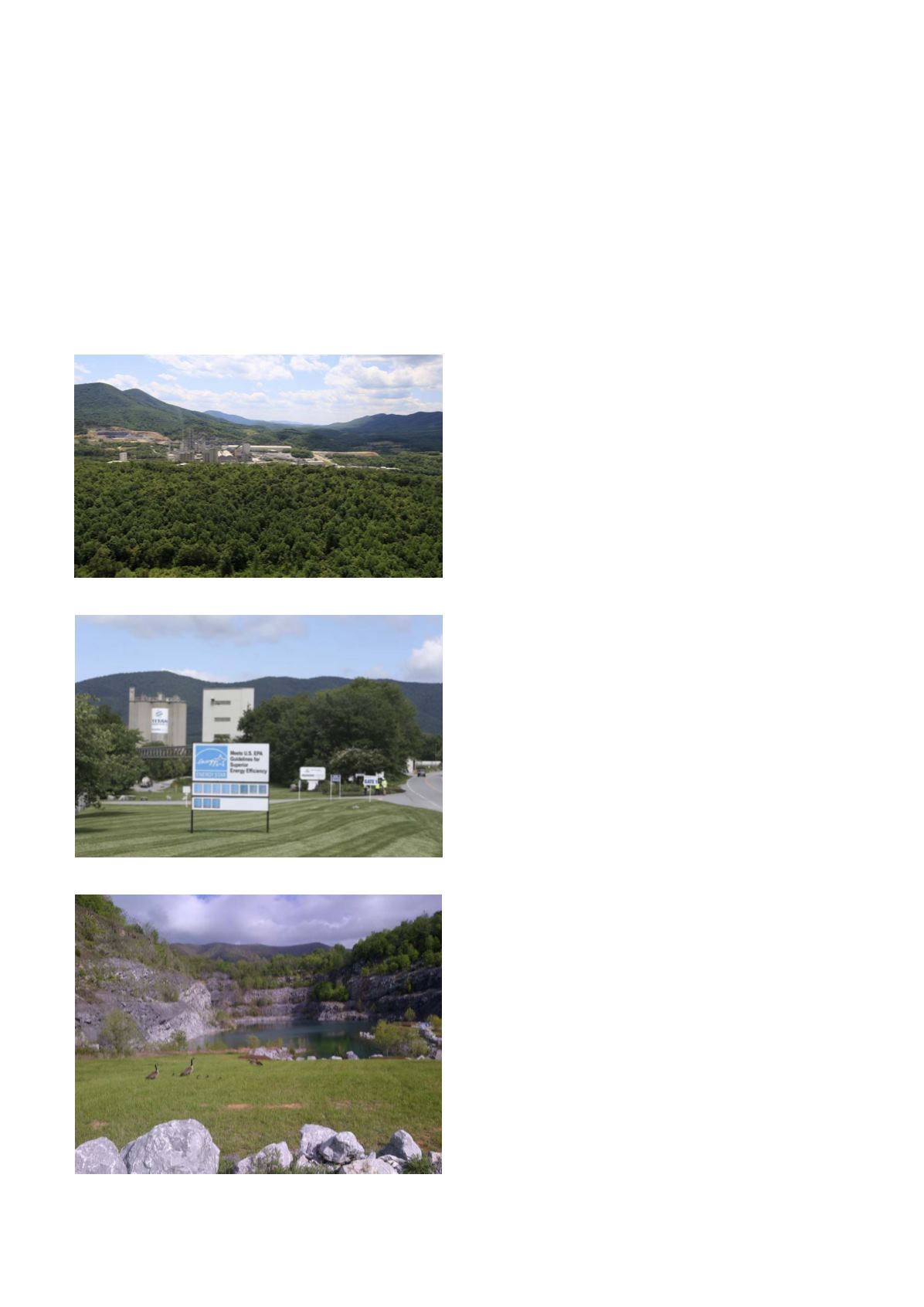
Quarry converted to trout pond.
ENERGY STAR signage at RCC.
Roanoke Cement Co. in the Blue Ridge Mountains.