


 97 / 140

heat for calcination is generated and deployed. It is
assumed that the kiln operation would be the same
as a traditional precalciner today. Table 3 illustrates
some of the differences between oxy-combustion and
indirect calcination.
The ECRA project is for total oxy-combustion
as seen in the second column from the right. The
kiln-only oxy-combustion is not being promoted; it is
only shown to compare oxy-combustion in a cement
plant to oxy-combustion in a coal-fired power plant.
The yield is an interesting concept that relates the
tonnes of CO
2
captured versus the tonnes of oxygen
consumed. This can be a surrogate for operating
costs, as the cost of air separation to provide the
pure oxygen stream will be a significant cost factor in
oxy-combustion systems.
Post-combustion processes
Indirect calcination and oxy-calcination are
the least likely technologies to be retrofitted
into existing cement plants. The provision for
oxy-calcination, however, should be the most
likely to be incorporated into new cement plant
projects. Existing plants can be retrofitted for full
oxy-combustion but will need modifications in
several areas, as mentioned above. This leaves a
significant amount of CO
2
that would still need to
be captured in post combustion, also known as ‘tail
pipe’ processes.
Post-combustion processes fall into one of several
main categories:
z
Sorbent systems, liquids, or solids.
z
Biological systems, microbes, or algae.
z
Membrane systems.
z
Cryogenic systems.
Liquid sorbent systems use a liquid sorbent that
combines with the CO
2
in the exhaust gas stream
in an absorber unit and then releases the CO
2
under different conditions in a stripper vessel or
desorber unit. The absorption and stripping is often
triggered by either temperature and/or pressure.
These systems have been in service for many years
and are quite well known. The most common liquid
sorbents are amine based, but many companies are
working on proprietary sorbents that avoid some
of the common issues of contamination, slip, and
deterioration. Liquid sorbent technologies have
been piloted in cement plants in the US and Norway.
Solid sorbent systems are gaining momentum.
These systems are similar to liquid sorbent systems,
except they use a solid sorbent material, which may
be more compatible to cement plant operation. One
solid sorbent technology, in particular, is carbonate
looping, where calcium oxide is used as the sorbent.
This is of particular interest to cement production as
the spent sorbent, lime, is a major raw material in
cement production. Several studies are continuing
Energy-efficient
separation, flexible
and compact
And all that:
Fast
Fair
Flexible
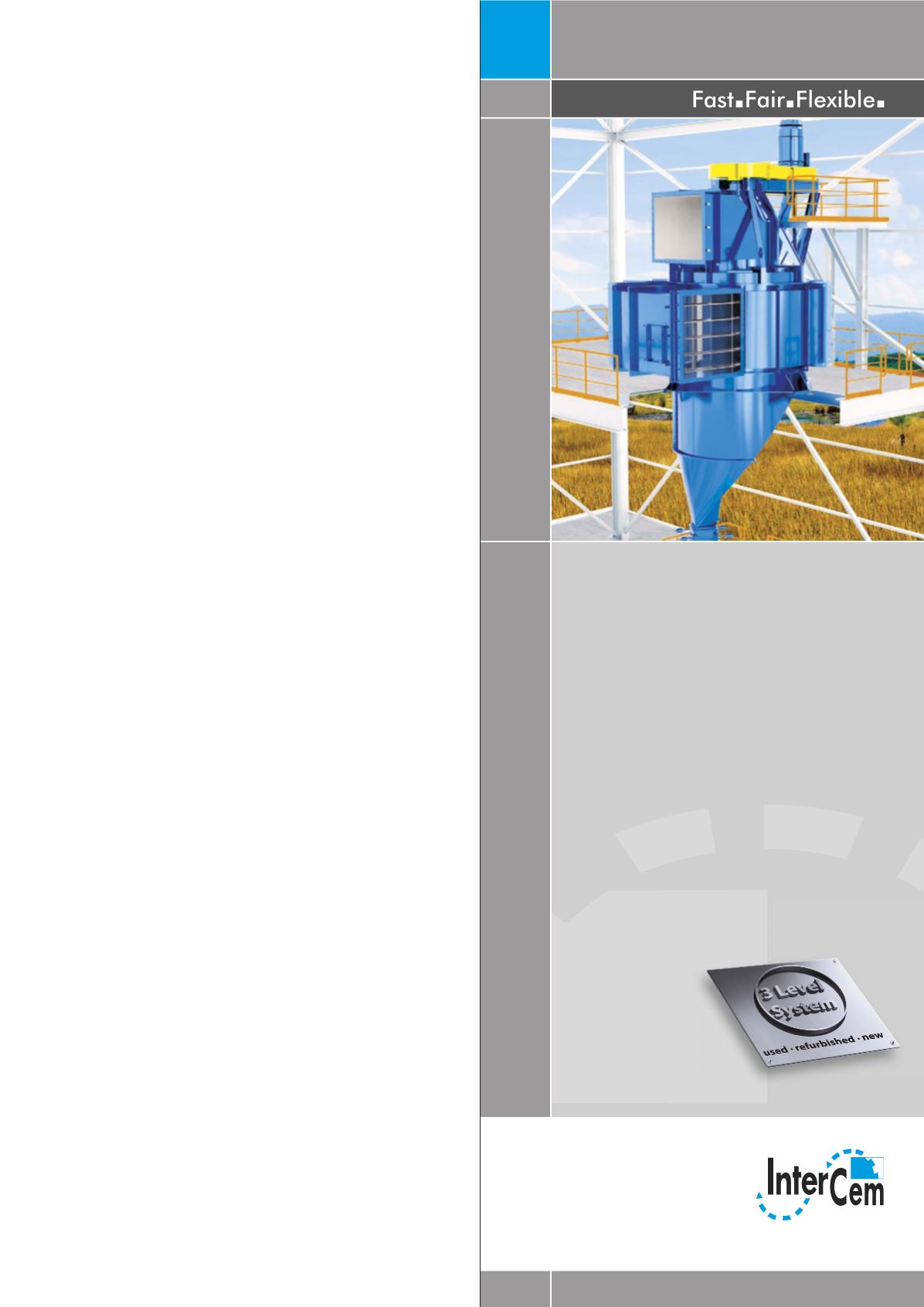
With the new optimized high-performance
separators of the third generation, Intercem
has the appropriate product for each specific
application.
A low bypass-rate ensures the highest possible
separation grade. Robust construction, minimal
maintenance, easy accessibility to bearings
and wear parts and extremely wear resistant
materials result in the highest wear protection
and are state-of-the-art.
We can either exchange old separators in
existing plants or integrate our high-efficiency
separators into
completely new
plants. References
all over the world
prove this.
Intercem Engineering GmbH
Intercem Installation GmbH
Carl-Zeiss-Straße 10 | 59302 Oelde
Germany | Tel.:
+49 2522 92058-0E-Mail:
info@intercem.de|
www.intercem.de