


 109 / 140

ZZZ GLVDE FRP Ɣ &RQWDFW8V#GLVDE FRP
DISAB
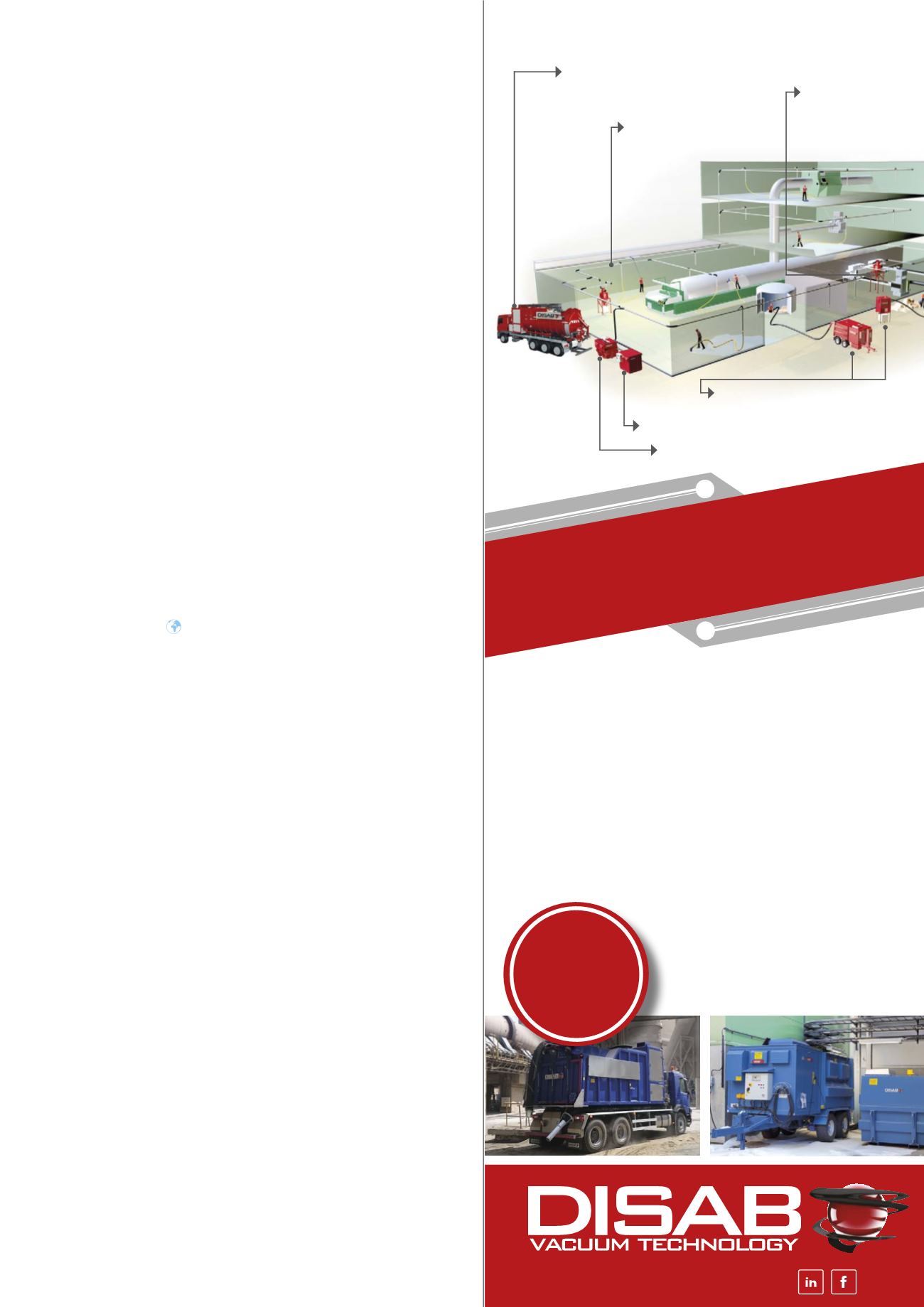
prevents dust build-ups from happening
by cleaning and removing dirt, dust and
spillages using vacuum based technology with
a powerful suction ability. Our mobile, semi-
mobile, and stationary machines and system
solutions help facilitate good housekeeping to
increase the safety of your workers.
Contact us for more information on how you can
keep your cement plant and workers safe!
Good Housekeeping:
Prevent dust build-ups with DISAB
9LVLW XV DW
AICCE23
BOOTH
# 68
Mobile Vacuum System
Filter Separator
Vacuum Unit (5-160 kW)
Pre-Separator
Stationary Vacuum System
Semi-Mobile Vacuum System
linked to a certain type of technology or product. Thus,
a proper technical assessment is fundamental, otherwise
benchmarking runs the risk of becoming a purely statistical
exercise, of which the added value for energy efficiency
optimisation purposes might be questionable.
Conclusion
By increasing the use of AFs and improving energy
efficiency, the cement industry has proven in the past
decades that sustainability and the simultaneous reduction
of operational costs can go hand in hand. Energy reviews
are one of the most time- and cost-effective ways to
uncover potential energy savings in cement plants and
thus reduce CO
2
emissions even further. Potential energy
savings are plant specific and some trade-offs must
be negotiated. Therefore, recommendations must be
technically supported and customer oriented. Numerous
energy reviews have shown that practically all plants
reviewed showed potentials for improvement with regard
to energy demand and, consequently, reducing energy
costs. In order to reach the highest technical level, the
correct operation and maintenance of state-of-the-art
equipment, tight control of the whole process, and careful
selection of fuels and raw materials is fundamental. A
detailed review can always help to uncover improvement
potentials, which was also the case in plants that were
well-operated and maintained, and where major energy
efficiency measures had already been identified and
implemented.
References
1. IEA, ‘Cement Technology Roadmap 2009,’
https://www.iea.org/publications/freepublications/publication/Cement.pdf
(accessed on 29/8/18).
2. HOENIG, V., KORING, K., FLEIGER, P., MÜLLER, C., PALM, S.,
REINERS, J., ‘Energy efficiency in cement production: part 1,’
Cement International
, Vol. 11 (March 2013), pp. 50 – 67.
3. Joint Research Centre of the European Commission, ‘Best
Available Techniques (BAT) Reference Document for the
Production of Cement, Lime, and Magnesium Oxide’ (2013).
4. ECRA, WBCSD, ‘Development of State of the Art Techniques
in Cement Manufacturing: Trying to Look Ahead’
CSI-ECRA
Technology Papers
,
http://www.wbcsdcement.org/pdf/technology/CSI_ECRA_Technology_Papers_2017.pdf, (2017).
About the authors
Marco Lindemann Lino is a Project Engineer and Researcher at
VDZ gGmbH. He has over 12 years of experience in cement
processing technology and in the past few years he has carried
out numerous energy reviews in cement plants worldwide. He
holds a diploma in mechanical engineering from IST - Technical
University of Lisbon, Portugal.
Volker Hoenig is the Managing Director of VDZ gGmbH. He has
more than 25 years of experience in cement and lime processing
technology. He is an expert in thermal processing, energy
efficiency, fuel substitution, and pyroprocess optimisation, as well
as environmental technologies. He holds a PhD in energy process
technology and environmental protection from the University of
Stuttgart, Germany.