


 94 / 140

November 2018
92 \
World Cement
what technologies to invest in for new plant design.
Cement companies that adequately address the
uncertainty of the carbon-constrained world will most
likely be the future industry leaders.
The major cement producers have been diligently
and successfully reducing their carbon footprints
over the past two decades. The traditional levers for
reducing the carbon footprint of portland cement can
be grouped into four main categories:
z
Improving energy efficiency.
z
Reducing the amount of clinker in cement and
concrete.
z
Increasing the use of biogenic (carbon neutral)
fuels.
z
Reducing the amount of calcium in portland
cement clinker.
Table 2 indicates how selected major cement
producers (all members of the CSI) are performing in
these areas, according to their latest sustainability
reports.
The IEA and CSI agree that the traditional levers
mentioned above will not be sufficient to meet the
future targets. The implication is that some form
of carbon capture will be required. The extent to
which each of the major levers can be employed
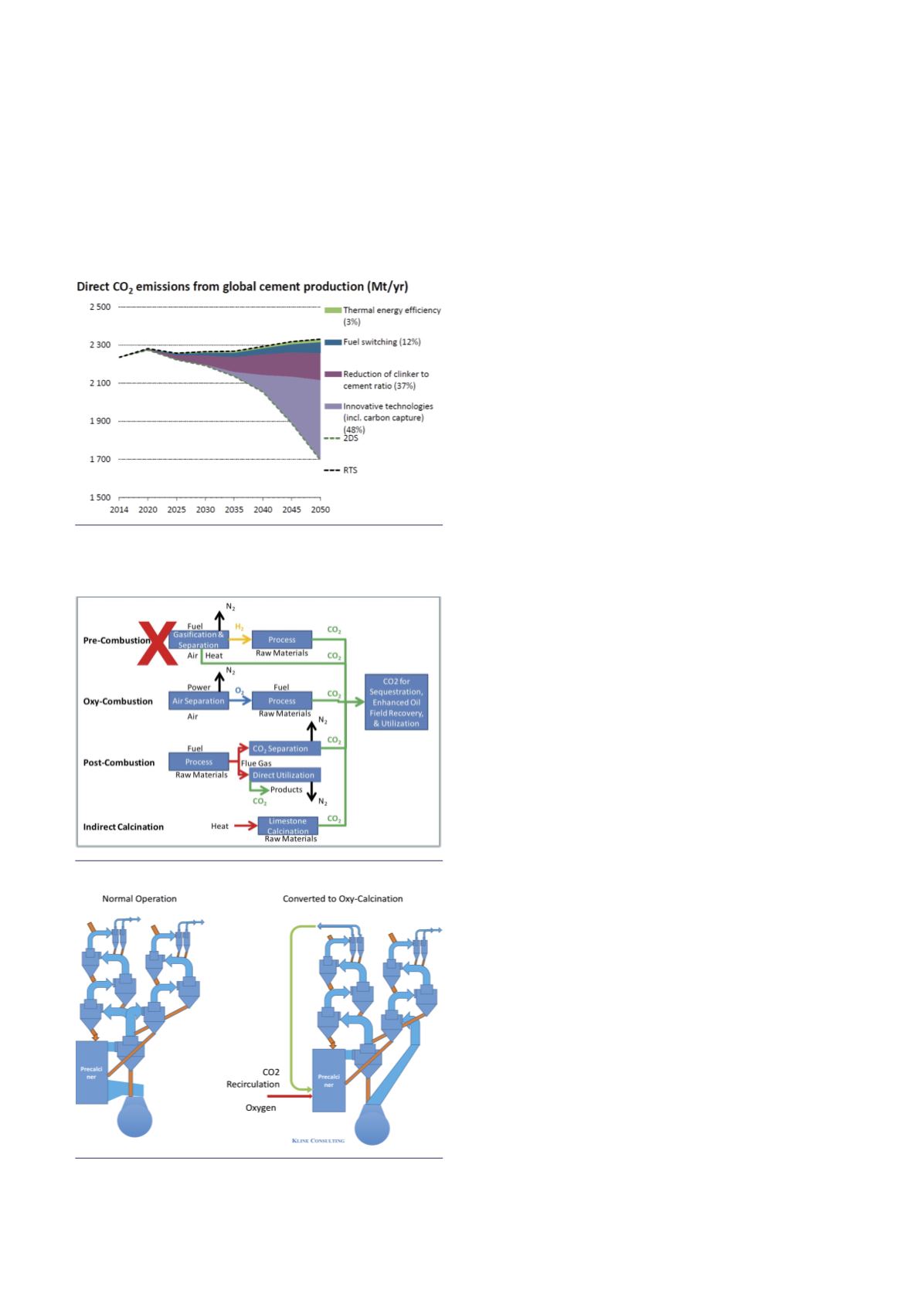
towards the 2050 target is demonstrated in Figure 1.
This figure predicts the total CO
2
emissions from the
global cement industry. The projected impact of each
CO
2
emission reduction lever is shown as a percentage
on the right side of the graphic. This indicates that
almost half of the reduction will have to come from
new technologies for carbon capture and utilisation.
Figure 1 references two 2050 scenarios: the 2DS
and the IEA Reference Technology Scenario (RTS).
The RTS has been developed through evaluation of
CO
2
reduction commitments that have been made
through global agreements and is closer to a ‘business
as usual’ approach. The fundamental difference is
that the RTS is projected to result in a 2.7˚C rise in
temperature by 2100 as opposed to the 2˚C rise in the
2DS. The two approaches achieve their projections
through different means: the 2DS is more top down
and the RTS more bottom up. More information can
be found in the CSI technology roadmap report.
1
CO
2
reduction technologies
The traditional approaches to CO
2
capture
include pre-combustion, oxy-combustion, and
post-combustion.
In pre-combustion technologies, carbon is
removed from the fuel before use. There are several
approaches for this type of technology, but, in
general, it is of little use to the cement industry,
as approximately 60% of the CO
2
emissions from
a modern cement plant come from the calcination
reactions. Therefore, pre-combustion technologies are
not being widely investigated by cement producers.
Oxy-combustion
Oxy-combustion systems have been proposed for
cement manufacture and the European Cement
Research Academy (ECRA) has been working for
over a decade on this approach.
In oxy-combustion,
nitrogen is removed from the combustion air and
the fuel is fired with pure oxygen. The combustion
products are therefore primarily CO
2
and water. The
water can easily be removed by chilling the gas,
Figure 1. IEA and CSI roadmap to 2050, indicating
projected impact of traditional levers for the 2˚C (2DS)
and the reference technology scenario (RTS).
8
Figure 2. CO
2
emission reduction technologies.
Figure 3. Preheater tower built for future
oxy-calcination (left) and converted (right).