



 24 / 108

air-fuel mixing and calcination reaction zones
which are practically impossible to access,
and can relocate fuel injection locations with
respect to meal inlets. This approach prevents
higher CAPEX calciner modifications frequently
implemented during the calciner upgrade, in
which gas residence time is increased – an
inefficient and expensive option, as reactions
away from the fuel burning zone (i.e., of the
order of 1 – 2 m) are extremely slow and
hardly increase burnout and calcination beyond
1 – 2%.
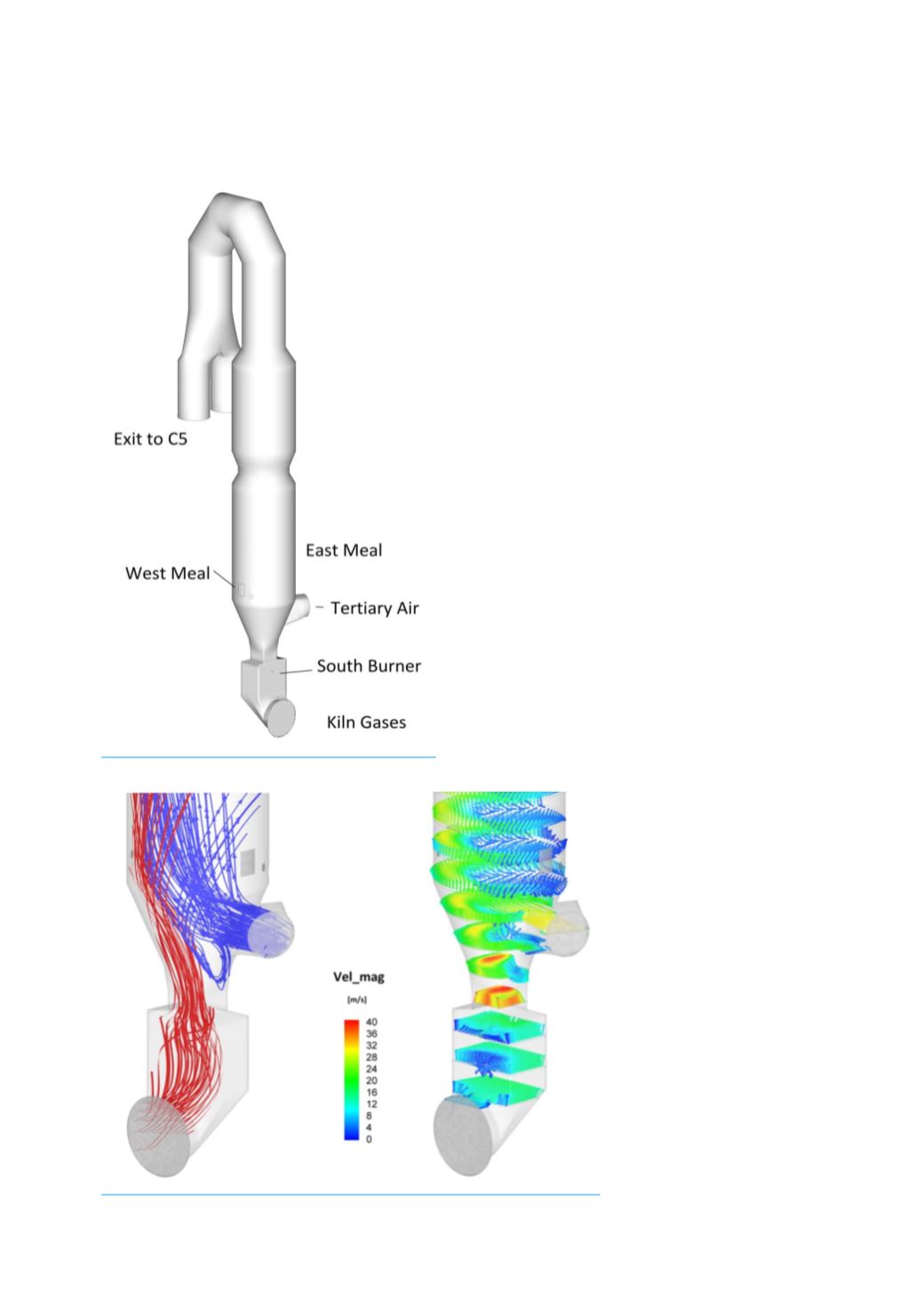
Figure 3 shows the specific mixing
characteristics of the Vasilliko calciner. The
length of the RGD prior to the entry location of
TAD air, TAD air inlet angle and velocities are
the main parameters influencing calciner mixing
and reaction zones. In each calciner, fuel
burnout and calcination levels are influenced
by the ignition of fuel-released volatiles and
suppression of temperature peaks through the
calcination of meal particles.
All of these are accomplished within a few
milliseconds of the onset of ignition. Therefore,
allowing a higher-than-necessary ignition delay
or inhibition of combustion reaction through
earlier mixing of the meal particles, results
in lower fuel burnout. Once the fuel burnout
decreases below 95%, an increase in the
volatile cycles is observed, causing build-ups,
leading to more air blasting and sometimes
even resulting in plant stoppages.
The early mixing of tertiary air reduces
any kiln-formed CO but increases the
NO
x
formation. Figure 3a shows the TAD
connection with the RGD inclined at a 30°
angle to the vertical, which diverts a portion
of the tertiary air downward, thereby reducing
the residence time of fuel volatiles within
fuel-rich and oxygen deficient sections; these
are necessary conditions
for kiln-generated-NO
x
destruction, via the
CHi radicals reactions.
Figure 3b shows the
diffusion of unreacted
volatiles into the sheer
layer between the tertiary
air and riser gases,
transporting the unreacted
nitrogenous species.
These conditions are
found to be unfavourable
for reducing NO
x
emissions but are able
to oxide CO. In order
to reduce NO, it was
necessary to reduce the
downward transgression
of the tertiary air stream
and also to complete the
consumption of petcoke
volatiles earlier and prior
to tertiary air inlet.
Figure 2. Vasilliko Calciner.
Figure 3(a). TAD connection with RGD inclined at a 30˚ angle.
22
World Cement
July 2020