BMHR 2016
42 \
World Cement
existing measuring system. The evaluation of the trend
recording was positive and just four weeks later, four
more Vegapuls 69 sensors were installed. Until now it
hasn’t been necessary to clean the instruments even
once.
Extended area of application
The examples show that level measurement in the
building materials industry makes special demands.
The Vegapuls 69 radar level measuring instrument can
make level measurement safer and more accurate.
Development paid particular attention to the demands
of the building materials industry. For example, the
level measuring instrument operates with a frequency
of 80 GHz which enables much higher focusing of the
product to be measured. This means that products with
poor reflection properties that were previously difficult
to measure can now be measured more precisely
and easily. In containers with large installation, this
focusing also helps for better differentiation of the
actual measuring signal from the interference signal.
With a measuring range of up to 120 m at an accuracy
of ±5 mm, there are enough power reserves even for
unusual applications, for example in mining shafts or
large bulk material dumps.
Better detection of useful signals
The cement industry often uses segmented silos for
different cement types. The radar level measuring
instrument Vegapuls 69 was tested in a 35 m high
cement silo. The good focusing and high dynamic
range of the sensor enable reliable level measurement
in all phases of the operation. The sensor reliably
measures the level regardless of dust deposits and large
measuring range.
The benefit of 80 GHz
The opening angle of the radiated radar energy and
therefore the focusing depends on two factors: The
transmission frequency and the active antenna area.
This means that a much better focusing is achieved at
a higher frequency with the same antenna size. The
Vegapuls 69 operates with a transmission frequency of
80 GHz and an antenna size of 75 mm. This achieves
an opening angle of just 4˚. In a radar sensor with a
transmission frequency of 26 GHz, the opening angle
with the same antenna size is about 10˚. The 80 GHz
beam misses installations or deposits on the container
wall, making the measurement more accurate and
reliable.
The antenna system itself is made of the robust
material PEEK, which has a high temperature and
chemical resistance. The lens antenna is insensitive to
deposits and dirt and shows no signs of wear. To make
commissioning easier, an intelligent swivel holder was
also developed with the aid of which the sensor can be
aligned quickly, easily and optimally.
Inspired by the spirit level App, the Vega engineers
developed an App which can be used to set the angle
of inclination for the installation of the measuring
instrument. The basic data of the container and
the installation site are entered in a menu and the
Smartphone is simply placed on the instrument. The
graphic display can be used for fast alignment of the
sensor.
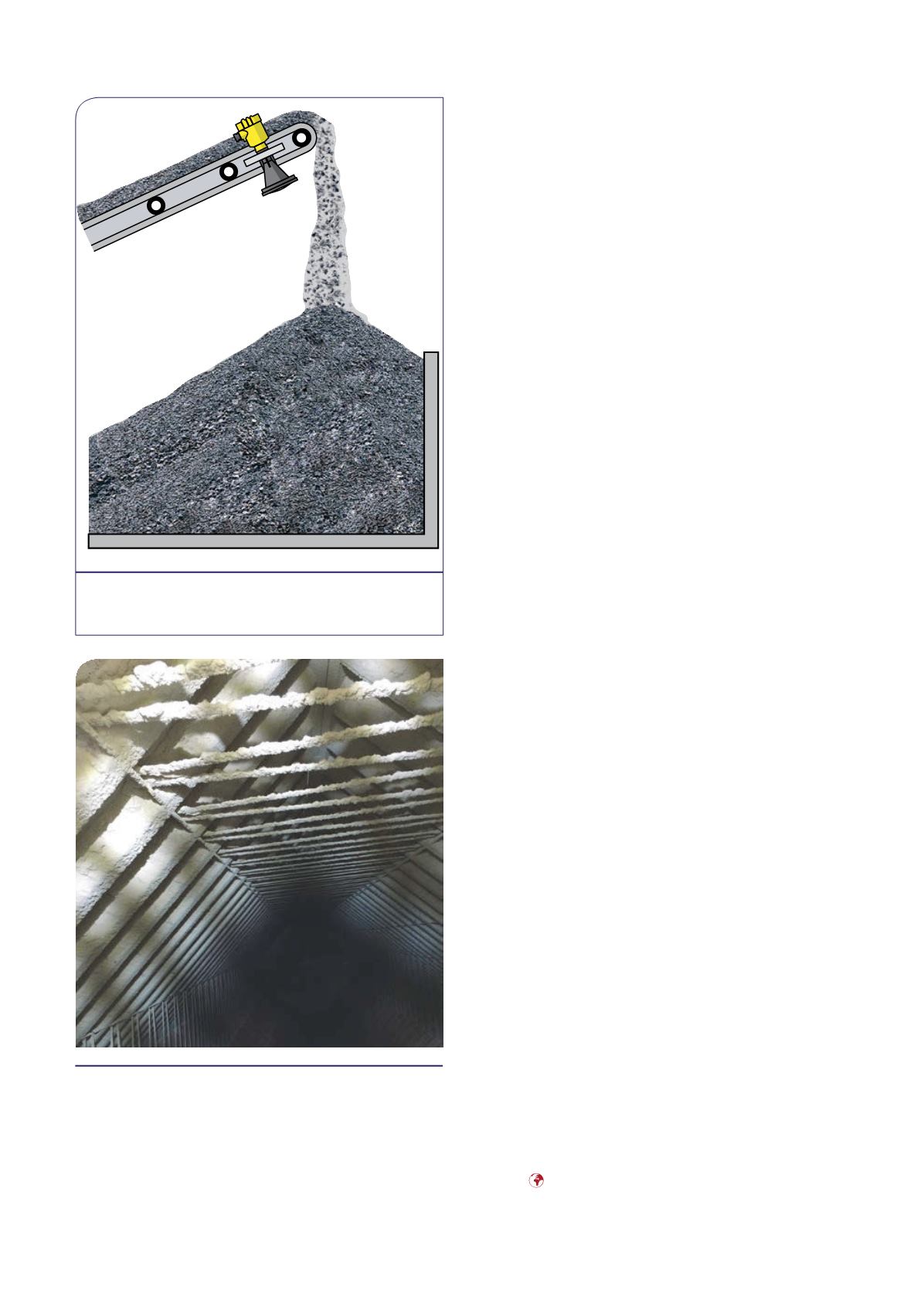
To ensure that the incoming material is distributed as
evenly as possible, the level of the blending bed must
be continuously measured.
Silo with highly textured wall and struts.


