BMHR 2016
40 \
World Cement
Distance and position measurements in moving
discharge devices such as conveyor belts are also
difficult. The incoming bulk material is temporarily
stored in a buffer silo to ensure optimum belt control.
Hereby, the level or at least the limit level must be
monitored. A continuous level measurement has
the advantage that the filling can be continuously
controlled.
In order to ensure continuous production, even with
a faltering supply, intermediate products such as clinker
for cement production, are stored in large bunkers up
to 30 m high with a diameter of up to 20 m. The large
dimensions of the silos require filling and emptying at
several points. Balanced filling and emptying of the
bunkers is achieved by measuring the level in different
places.
For level measurement in cement silos, the
measuring instruments face the challenge that the
fine dust mixes with moisture and produces very
aggressive alkaline compounds which exert very great
wear on mechanical measuring systems in the long
term and lead to high maintenance expenses. Here
too, measuring instruments which operate with radar
technology are ideal because they measure levels
without any wear and additional maintenance expense.
Radar level measuring instruments are also used
in mixing plants for concrete or mortar. In order to be
able to respond flexibly to requirements, the different
raw materials are stored in a segmented mixing tower
and mixed with cement, lime and other materials in the
specific recipe. The level measurement in the individual
segments ensures high availability of the raw materials
and economic operation of the plant. The confined
space conditions and massive reinforcements of the
partition walls pose a great challenge for the measuring
technology.
Another application can be found in a so-called
blending bed. To maintain a high quality and uniform
material consistency in the finished cement, the raw
materials are homogenised in a blending bed. In order
to achieve this, the rock is distributed evenly over the
blending bed with a stacker. The material is reclaimed
in reverse order with the help of a scraper. To optimally
control the conveyor systems, their positions must be
determined as precisely as possible. This measuring
method guarantees reliable results and is unaffected by
dust and noise.
Unimpressed by dust and dirt
There are already quite a number of applications where
Vegapuls 69 has proven to be a real problem solver. This
was the case, for example, in a large concrete silo with
a 10 m dia. and a measuring range of 40 m, where huge
amounts of dust were generated due to the constant
filling and emptying of cement. The bottom of the silo
is an upward-pointing cone that covers the entire dia.
The cement is discharged via eight outlets that lead to
two loading nozzles. This arrangement enables uniform
emptying and the simultaneous filling of two silo trucks.
Due to the very high product turnover in the silo
and the resultant dust, the antenna of the previous
level transmitter had to be cleaned regularly. For
this, however, the entire measuring instrument had
to be dismounted. Although installing a rinsing air
system could reduce this servicing work, operating
the compressors and associated equipment of
course generated additional costs. For that reason a
Vegapuls 69 was installed for test purposes and its
readings recorded in the control system, parallel to the
The processes in cement production require a high
level of productivity and efficiency.
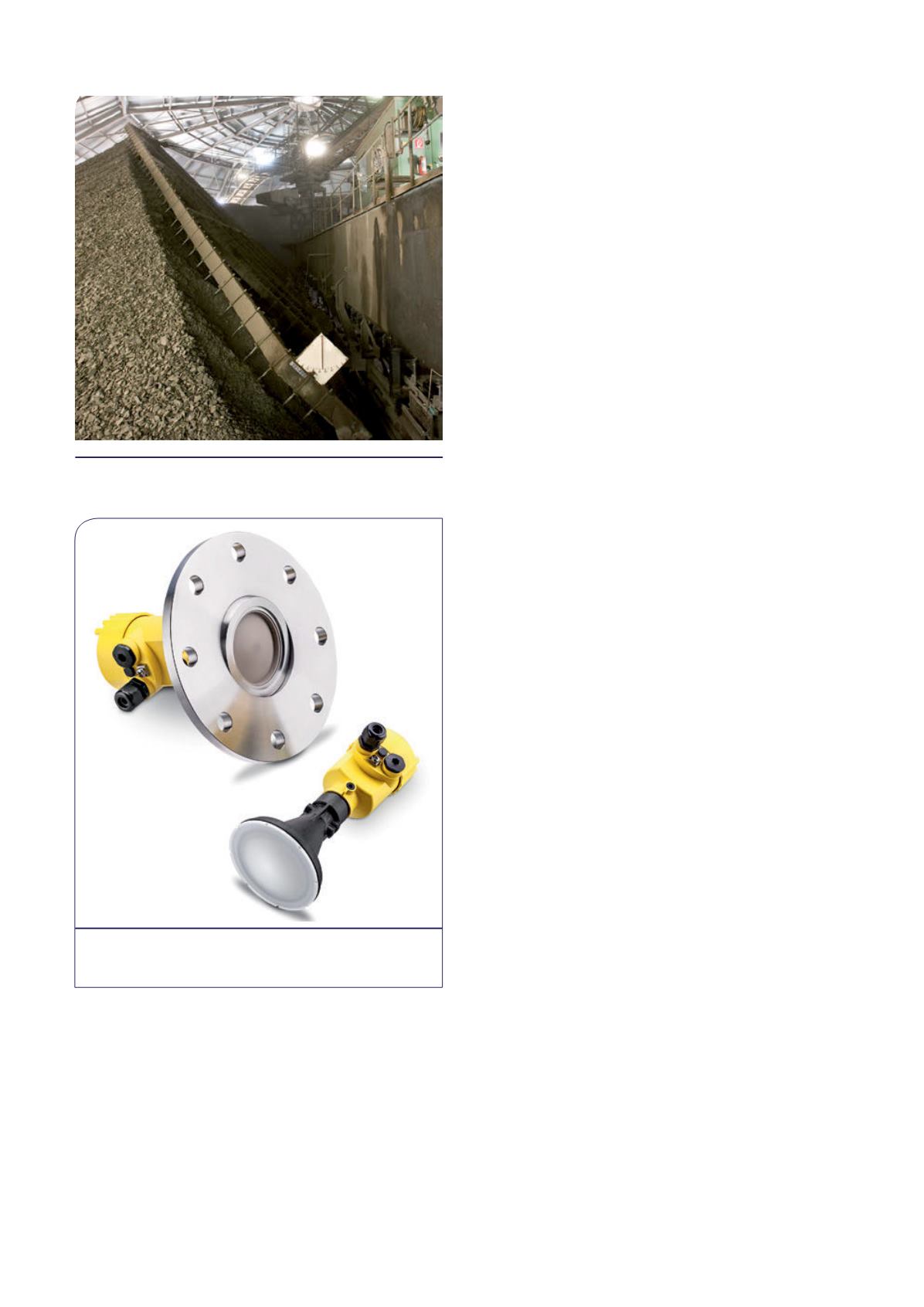
The Vegapuls 69 is available with a simple, light
plastic antenna and a lens antenna integrated in a
flange.


