


 36 / 140

November 2018
34 \
World Cement
some pozzolanas, for example phonolith, can be increased
by thermal treatment. By heating up to 300˚C to 500°C,
the crystal lattice expands and the surface area increases.
Thereby the formation of hydrate-phases is supported.
3
The grindability of natural pozzolana varies widely.
In Figure 2, the specific surface area acc. to Blaine
depending on the grinding time is shown. For achieving
5000 Blaine, for example, a time of exposure in the
laboratory ball mill is between 30 min. to 75 min.
This behaviour has to be taken into consideration for
rating the industrial mill. Additionally, the reactivity of
pozzolanas is very different and has tremendous impact,
in combination with the clinker, on the produced
cement. Therefore, a fine adjustment of feed material
properties and target fineness of finish product need to
be done.
Final remarks
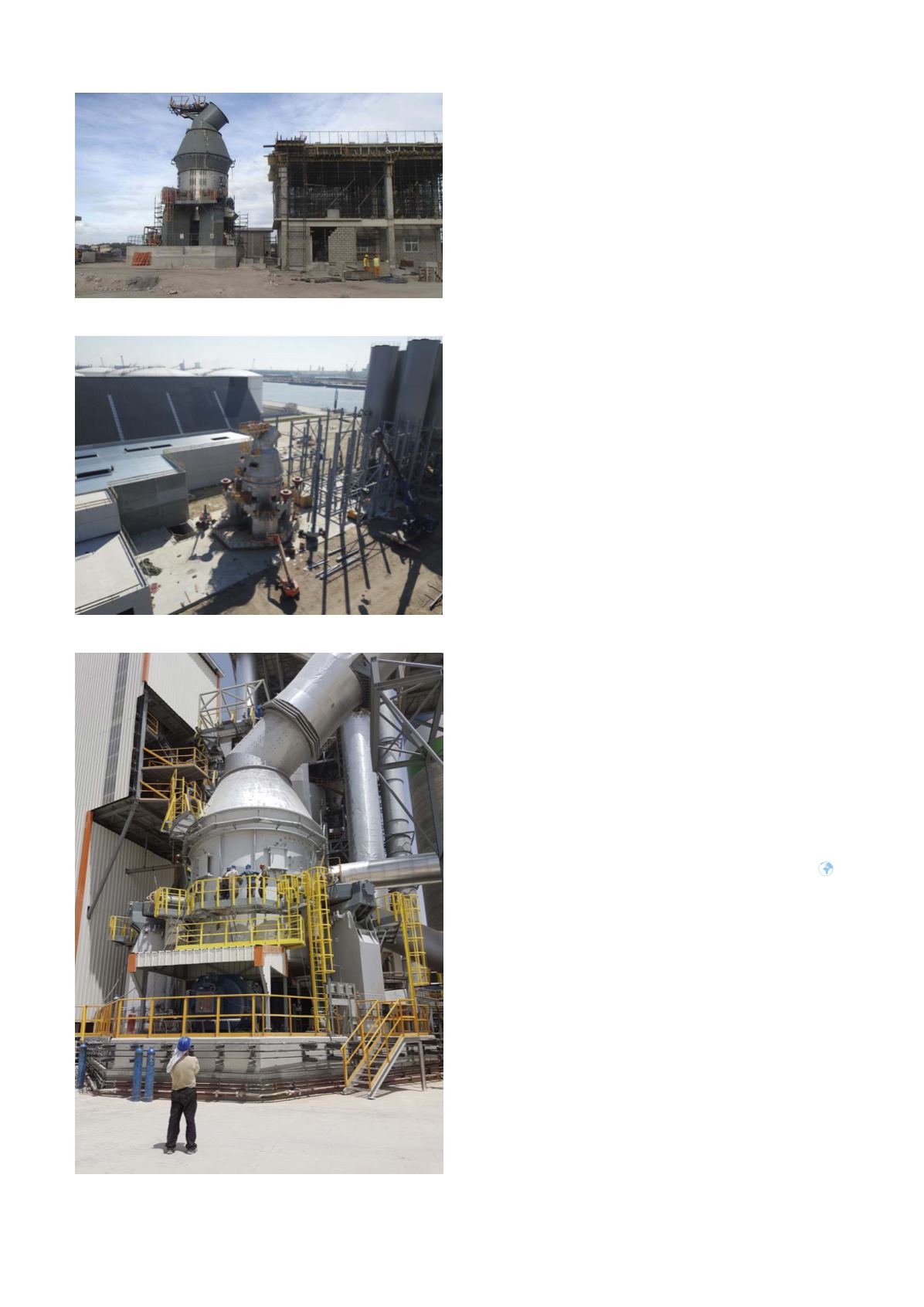
Many MVR mills are under execution and erection. For
example, in South Africa, a second MVR 3750 C-4 is under
erection. Figure 3 shows the progress of construction work.
This mill will be capable of producing CEM I, CEM II/B-L, and
CEM III/A with output rates of up to 110 tph at 4500 Blaine.
Commissioning will take place in Autumn 2018. Another
MVR 5300 C-6 mill is under erection in Europe. This
grinding plant will cover a wide range of products: from
CEM I to CEM III/C with fineness up to 5200 Blaine. Figure 4
shows the status of erection. This mill is equipped with a
conventional drive with a rated power of 4600 kW.
MVR mills are not only proven for cement grinding, but
also for cement raw material grinding. A mill of the size
MVR 5000 R-4 installed in Uzbekistan (Figure 5) is grinding
cement raw material with a higher than guaranteed
capacity of 410 tph at 12% R 90 µm.
During the past decade more than 70 mills have been
sold. A large number of those mills is in operation for
production of a wide range of materials. The MVR mill
technology, which has been available on the market for the
past 10 years, is the right choice for the handling of versatile
feed components. In combination with increased plant
availability and ease of maintenance the MVR mill offers
low specific electric and thermal energy consumption.
References
1. CLARK, M., “Pozzolana is the key”,
ICR
(November 2017),
pp. 48 – 49.
2. SNELLINGS, R., MERTENS, G., and , ELSEN, J.,
“Supplementary Cementitious Materials”,
Reviews in
Mineralogy and Geochemistr
y, 74 (2012), pp. 211 – 278.
3. KASSAUTZKI, M., “Phonolith als puzzolanischer Zumahlstoff
in der Zementindustrie“,
ZKG
(1983), pp. 688-692
About the author
Dr Caroline Woywadt has been Director – Process Technology at
Gebr. Pfeiffer since 2011. After graduating from RWTH Aachen,
Germany, with a degree in mineral processing and a PhD in the
field of grinding, she worked as a process and quality control
manager at cement grinding plants in Germany and Poland, as
well as a product manager for grinding products.
Figure 3. MVR 3750 C-4 under construction in South Africa.
Figure 4. MVR 5300 C-6 under construction in Europe.
Figure 5. MVR 5000 R-4 under construction in Uzbekistan.