



 34 / 108

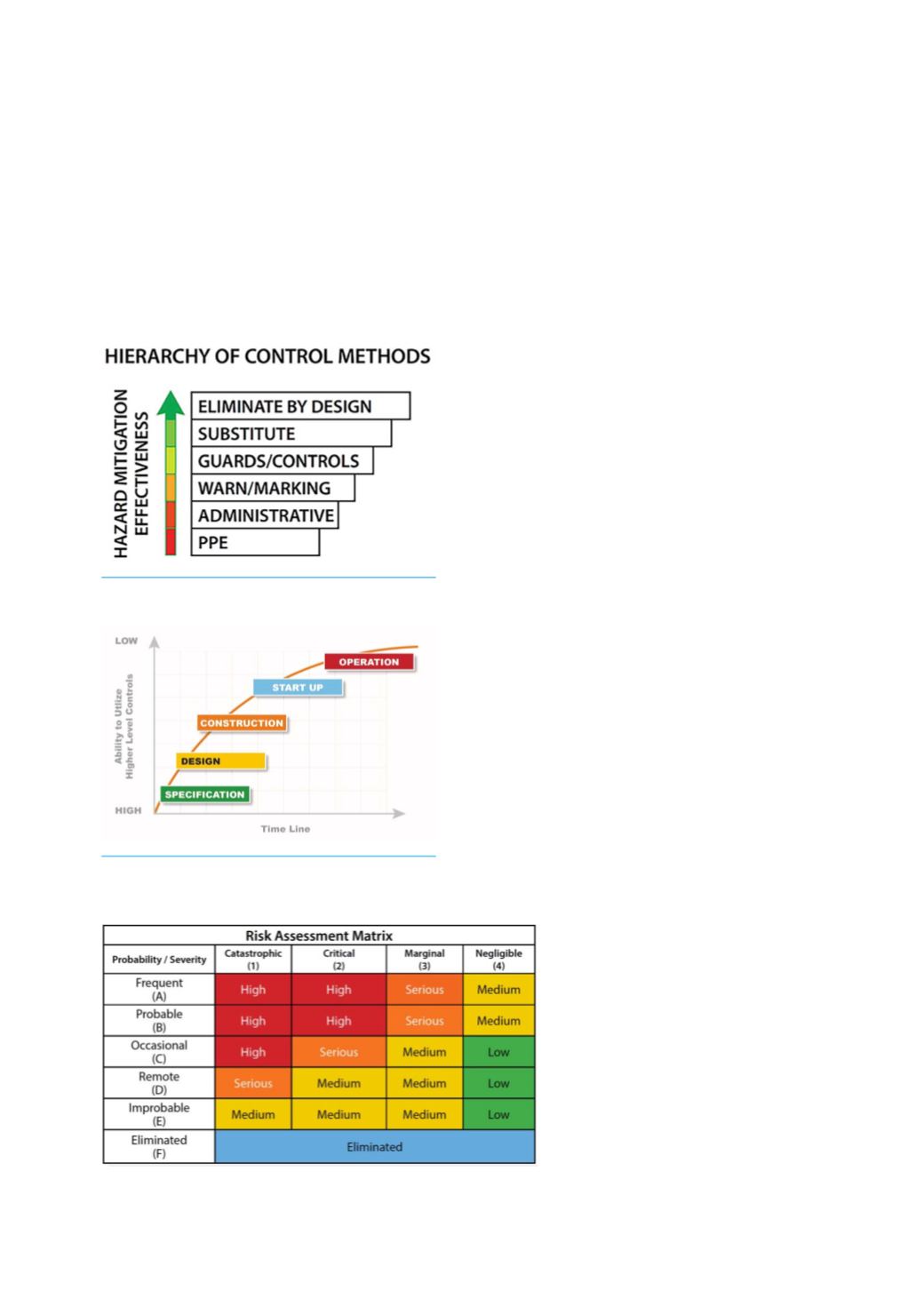
To reduce hazards in the workplace, operators
employ a variety of methods, from requiring the
use of personal protective equipment (PPE) to
installing the latest and safest equipment designs.
When examining the safety of a system, improving
efficiency and reducing risk can be achieved
by utilising a hierarchy of control methods for
alleviating hazards. The consensus among safety
professionals is that the most effective way to
mitigate risks is to design the hazard out of the
component or system. This usually requires a
greater initial capital investment than short-term
fixes, but yields more cost-effective and durable
results.
The science: Hierarchy of control
methods
Examining the US Occupational Safety and
Health Administration (OSHA) accident database
reveals the dangers of working around conveyors.
1
Studies have revealed that accidents are most
likely to occur near locations where cleaning and
maintenance activities most frequently take place –
the takeup pulley, tail pulley and head pulley.
Experienced engineers often recommend
that operators retain an outside firm to examine
system requirements and design new equipment
around historical issues and specific needs
of the application, with an overall objective of
safety. Before the drafting phase, designers
should establish the goals of reducing injuries
and exposure to hazards (dust, spillage, etc.)
to increase conveyor uptime and productivity,
and seek more effective approaches to ongoing
operating and maintenance challenges. Designs
should be forward-thinking, exceeding compliance
standards and enhancing operators’ abilities to
incorporate future upgrades cost-effectively and
easily by taking a modular approach.
Designing hazards out of the system means
alleviating causes with the intent to bolster
safety on a conveyor system, but the methods of
protecting workers can vary greatly. In many cases,
it will be necessary to use more than one control
method, by incorporating lower ranked controls.
However, these lower-ranking approaches are
best considered as support measures, rather than
solutions in and of themselves.
PPE includes respirators, safety goggles, blast
shields, hard hats, hearing protectors, gloves, face
shields and footwear, providing a barrier between
the wearer and the hazard. The downsides are that
they can be worn improperly, may be uncomfortable
to use through an entire shift, can be difficult to
monitor and offer a false sense of security. But the
bottom line is that they do not address
the source of the problem.
Administrative controls (changes to
the way people work) create policies
that articulate a commitment to
safety, but written guidelines can be
easily shelved and forgotten. These
controls can be taken a step further
by establishing ‘active’ procedures
to minimise the risks. For example,
supervisors can schedule shifts that
limit exposure and require more
training for personnel, but these
positive steps still do not remove the
exposure and causes of hazards.
Warning signage is generally
required by law, so this is less of
Safety improves as the type of hazard control
moves higher up the hierarchy of methods.
2
Incorporating effective hazard control
techniques is easier and less costly in the early
stages of a project.
2
Risk assessment applied to design helps create a safer
conveyor system.
32
World Cement
July 2020