



 74 / 140

November 2018
72 \
World Cement
Data acquisition unit and computer
display
The PC computer display can be either a
conventional monitor with keyboard and mouse
or an embedded computer and touchscreen built
into the display cabinet. The bar graph displays
change colour at each alarm level and clicking on
any bar graph displays its associated trend graph,
which shows one day, one week, or one month,
with additional ability to select any date range.
The previous 30 days of data for any vessel can
be downloaded as an Excel file for use in delivery
measurement and similar applications. Other
computers on the local network can view the
displays through standard web browser software.
With a local internet connection, all results can
be transferred to the main server and viewed on
the internet: this software is exactly the same as
used on the local server and, with the appropriate
password, is visible to registered users. Viewing is
possible from desktop and laptop computers, tablets,
and mobile phones with an internet viewer. The
ability to send text and email alerts to chosen users,
as pre-programmed alarm levels are passed, ensures
that no vessel runs out of material and that suppliers
can view the display to plan the day’s deliveries,
saving on transportation costs. An optional alarm
I/O relay panel can be built into the data acquisition
unit (DAQ) cabinet to give hard-wired alarms. In this
way, overfilling can be positively prevented by either
activating a pinch-off valve to halt the flow before the
filters are destroyed or by sounding a warning horn.
To ensure a successful installation, the stress in the
vessel’s support structure must be adequate. This is
calculated by measuring the dimensions of the legs or
skirt and entering these values into a stress calculator.
This advises the user directly with pre-programmed
messages. Even if the stress is adequate, however,
strong sunlight distorts the structure and affects the
readings. Sensors using the semiconductor strain
gauge principle are particularly prone to this effect,
but even the L-strain sensors, which use the same
metal strain gauges as used in load cells, are not
immune to it. Sun shields over the sensors reduce the
effect, but a silo can still give large daily swings in
readings when the stress is marginal.
People in the weigh scale industry are familiar
with settling filters, designed to give quickly settling
readings when items are dropped onto a scale
platform, but they work in seconds and milliseconds.
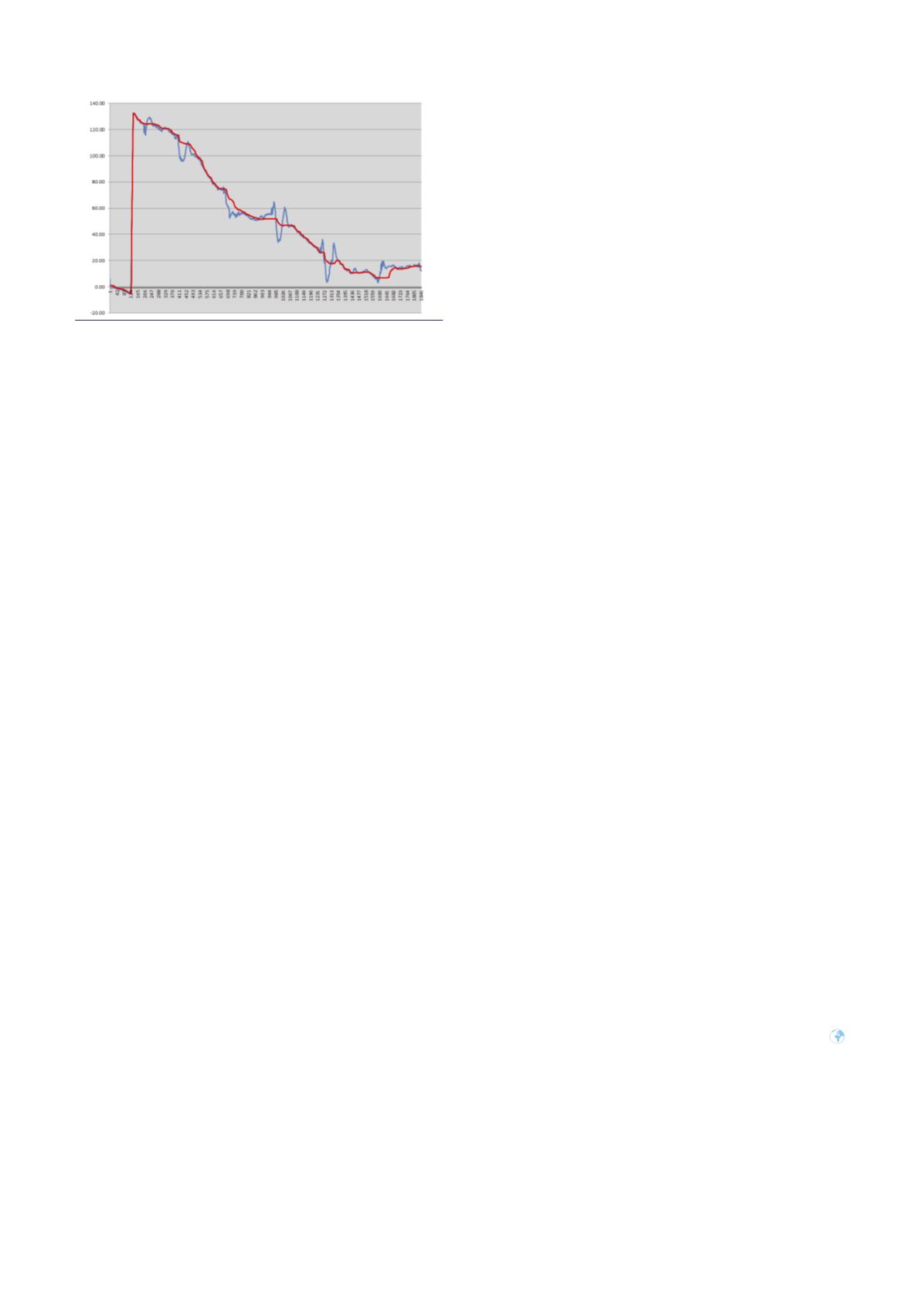
Filters that work in hours improve stability and
accuracy to a remarkable extent (Figure 3), which
is taken from a skirted silo with marginal stress.
Unfiltered values are in blue and filtered values are
in red. This shows seven days, with filling taking
place on the first day and discharge throughout
the week. Note the instantaneous response
during filling, the very minor lag during periods
of fast discharge, and the lack of response during
sunlight-induced swings.
Levels in liquid tanks, such as admixtures in
concrete plants, can also be measured. A pressure
sensor in the discharge line or spare outlet measures
the head of liquid, which can be connected directly
to analogue inputs or through adapter boards to
the digital transmitters. Accuracy is high and tanks
can be calibrated to read in volumetric units, such as
litres or gallons.
Conclusion
Weight sensors can be installed on any vessel that
has metal legs or a skirt, with the containment vessel
supported on the structure. The large diameter
grain silos seen on many farms and mills use a
concrete base, sitting on the ground, and cannot
be fitted with weight sensors. Likewise, concrete
and wooden structures, such as those used in the
Far East, cannot be fitted either. Scale-Tron recently
completed installation on a set of four skirted silos
at Jing Chyi Enterprise Co. Ltd. in Taiwan, the largest
manufacturer of plastic drinking cups in the world.
The skirted silos, with reinforcing columns on the
interior walls, stand 100 ft high and hold plastic
pellets for the injection moulding process. This was a
typical installation; other industries that have been
successfully fitted with weight sensors include bulk
cement terminals, concrete plants, animal feed mills
and farms, grain silos, blasting supplies in mines and
quarries, fracking sand, breweries, bakeries, and
asphalt. Since the sensor is related to load cells, these
can be used when high accuracy is needed and special
applications can be made legal for trade, when an
approved weight indicator and load cells are used.
About the author
Robin Shepherdson graduated from the University of
Bradford with a degree in electrical engineering. He is
President of Scale-Tron Inc., a Professional Engineer, and
is currently President of the National Industrial Scale
Association in the US.
Figure 3. Filter performance showing skirted silo with
marginal stress, unfiltered (blue) and filtered (red), over
one week of use.