BMHR 2016
22 \
World Cement
of the proportioning process can also be
completely
different, depending on where the system shall be
installed within the complete manufacturing and
logistic process chain. Legal requirements are often
also very important within this context and need to
be fulfilled due to strict international standards and
quality management procedures.
If all above mentioned boundary conditions are well
defined, it is still not guaranteed, that the actual task
of choosing and integrating the optimal corresponding
dosing equipment can be completed successfully, since
it is observable that the decision for one or other
solution is not following clear rational guidelines, but
more fuzzy decision factors. A typical example for such
a misconception during the planning and installation of
dosing equipment is the transfer of positive or negative
operational experiences with a particular piece of
equipment from a quite specific field of application to a
completely different scenario. Such an ill-posed transfer
of experience is a typical trap during all conceptual
phases of modern engineering, since it is contrary to a
logical and rational selection of the optimal equipment.
In order to give a clear guideline as to which
proportioning system or method is a preferable
solution within different application scenarios, this
article provides an introduction to a framework for the
systematic classification and description of different
approaches to dosing and metering of bulk materials,
which was developed by Di Matteo.
Di Matteo has introduced a new tubular
gravimetric dosing system ODM-WeighTUBE
®
,
1
and
the development of the modular and comprehensive
ODM-GravitAS control platform and software library,
as introduced in (see Figure 1).
2
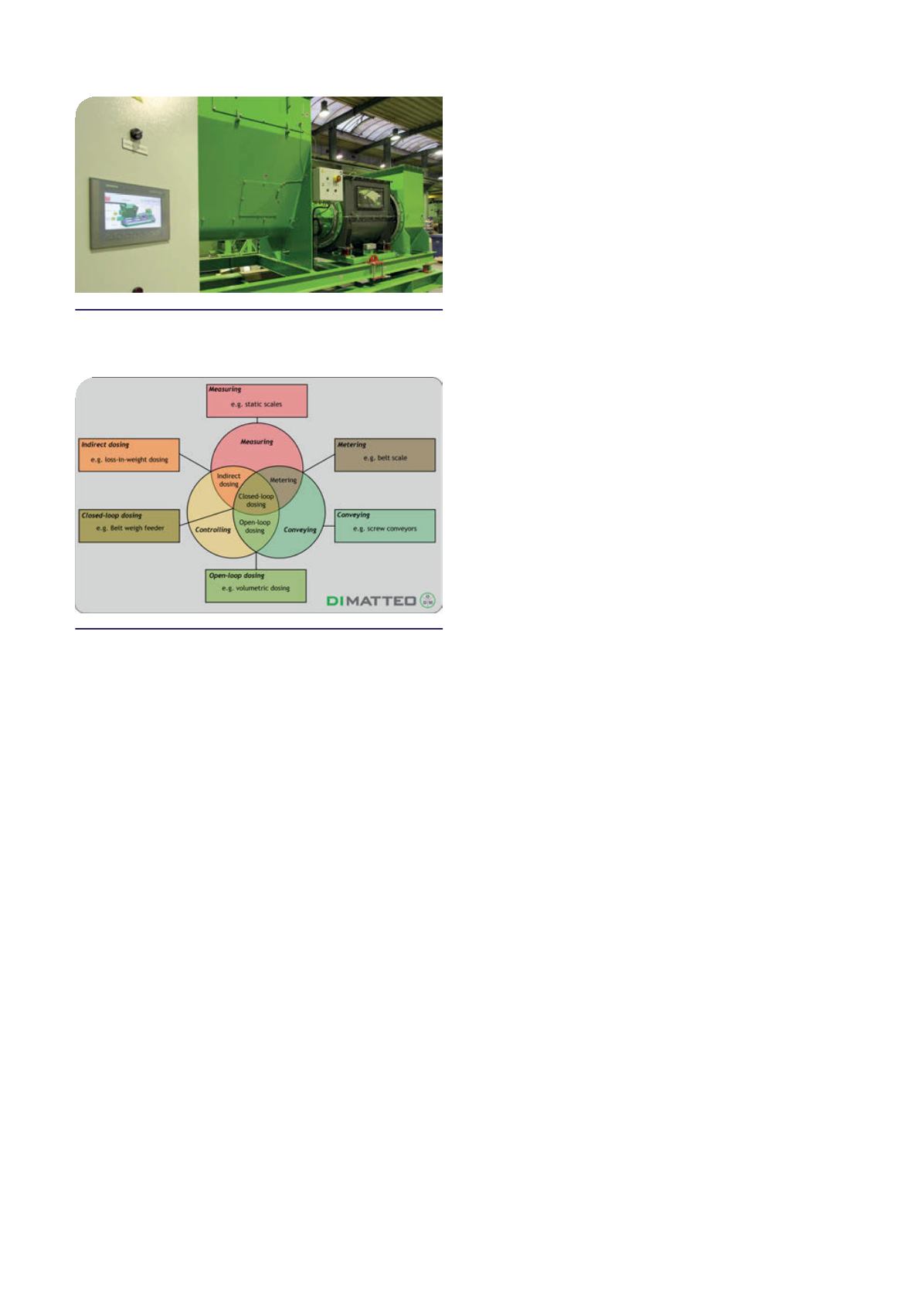
General classification of bulk-material dosing
devices
The base for a classification of different dosing
and proportioning devices for bulk materials is the
former definition of the functional entities of those
machines. For this it is reasonable to distinguish three
main functional elements of typical dosing devices:
(i) measuring, (ii) conveying and (iii) controlling.
3
The
combination of either any two or all three of these
basic elements defines the specific character of the
equipment, as shown in Figure 2.
Here, it is possible to name six different classes of
machines as a general taxonomy for the proportioning
of bulk materials. The exact definition and
corresponding aspects are summarised within Table 1.
All of these machines are justified within their
specific field of application and there is no suitable
piece of equipment that can meet all technological
and economic requirements of every possible field
of application. If, for example, a continuous flow of
material is required by the process (e.g. supply of
alternative fuels), there is no possibility to utilise an
indirect dosing setup, such as a loss-in-weight system,
even if other aspects indicate it.
Typical proportioning equipment
There is a great variety of available products in the
field of bulk material dosing and proportioning and
within this section some prominent examples are used
to clarify the taxonomy.
Pure measuring devices – silo scales and
weighing hoppers
Typical examples for pure measuring devices are
weighing hoppers and silo scales, which are mainly
used in order to determine the actual filling in terms
of weight m [kg] and/or, for bulk material with
constant density and humidity, also the volume V [m³].
The mass of the material is measured by means of a
set of load cells, corresponding mechanical mounting
modules for effective force transmission (see Figure 3)
and a corresponding evaluation unit.
A proper proportioning of the material within
the silo or hopper is only possible, if the setup is
complemented with a controllable discharge system
(e.g. a screw discharge bottom – ODM-ScrewDOS).
Such a setup would be an indirect dosing system,
where the following section provides an example.
Figure 1. ODM-WeighTUBE (back) and ODM-GravitAS
control system (front).
Figure 2. Classification of different dosing/metering/
weighing devices based on three basic functional
elements.


