BMHR 2016
24 \
World Cement
Indirect dosing – differential dosing setups
The indirect dosing setup consists typically of a silo
scale or weighing hopper, which is equipped with a
controllable discharge system. Here a screw is used to
discharge a hopper, which is placed on a set of load
cells, which acquire the actual material weight m [kg],
within the hopper. By using the loss-in-weight principle
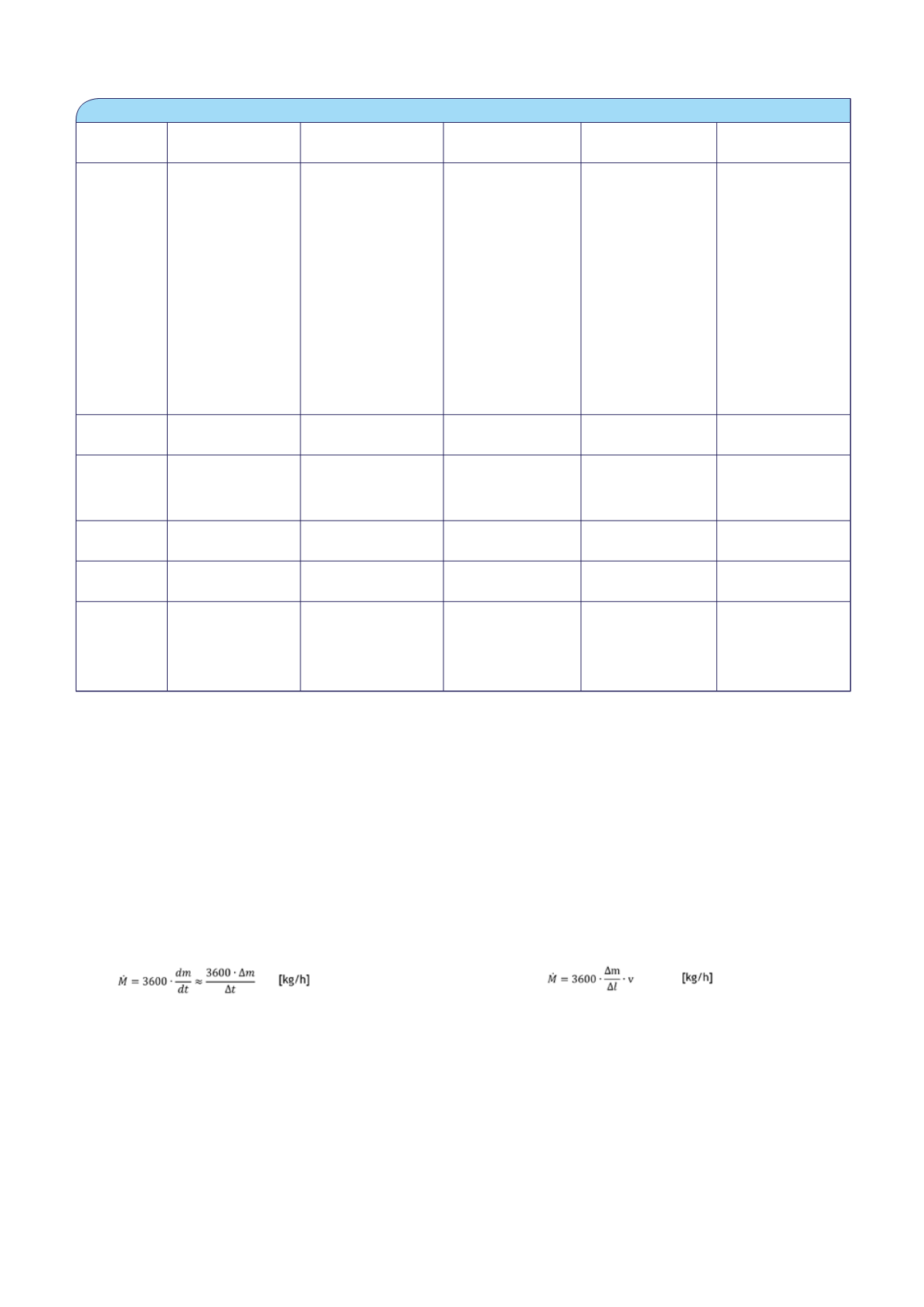
the actual mass flow
M
[kg/h] can be continuously
calculated by taking into consideration the mass
difference
Δ
m [kg] within a defined time interval
Δ
t [s]
(time derivative of the material weight), according to
the following relation:
By an adaption of the screw speed it is therefore
possible to achieve a desired mass- or volume flow.
However, the main drawback of this setup is the
missing possibility to dose the material continuously,
since the relation shown above is of course only true,
if there is no simultaneous material infeed to the
hopper. This means, that the setup is only suitable for
batch-type dosing tasks, such as batch mixing or filling.
Metering
The process of metering of mass flows consists of
a standard conveying system (e.g. a belt or screw
conveyor) and the determination of the actual flow
by means of an integrated weighing system. A belt
conveyor transports material with a certain speed
v [m/s] to a single weighing roller, which determines
the actual belt load mbelt [kg].
From the measured belt load mbelt it is possible
to compute the actual mass per length unit
(
Δ
m/
Δ
l [kg/m]), which can be used to determine the
actual mass flow
M
[kg/h] as follows:
The standard metering device contains no control
circuit at all, since it is only computing the actual
mass flow but there is no feedback between this
information and the actual speed of the conveyor.
Di Matteo offers such metering devices either as
belts or as screw conveyors. An ODM-ScrewMASTER
screw scale, for example, is completely closed and
dust-proof.
Table 1.
Overview of different dosing/metering/weighing devices
Class of
Machine
Measuring
Metering
Indirect dosing Open-loop dosing Closed-loop
dosing
Description The actual volume
V or weight m
of the material
is measured and
used to define the
actual amount at a
given time.
The material is
conveyed with a
certain conveying
speed v and at
the same time the
actual massflow
M
is determined based
on a measured
weight m.
The actual volume
V or weight m
of the material
is measured and
used to define the
actual amount at
a given time and
at the same time a
separate conveying
system is controlled
in order to achieve
a certain volume
flow
V
or mass
flow
M
.
The actual
conveying speed v
is controlled based
on a pre-defined
calibrated relation
in order achieve
a certain volume
flow
V
or mass
flow
M
.
The actual weight
m or volume V
and the actual
conveying speed
v is measured
to calculate the
actual mass flow
V
or volume flow
M
. The actual
conveying speed
is continuously
controlled in
order to achieve
a desired mass or
volume flow.
Measured
values
m [kg], V [m³]
v [m/s], m[kg]
v [m/s], m[kg]
-
v [m/s], m[kg],
V
[m³/h],
M
[kg/h]
Control
variables
-
-
V
[m³/h],
M
[kg/h]
v [m/s]
v [m/s]
→
(
V
[m³/h],
M
[kg/h])
Type of
operation
-
Continuous
Discontinuous
Continuous
Continuous
Type of
dosing
-
-
Gravimetric
Volumetric
Gravimetric
Example
Silo scale
Belt scale
Differential dosing
setups (e.g. loss-in-
weight systems)
Screw conveyor
wit pre-defined
calibrated relation
between volume
and screw speed
ODM-WeighTUBE
®


