BMHR 2016
26 \
World Cement
Open-loop dosing
Open-loop dosing is also often called volumetric dosing,
since the main principle behind it is the operation of
a certain conveyor with a certain pre-defined speed
for each possible mass flow setpoint. Thus, the actual
weighing of the real material weight is neglected
and instead it is assumed, that for the generation of a
constant mass flow
V
[kg/h] it is sufficient to generate
a constant volume flow [m³/h]. This assumption is of
course only valid, if it can be guaranteed that the bulk
density
ρ
[kg/m³] of the conveyed material is constant.
Since there is no information of the actual mass flow
from a gravimetric measurement unit, it is necessary to
define a calibration curve or generalised mathematical
relation in order to define the dependency between the
actual speed of the conveyor v [m/s] and the mass flow.
In most cases volumetric dosing is realised by a screw
conveyor, since the usage of a through or tubular screw
conveyor guarantees a quite stable volumetric feeding
behaviour for different speeds if compared to e.g. a belt.
However, especially for materials with time-varying
properties and volatile humidity or density, e.g. for
the accurate dosing of alternative fuels, a closed loop
dosing method is not applicable.
Closed-loop dosing
The most sophisticated and accurate solution for the
proportioning of bulk materials is closed-loop dosing,
which is often also referred to as gravimetric
dosing, since the actual mass flow
M
[kg/h] is
determined by means of an integrated weighing
unit.
One example of such a system is the
ODM-GraviSCALE belt weigh feeder. The working
principle for the determination of the actual
massflow is similar to the one shown before,
which means that the actual conveying speed
v [m/s], as measured e.g. by an incremental
encoder, and the actual material load m [kg] are
evaluated continuously. The closed-loop principle
can be interpreted in such a way, that there is a
direct feedback from the calculated mass flow
to the variable speed drive unit. If there is a
deviation between the actual mass flow and the
desired setpoint, the actual conveying speed can
be therefore continuously adapted. Thus, a high
precision of the dosing operation is guaranteed
and typically the maximum deviation from the
setpoint lies below ±2%.
However, the operation of belt weigh feeders
in practical applications is characterised by two
main aspects. First of all, it needs to be said
that belts are by nature non-closed systems.
This leads to non-negligible dust emissions and
spillage of material, which affects as a logical
consequence subsequently the weighing units
and their accuracy. Di Matteo designed the
ODM-GraviSCALE in such a way to avoid those
effects as much as possible, which is achieved by a
smart casing, sealing and scraping concept.
On the other hand and as it was already stated
above, all existing dosing methodologies are suffering
immensely from possible time-variant material
properties of the conveyed bulk. This leads in practical
applications to a non-negligible drift in the dosing
accuracy over time. Thus, belt weigh feeders need to
be recalibrated on a regular basis (e.g. once a month)
in order to guarantee a long-term stability of the
feeding process. This re-calibration needs to be done
manually by service technicians in a time-consuming
process, during that the machine has to remain
offline.
These two aspects led to the development of the
tubular weigh feeder ODM-WeighTUBE
®
.
A novel gravimetric closed-loop dosing unit
The initial base for the development of the
ODM-GravitAS control system was the introduction of
the ODM-WeighTUBE
®
platform in 2010. Even if the
first installations of the dosing system were mainly
focused on plants for problematic bulk material,
such as residue derived fuels (RDF), shredded tires
or polyethylene granulate material, units have since
been used for more conventional bulk materials,
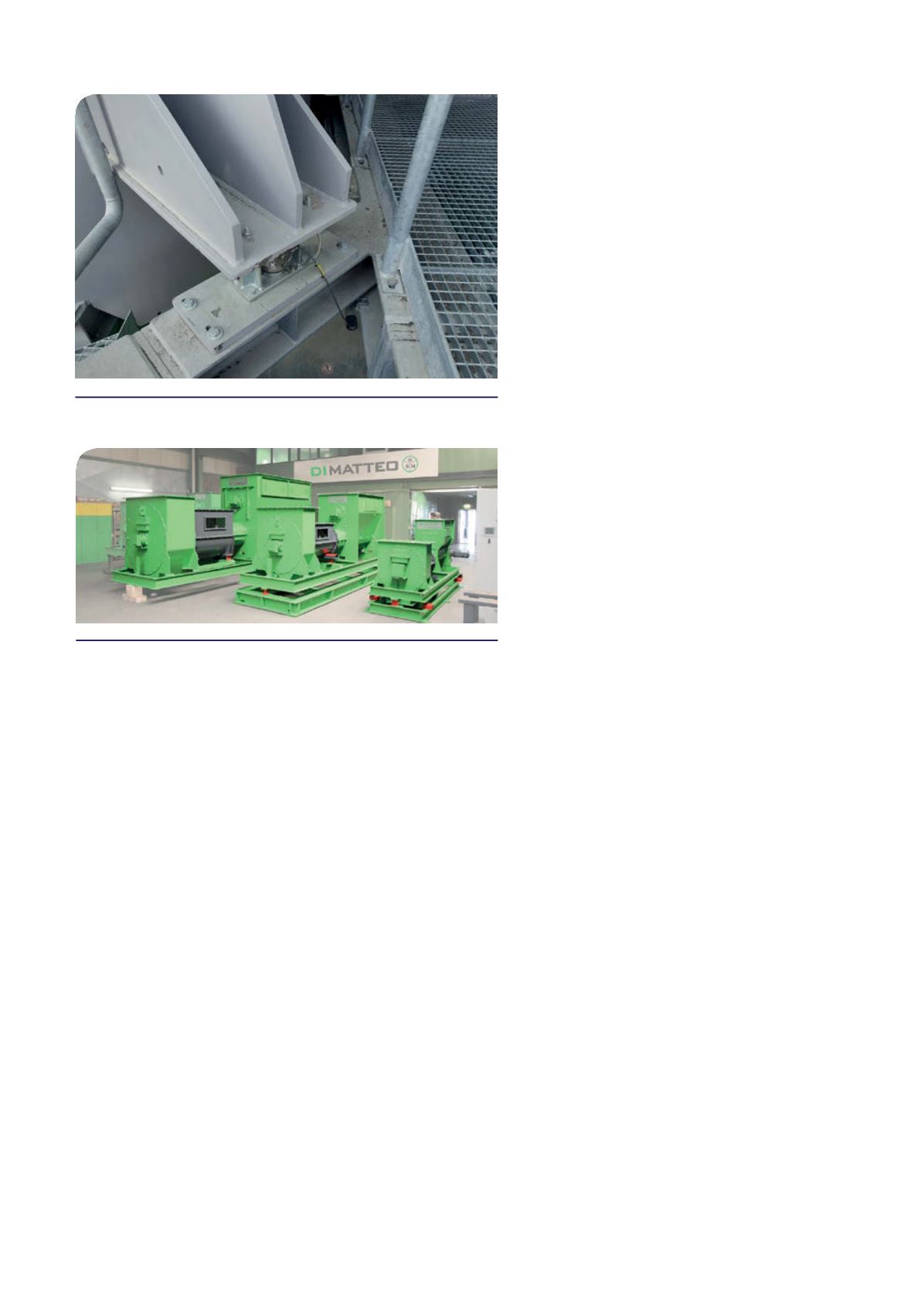
such as raw meal, flyash, iron core or clinker. Figure 4
provides an overview of the ODM-WeighTUBE
®
RWS
series, in the German production facility of Di Matteo.
Figure 3. Typical load cell module for silo scales or weighing
hoppers.
Figure 4. ODM-WeighTUBE RWS series.


